The URBACT call for Action Networks is now closed.
The URBACT call for Action Networks, running from 17 March to 17 June 2026, aims to create partnerships of cities willing to put their city strategies in motion and implement concrete actions in their local contexts. The results will be announced in October 2026.
Cities from European Union's 27 Member States and Partner States (Norway, Switzerland, Albania, Bosnia & Herzegovina, Montenegro, North Macedonia and Serbia, Moldova and Ukraine) were invited to apply to this call for Action Networks.
Discover all the unique opportunities for your city offered by this call in the infographic (available in different languages) and in the information and call documents below!
All you need to know about the call
DOCUMENTS
About the call
-
URBACT IV_GUIDE_Call for Action Networks.pdf(PDF, 698Ko)
-
Infographic call for Action Networks.pdf(PDF, 893Ko)
-
URBACT IV Programme Manual _March 2026.pdf(PDF, 3Mo)
-
URBACT IV_State Aid Guidance for applicants.pdf(PDF, 542Ko)
-
URBACT IV Beneficiaries - March 2026.xlsx(VND.OPENXMLFORMATS-OFFICEDOCUMENT.SPREADSHEETML.SHEET, 48Ko)
Templates for the application
-
ToR Annex 1 - Application form outline_URBACT Call for Action Networks.docx(VND.OPENXMLFORMATS-OFFICEDOCUMENT.WORDPROCESSINGML.DOCUMENT, 44Ko)
-
ToR Annexes 2 & 3 - UIV Call for Action Networks.docx(VND.OPENXMLFORMATS-OFFICEDOCUMENT.WORDPROCESSINGML.DOCUMENT, 53Ko)
-
Budget template Synergie - URBACT Call for Action Networks.xls(VND.MS-EXCEL, 111Ko)
In preparing your application, applicants are invited to refer to the following documents:
- Terms of Reference of the Call
- Guide to Action Networks (necessary for a quality submission)
- SYNERGIE-CTE Practical Guide for the creation and submission of applications for Action Networks
INFO SESSIONS
AT EUROPEAN LEVEL: Join the online info sessions hosted by the URBACT Secretariat to find out all about the call for URBACT Action Networks and ask your questions!
- 1 April 2026, 10.00-11.30 CEST: Call presentation & how to build a strong partnership for an Action Network, rewatch the recording here, access the presentation here and the Questions and answers document here
- 12 May 2026, 10.00-11.00 CEST: Exchange and learning during the network journey, rewatch the recording here, access the presentation and the Questions and answers document here
- 27 May 2026, 10.00-11.00 CEST: Time to submit your application: tech & troubleshooting (for candidate Lead Partners), rewatch the recording here, access the presentation here and the Questions and answers document here
- 29 May 2026, 10.00-11.30 CEST: How to write good applications using storytelling techniques, rewatch the recording here and access the presentation here
- 9 June 2026, 10.00-11.00 CEST: Final troubleshooting (for candidate Lead Partners), rewatch the recording here, access the presentation and the Questions and answers document here
AT NATIONAL LEVEL: Attend the national info sessions on the call organised by the National URBACT Points in your national language!
CONTACT
Do you have a question about the call for Action Networks? Send your question to the URBACT Secretariat at: an@urbact.eu
FREQUENTLY ASKED QUESTIONS
Find below the most frequently asked questions about preparing a bid for an URBACT Action Network!
PROGRAMME AREA
URBACT facilitates the sharing of knowledge and good practice between cities and other levels of government. The purpose is to promote integrated sustainable development in cities, improve city’s policies and improve the effectiveness of cohesion policy in cities.
The URBACT IV cooperation area covers the whole territory of the European Union with its 27 Member States, Norway and Switzerland, 5 Instrument for Pre-Accession Assistance (IPA) countries: Albania, Bosnia and Herzegovina, Montenegro, North Macedonia and Serbia, as well as Ukraine and Moldova (countries covered by the Neighbourhood, Development and International Cooperation Instrument).
Cities from other countries can take part in network activities at their own costs.
Only cities from:
- the 27 European Union Member States
- Norway
- Switzerland
- IPA countries (Albania, Bosnia and Herzegovina, Montenegro, North Macedonia and Serbia
- as well as NDICI countries (Ukraine and Moldova)
are eligible beneficiaries for the call. Cities from the 27 EU Member States, as well as all cities from the Partner States (Norway, Switzerland, IPA countries: Albania, Bosnia and Herzegovina, Montenegro, North Macedonia and Serbia, and NDICI countries: Moldova and Ukraine) can act as Lead Partners.
However, cities from other countries can take part in network activities at their own costs. This means they can be actively engaged but are not eligible to the ERDF/IPA/NDICI budget to cover costs incurred by participating in the network.
CALL THEMATIC COVERAGE
URBACT supports networks in any thematic issues on any topic related to sustainable urban development or governance. The Call for Action Networks is open to any urban topic, without any thematic weighting or ring-fencing. Candidates will need to explain in their application form how their network proposal links to the Cohesion Policy Objectives and scope (as presented in Article 5 of the common provisions regulation (EU) 2021/1060 and Article 3 of the ERDF regulation (EU) 2021/1058).
The current Programme integrates the crosscutting EU priorities of digital, green and gender-equal policy-making into its activities.
This means that, while addressing the main policy challenge the URBACT networks will chose to work on, they will also have to reflect on how their activities address the cross-cutting considerations of green transition, digital transformation and gender equality. Whether cities aim to address mobility issues, cultural heritage, financial engineering, energy transition or any other topic, URBACT invite to take the extra mile and consider how these holistic themes can be part of the challenges.
NETWORK PARTNERSHIP
Cities from:
- the 27 EU Member States
- Norway
- Switzerland
- IPA countries (Albania, Bosnia and Herzegovina, Montenegro, North Macedonia and Serbia)
- as well as NDICI countries (Ukraine and Moldova)
are eligible beneficiaries of the call for Action Networks.
Under URBACT IV, the beneficiary “city” refers to the public local authority representing:
• Cities, municipalities, towns;
• Local agencies defined as public or semi-public organisations set up by a city, partially or fully owned by the city authority, and responsible for the design and implementation of specific policies (economic development, energy supply, health services, transport, etc.);
• Infra-municipal tiers of government such as city districts and boroughs in cases where they are represented by a politico-administrative institution having competences for policy-making and implementation in the policy area covered by the URBACT network concerned in which they are willing to get involved;
• Metropolitan authorities and organized agglomerations in cases where they are represented by a politico-administrative institution having delegated competences for policy-making and implementation in the policy area covered by the URBACT network.
In addition to city partners, Action Networks can also include a limited number of other beneficiaries (non-city partners). In the case of Action Networks, non-city partners as defined below are eligible:
• Provincial, regional and national authorities, as far as urban issues are concerned;
• Universities and research centres, as far as urban issues are concerned;
• Managing Authorities of Cohesion Policy and EU Solidarity Funds.
The partnership may include 1 “non-city” partner maximum.
In order to be eligible, other beneficiaries (non-city partners) must be public authorities or Equivalent Public Bodies.
Equivalent Public Body (EPB) refers to any legal body governed by public or private law:
- established for the specific purpose of meeting needs in the general interest, not having an industrial or commercial character (which does not exclude bodies partly having an industrial or commercial character), and
- having legal personality, and
- a) either financed, for the most part, by the State, or regional or local authorities, or other bodies governed by public law
b) or subject to management supervision by those bodies
c) or having an administrative, managerial or supervisory board, more than half of whose members are appointed by the State, regional or local authorities or by other bodies governed by public law.”
In case of doubt, lead applicants or other beneficiaries (non-city partners) are invited to contact the URBACT Secretariat at an@urbact.eu and provide the legal status of the institution in national language. The Secretariat will request legal advice from the relevant National Authority in order to verify that the interested institution is a Public Authority or that it fulfils the criteria for Equivalent Public Bodies.
The answer is usually “no” BUT you can contact us directly with more specific details on AN@urbact.eu and we can respond case by case. Often such partners are involved in URBACT Local Groups in partner cities.
There is no limit of population size for cities wishing to participate in URBACT activities. The calls are open to all cities, regardless of their size. URBACT specifically supports urban authorities from neighbourhood to functional urban area level depending on the topic covered and the impact that can be made. This includes urban-rural linkages and cross-border functional urban areas.
The partnership shall be set up for the submission of the application.
In addition to the Lead Partner, the partnership to be proposed must include from 5 to 7 project partners from eligible countries. Therefore, a network will include from 6 to 8 city partners in total.
Cities from all EU Member and Partner States can be Lead Partners of Action Networks.
The candidate Lead Partner can be candidate Lead Partner in one URBACT proposal only under this call.
The Lead Partner city will manage a transnational network, which is a challenging and time-consuming task. The Lead Partner City should therefore allocate sufficient resources to the project to ensure suitable project management. The project staff should have experience in the management of transnational projects, be able to communicate in fluent English, be able to handle the challenges of different languages and cultures, and have skills to get the best from the partnership. With overall administrative, co-ordination, management, implementation, communication, financial and legal responsibility for the project, the Lead Partner acts as the link between the URBACT Managing Authority and the project partners.
For further explanation, refer to the Programme Manual, Book One – Section C. MANAGING AN URBACT NETWORK and Section F. COMMUNICATION AT NETWORK LEVEL.
According to the eligibility criteria set in the Call for proposals, an Action Network cannot include more than one partner per country. In general, it is recommended to build a diverse partnership. This will be assessed by the external assessment panel using the assessment criteria as outlined in the terms of reference of the call.
Non-city partners are full project partners so they are to be counted in the 6-8 project partners. Like any city-partner, a non-city partner would have to participate in the project, take on roles and implement activities as indicated in the work plan, more especially they commit to participate in the transnational meetings planned, to set up an URBACT Local Group and work with key stakeholders.
The partnership can be composed of eligible institutions from all types of EU Member States regions as well as from Norway, Switzerland, Albania, Bosnia and Herzegovina, Montenegro, North Macedonia, Serbia, Ukraine or Moldova.
According to EU regulations, projects receiving EU funds must involve partners from at least three countries, of which at least two must be beneficiaries from EU Member States. A partnership can include a maximum of one partner from IPA (Albania, Bosnia and Herzegovina, Montenegro, North Macedonia and Serbia) and NDICI (Moldova, Ukraine) countries.
Transnational partnerships are cornerstones of URBACT Action Networks. The rules defined translate into eligibility criteria and shall therefore be respected.
URBACT encourages projects to include a mix of regions with different levels of development. Wider geographical coverage allows partners to broaden their pool of experience, exchange and learn from practices in different local cultures and contexts.
According to the eligibility criteria set in the Call for proposals, when it comes to geographical coverage,
- The partnership shall bring together between 6 and 8 candidate partners, including the Lead Partner
- The partners in the application cannot count two cities from the same country.
- The proposed partnership respects the minimum of partners from EU Member States and maximum of partners from IPA (Albania, Bosnia and Herzegovina, Montenegro, North Macedonia and Serbia) and NDICI countries (Moldova and Ukraine), within the proposed network.
It is not always easy to build a relevant partnership during the short period available for partner search during the application process. This is why the programme provides support to do this online via the URBACT Partner Search Tool: urbact.eu/partnersearchtool
In addition, contacts of National URBACT Points can be very useful for finding right partners from different countries. These are provided in section 12 – useful resources of the Call document. More information and contact details about National URBACT Points can be found at this link: urbact.eu/how-find-us
EXPERTISE
During their lifetime, approved Action Networks will be assisted by a validated URBACT Lead Expert who shall support the partnership over the entire duration of the network with:
- the definition of the main focus of network activities based on the deep analysis taking place at the beginning of project cycles. It includes designing the network work plan with a menu of exchange and learning activities with various formats, elaborating the main expected results and production of network outputs
- the delivery of transnational exchange and learning activities with effective facilitation techniques.
- the knowledge of EU policy frameworks and the specific thematic fields tackled by the network
- coaching on the use of effective methods and tools for the design and delivery of integrated and participatory processes in partner cities
- the knowledge capture and uptake
- the communication of network results
This list of tasks is not exhaustive; each Lead Expert will have a dedicated work plan based on the specific expertise framework defined for the call.
In their application form, applicants shall indicate the needs identified by the network for the use of URBACT Lead Experts and Ad Hoc Experts to assist the network. In many cases the skills and experience required for the Lead Expert will include:
- Experience in working with complex transnational partnerships
- A track record in getting results
- Expertise in the design and use of partnership tools and exchange and learning methodologies
- A commitment to the URBACT principles of participation and integrated approaches
- Relevant thematic knowledge
- Solid facilitation skills
- Coaching skills
- Perfect spoken and written English
Applicants may then have specific additional competencies in mind when considering their expertise requirements.
To know more about the URBACT IV pool of experts, you can have a look at the “The time to join the URBACT pool of experts is (almost) here” article here.
Over the network duration, in addition to the Lead Expert, at least two ad hoc experts shall be appointed by each network to deliver specific services not provided by the Lead expert.
In the case of the Action Networks, shortly after the approval of the Action Networks, the URBACT Secretariat will invite URBACT experts (validated in the URBACT Pool of Experts), through a call for expression of interest, to position themselves against the requested skills and knowledge requested by networks. Following this short call for expression of interest, the URBACT Secretariat will check all the Lead Expert candidates and organise interviews of shortlisted experts with the Lead Partner, in order to perform the final selection of the network’s Lead Expert.
It should be noted that only experts who have not been directly involved in developing the network application can be proposed. A strict conflict of interest procedure will be followed.
NETWORK BUDGET
No, preparation costs are not eligible. That means that you cannot get reimbursed from hiring external consultants for instance to help you in preparing your Application Form.
First of all, costs will be eligible starting from the date of approval of Action Networks by the Members of the URBACT IV Monitoring Committee (this should occur in October 2026).
To be claimed, costs have to be verified by a qualified controller according to the First Level Control system established on a national level.
Now, concerning the eligibility of costs during the project’s life, we invite you to read the Programme Manual, Book One – Section D. MANAGING COSTS AND REPORTING PROGRESS which provides more information about the eligible costs and the claim procedures, types of documents to be provided to get reimbursement, etc.
Please note that the URBACT programme does not give you money in advance. All costs must be paid first and are then to be claimed. The reimbursement by ERDF/Norwegian/Swiss/IPA/NDICI funds is made after each reporting period based on the costs claimed by each partner. It is then the responsibility of the Lead Partner to refund the funds due to its partners. If you have questions please contact AN@urbact.eu.
Ukrainian cities can apply for advance payment e.g. 20% of their total partner budget to be received in one amount.
The total budget for an Action Network is EUR 1.000.000 maximum, comprised of local co-financing and of ERDF/CH/NO/IPA/NDICI co-financing included.
In addition to the network budget, each approved network will have an allocation of EUR 127.500 to cover the costs of expertise support (fees) over the lifetime of the project. This available envelope shall cover days of expertise only. Travel & Accommodation costs for experts will be covered and reimbursed directly by the Programme.
When preparing your budget, please note that as stated in the Terms of Reference, EUR 1.000.000 is the maximum you can allocate. If your budget exceeds this sum, your network’s proposal will not be eligible and therefore will not even be assessed.
The total budget of maximum EUR 1.000.000 is comprised of local co-financing and of ERDF/IPA/NDICI/CH/NO co-financing included.
Depending on the partnership, the co-financing rate can vary depending on the cities forming the partnership:
- 80% ERDF for partners coming from a less developed region,
- 70% ERDF for partners coming from a transition region,
- 65% ERDF for cities coming from a more developed region,
- Up to 50% national fund for cities coming from Norway or Switzerland. Participants are asked to contact their national authority to receive information on the available funds under this call,
- Up to 95% IPA funds for partners coming from the 5 IPA countries – Albania, Bosnia and Herzegovina, Montenegro, North Macedonia and Serbia.
Up to 95% NDICI funds for partners coming from Ukraine and Moldova.
Partners from other countries may participate in Action Networks at their own cost for this call.
The map showing the categorisation of EU Regions for 2021-2027 can be found here. The full list of regions eligible for funding is available at this link here: https://eur-lex.europa.eu/legal-content/EN/TXT/?uri=CELEX%3A32021D1130.

The complementary local co-financing has to be borne by the Lead/Project Partner institutions. The local co-financing is formalised in the form of letters of commitment to be submitted as part of the application package. These letters of commitment are to be found in Annex 2 and 3 of the Terms of Reference, filled in and signed by each Lead/Project Partner.
Yes, all partners need to provide a scanned version of signed letter of commitment along with the Application Form and other documents to be submitted by the Lead Partner via email to the URBACT Secretariat. The templates of the Programme can be found in the Terms of Reference for the call.
The letters have to be signed. The signing person has to be a legal representative with authority to sign for the Lead/Project Partner and in the position of committing the institution’s resources to be engaged in the project (staff, budget, etc.).
SYNERGIE APPLICATION
A unique login and password are linked to a network proposal in the Synergie-CTE system. This is an online system; therefore, you can come back to it any time to keep on completing it and work on your application at any time until the submission deadline. Nevertheless, do not forget to SAVE the information before going to next chapter, otherwise the information will not be saved. We strongly recommend that you draft the large text questions in a word document and then copy/paste into the SYNERGIE system to avoid losing your work.
You are welcome to draft your application using the other following files (Budget template and Application Form outline) which are meant to help you with the preparation of your network’s proposal, but keep in mind that the formal application needs to be submitted through the online Synergie-CTE system.
Anyhow, please be careful: the system might get overloaded and thus could be slower so avoid last minute online completion to ensure that your application is submitted properly and on time by the deadline of 17 June 2026 at 15:00 CEST.
Note that two webinars will be specifically dedicated to last chance troubleshooting and application submission (especially in relation to SYNERGIE-CTE online application platform related questions) on 27 May 2026 and 9 June 2026, at 10:00 - 11:00 CEST.
MORE URBACT OPPORTUNITIES
No matter if you are involved in an URBACT Network or not, you can always connect with peers across Europe at our events. All year round, throughout the duration of URBACT IV (2021 - 2027) you can take part in open events like the URBACT City Festivals, webinars, seminars, conferences and thematic policy labs.
Mark your calendars for the next events:
- 2026 URBACT University - the URBACT University comes back this summer on 25-27 August to Cork, Ireland to train hundreds of city representatives from Transfer Networks on stakeholder engagement and participatory policy-making. Find out more here!
- 2026 URBACT City Festival - the URBACT City Festival will celebrate more than 300 urban actions in Nicosia, Cyprus on 29-30 September 2026. Find out more here!
- EU City Lab on Housing - discover how to scale affordable housing solutions in your city on 15-16 October 2026 in Brussels, Belgium. Register now here!
Do you want to work on a specific urban challenge with peer cities across Europe? Apply to join an URBACT Network alongside other cities that want to make real change in their communities!
As part of a Network, you will embark on a two year journey with a dedicated URBACT Expert, Ad-hoc Experts, the URBACT Secretariat’s guidance and EU financial support to cover exchange activities – depending on your geographic location. The 27 Member States, the five EU pre-accession countries (IPA) – Albania, Bosnia-Herzegovina, Montenegro, North Macedonia, Serbia – and the two Neighbourhood Development and International Cooperation Instrument (NDICI) – Ukraine and Moldova – are eligible to receive funding from URBACT. Cities and partners from Norway and Switzerland can participate in URBACT Networks with Norwegian or Swiss national funds covering up to 50% of the costs.
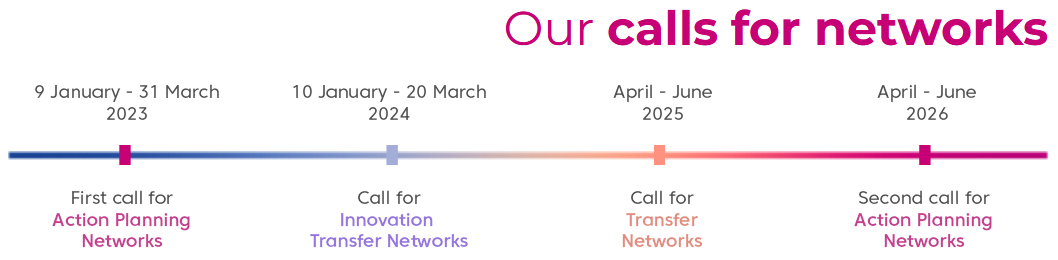
Calls for proposals are released roughly every year for the following types of Networks:
- call for Action Networks: open between 17 March - 17 June 2026. Find out more here!
Municipalities, regional and national authorities, metropolitan areas, specialised municipal agencies, districts and boroughs – and other levels of governance that are mentioned in the terms of reference for specific URBACT calls – are eligible to apply to take part in URBACT Networks.
Applicants responding to an URBACT call must undergo an assessment to determine whether their proposed activities involve a potential risk of State aid. State aid is defined as any aid granted by a Member State or through State resources in any form whatsoever which distorts or threatens to distort competition by favouring certain undertakings or the production of certain goods, insofar as it affects trade between Member States. Applicants are invited to consult this related guidance and complete the dedicated EU Survey as part of their assessment process.
Citizens, civil society, NGOs, academia and private sector who are based in an URBACT beneficiary city can also get involved with an existing Network through the URBACT Local Group. Every beneficiary city has to set up an URBACT Local Group to gather relevant people who have a stake or interest in co-designing integrated local policies. Local stakeholders join these groups as members on a voluntary basis and without financial compensation, nonetheless, they can benefit from transnational visits, trainings and closed capacity-building events.
As soon as URBACT Networks are approved – following the competitive call, the external assessment and the approval from the URBACT Monitoring Committee – the involved partner cities become programme beneficiaries. So far, 40 networks have been formed under URBACT IV, with 340 partner cities from 29 countries involved. Discover current Action Planning Networks and Innovation Transfer Networks!
Experts play a key role in guiding cities through URBACT Networks and providing in-depth thematic and methodological knowledge. You can apply to become a Validated Expert at any given time! The call for experts remains open throughout the whole duration of URBACT IV (2021 - 2027). Fill in the application form to join the URBACT Pool of Experts now!
There are two types of URBACT Experts, which you can apply to be: Lead Experts, who support a Network throughout its duration and help cities design and implement activities and Ad-hoc Experts, who provide further assistance to Networks’ cities and local groups when needed. All experts can be called out to support Programme-level activities, which might play a role in the availability of experts to take on other Network missions.
Becoming an URBACT IV Expert can open the door to a diverse range of missions to support approved networks and the Secretariat. We need professionals with practical and academic experience in a wide spectrum of fields contributing to sustainable urban development.
The call for experts is officially open for the whole duration of this programme period (2022 – 2027). New candidates, and all experts previously validated in URBACT III, are invited to (re)apply to the new pool. Start by reading the guide for the call (below) and, then, completing the Expert Application Form*. Applications will be assessed by an external panel. Validated Experts have their public profile showcased in the URBACT IV Pool.
*Candidates who are new to URBACT will need to create a login to the website, whereas URBACT III Experts can use their existing login details.
Once you have duly read the document above, you can then proceed to the APPLICATION FORM
Based in Paris (France), the URBACT Joint Secretariat is a group of 18 very an enthusiastic and committed team, organised into three units – organised in four working areas: Networks and Capacity-Building, Knowledge and Communication, Programme Management and Administration; and Strategic Programme Development.
Follow us on social media and subscribe to our newsletter to stay up to date with URBACT and to be the first to hear about upcoming opportunities.
If you are looking for news in your language and country, keep an eye on your National URBACT Point’s webpages.
For any other enquiries, you can reach out to us the URBACT Secretariat at communication@urbact.eu