In 2015, as the Transylvanian city of Cluj-Napoca was basking in its title as European Youth Capital, a small team of visionaries put that idea to the test. They called it Com’ON – with reference to “common”, “community on” and the call to action “Come on!” – and they designed it to be as un-bureaucratic as possible. No registered organisations required. No lengthy reporting forms. No jury of grey-suited officials deciding whose vision of the city deserved to live. Instead, informal groups of at least three young people could pitch an idea, let residents vote on it, and then go ahead and build it, plant it, paint it, or perform it.
More than a decade later, Com’ON has backed over 1,000 youth-led projects across Cluj-Napoca – community gardens, neighbourhood festivals, accessibility ramps, mental health workshops, mural trails. It has involved thousands of residents as voters and is now recognised as one of Europe’s most innovative models of youth civic engagement, carrying the formal stamp of an URBACT Good Practice. And now, under a new EU-funded transfer network called Com’ON City, it is being exported — carefully, thoughtfully, and with full awareness of the pitfalls — to four other European cities that want to do something similar.
Young people outside the usual suspects
To understand why Com’ON matters, it helps to understand the problem it was designed to solve. Cluj-Napoca, Romania’s second-largest city and its most dynamic tech and university hub, had no shortage of engaged young people in 2013 when preparations for the European Youth Capital title began. What it lacked was a way of reaching the ones who weren’t already organised – the teenagers who weren’t in youth clubs or student councils, who didn’t speak the language of grant applications or institutional partnerships.
The response was to strip participation down to its essentials: a low-threshold call for ideas, a public online vote open to anyone who lives, studies or works in the city, and a micro-grant paid not as a reimbursement (which would require invoices) but as an award – meaning a 15-year-old with a vision for a community herb garden could actually receive the money and spend it.
The genius of the award model is partly legal and partly psychological. Legally, it sidesteps the financial reporting obligations that typically make public funding inaccessible to informal groups. Psychologically, it signals trust – the city is betting on young people, not auditing them. That trust, the programme’s organisers have found, is repaid. Youth gain faith in institutions; institutions gain confidence in youth-led delivery.
How it works: five stages, one annual cycle
Com’ON runs on an annual rhythm that has been refined over ten years into something close to an art form. It begins with preparation – strategic planning, legal groundwork, communication materials, the involvement of a multi-stakeholder governance board that brings together the municipality, the PONT Group (the specialist NGO that runs the operational side), the Cluj Youth Federation, youth facilitators and mentors.
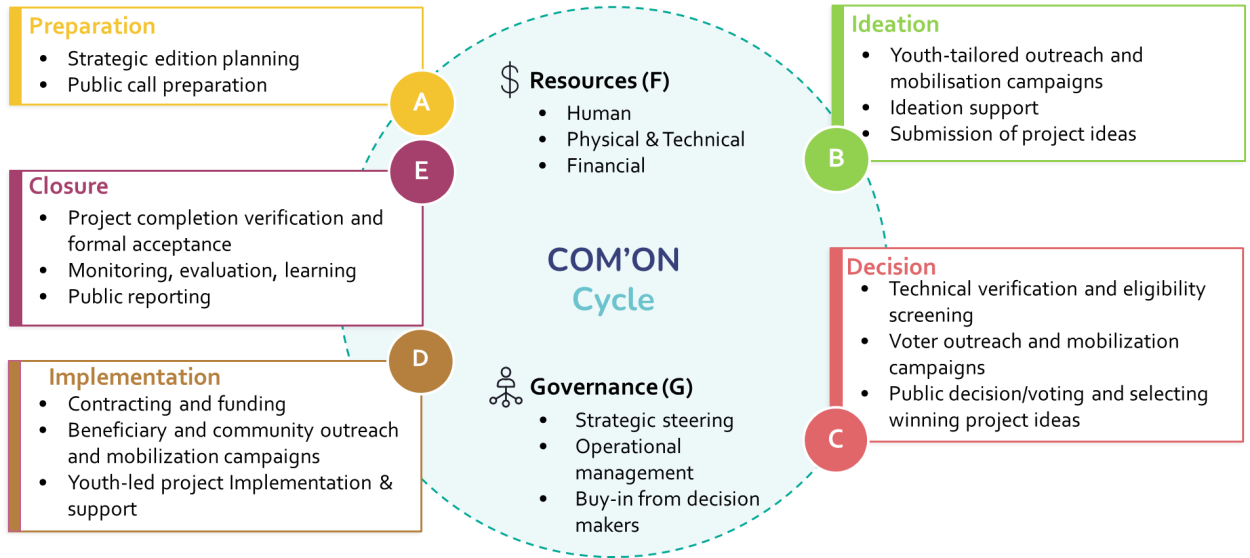
The Com’ON Cycle
Then comes ideation: a public call goes out across social media, schools, youth centres and street events. Young people aged 14 to 27 can form informal groups and submit project proposals, supported by workshops, co-creation labs and one-to-one mentoring if they want it - but none of it compulsory. The application form is deliberately simple. The helpdesk is real.
After submissions close, a light technical review screens for basic eligibility before all valid ideas go to a public vote. Any resident aged 14 or over who declares they live, study or work in Cluj can vote, using SMS or email validation. There is no ID check, no registration wall. Voters must choose between three and ten ideas — a rule designed to prevent friend-mobilisation campaigns from dominating and to encourage people to actually engage with proposals, which do not just come from friends.
Winning teams receive their micro-grant within a couple of weeks, then spend four to six months implementing their project, supported by a mentor who is available on demand rather than hovering overhead. The cycle closes with a community showcase – teams present their work, the programme collects data, the governance boards reflect on what to improve – and then the whole thing begins again.
There is also a Mini edition, running inside schools, where pupils receive €5,000 to propose, vote on and see implemented improvements to their own learning environment. The school administration handles procurement; the students handle democracy.
Five cities, one shared problem
The URBACT Com’ON City transfer network, running from 2025 to 2028 under the URBACT programme, brings together Cluj-Napoca as lead partner with four cities at very different stages of their own youth participation journeys: Leeuwarden in the Netherlands, Piacenza in Italy, Valongo in Portugal, and Veszprém in Hungary.
Their populations range from around 55,000 in Veszprém to 287,000 in Cluj-Napoca. Their political cultures, administrative traditions and existing youth infrastructure are all different. But the challenge they share is strikingly consistent: young people are disengaging from formal civic life; participation tends to cluster among the already-engaged; marginalised young people — those from low-income households, minority communities, peripheral neighbourhoods — remain stubbornly hard to reach.
| City | Country | Inhabitants | Age 10–29 | % Age 10–29 | Area |
|---|---|---|---|---|---|
| Cluj-Napoca (LP) | Romania | 287,000 | 61,000 | 21 % | 180 km² |
| Leeuwarden | Netherlands | 130,000 | 36,000 | 28 % | 237 km² |
| Piacenza | Italy | 103,000 | 20,000 | 20 % | 119 km² |
| Valongo | Portugal | 101,000 | 20,000 | 20 % | 75 km² |
| Veszprém | Hungary | 55,000 | 11,000 | 21 % | 127 km² |
Overview of partner cities
Each city has something to contribute. Leeuwarden, which served as European Capital of Culture in 2018, brings a rich tradition of citizen-led creative placemaking and a micro-budget youth programme called Project500, which provides €500 grants approved by a youth commission within two weeks. Piacenza brings deep experience in grassroots neighbourhood governance and an existing participatory budgeting mechanism for public spaces. Valongo, in the greater Porto metropolitan area, has already developed a youth participatory budget targeting residents aged 6 to 35. Veszprém, a historic university city that was European Capital of Culture in 2023, launched its first residents’ participatory budget only in 2025 and has no dedicated youth format yet — making it the network’s most ambitious adopter.
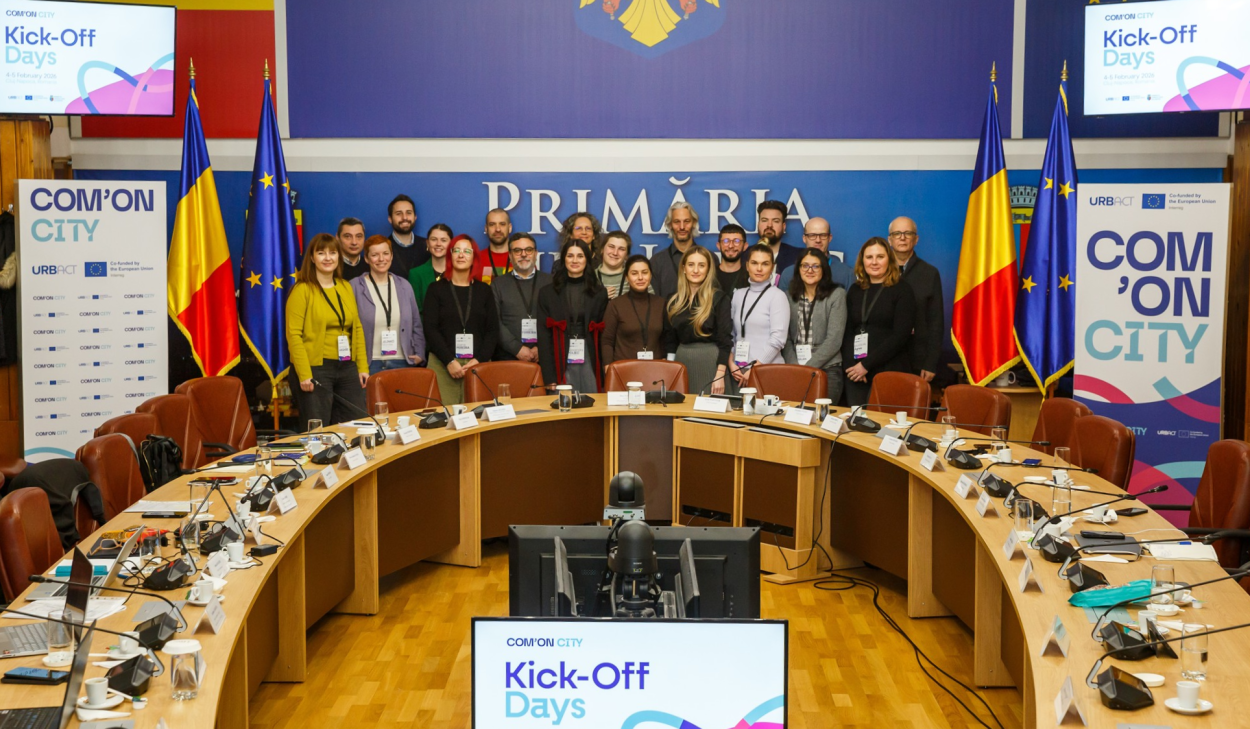
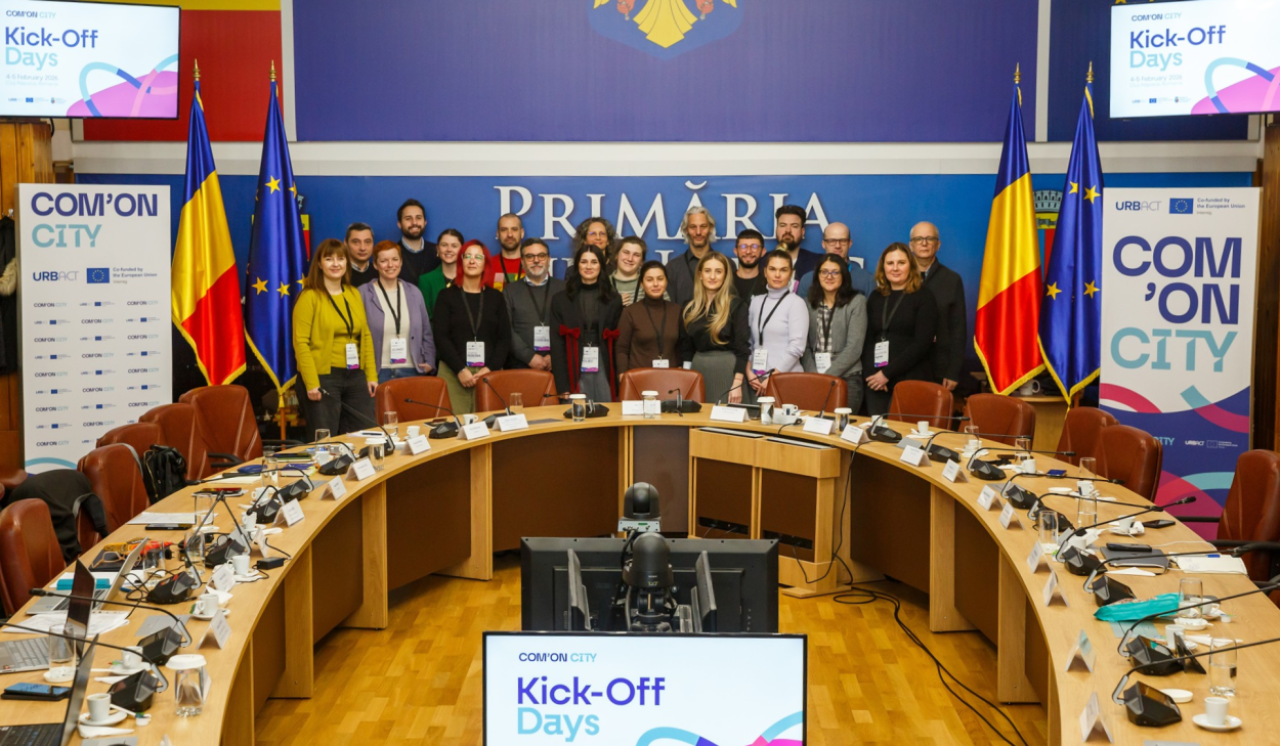
Kick-off meeting in Cluj-Napoca, 2nd Feb. 2026
Transferring a model — without cloning it
The most important thing the Com’ON City network is not doing is trying to copy Cluj-Napoca’s programme wholesale. Transferring the model does not mean replicating it in every detail – it means translating its core principles and structural logic into a locally owned, locally adapted system that fits each city’s administrative context, institutional culture and available resources.
Those core principles – low bureaucracy, trust-based micro-funding, demand-driven mentoring, inclusive outreach, continuous learning and improvement – are the transferable DNA. The specific formats, budget levels, governance arrangements and digital tools are for each city to design, ideally in co-creation with young people themselves, through focus groups, informal meetups and engagement with schools, NGOs and peer networks.
The network’s first in-person meeting takes place in Valongo in early July 2026, where partners will agree on how they want to work together and begin exploring different models of youth participatory budgeting: city-wide editions, school-based versions, neighbourhood formats, thematic calls. Subsequent meetings will work through each stage of the Com’ON cycle in depth, with partners sharing what they are trying, what is not working, and what they are learning from each other. Bilateral city visits – where practitioners from one city spend a day observing another city’s ideation workshop or voting event – will complement the network meetings.
Cluj-Napoca, meanwhile, is not simply positioning itself as a teacher. Its team is using the transfer process to interrogate its own model: how to reach Roma youth, LGBTQIA+ young people and young people with disabilities more effectively; how to move from a single city-wide format to more localised, neighbourhood and school editions or go even beyond the city limits to the metropolitan area; how to build alumni engagement so that a first-time participant becomes a future mentor.
A generation that shapes its city
The ambition behind Com’ON City is both modest and enormous. Modest, because what it is asking cities to do is give small amounts of money to informal groups of teenagers and trust them to do something useful with it. Enormous, because the theory of change behind that act of trust is nothing less than rebuilding the relationship between young people and democratic institutions.
The network’s vision is clear: a generation of young people who actively engage in the development of their cities and neighbourhoods, whose needs are recognised and reflected in political decisions, and who are genuinely involved through co-creative, trust-based processes – contributing to empowered, skilled citizens and stronger, more inclusive local democracies.
In Cluj-Napoca, ten years of evidence suggest that is not a fantasy. Whether five very different European cities, with their different laws, budgets, languages and youth cultures, can build something similar - adapted, owned and driven by local young people – is exactly what the next three years will find out. And the Com’ON network is intended to be a milestone in the development of a European movement for youth participatory budgeting and youth empowerment based on the Com’ON model.
Com’ON City is an URBACT transfer network running from 2025 to 2028, led by the Municipality of Cluj-Napoca with partner cities Leeuwarden (Netherlands), Piacenza (Italy), Valongo (Portugal) and Veszprém (Hungary).