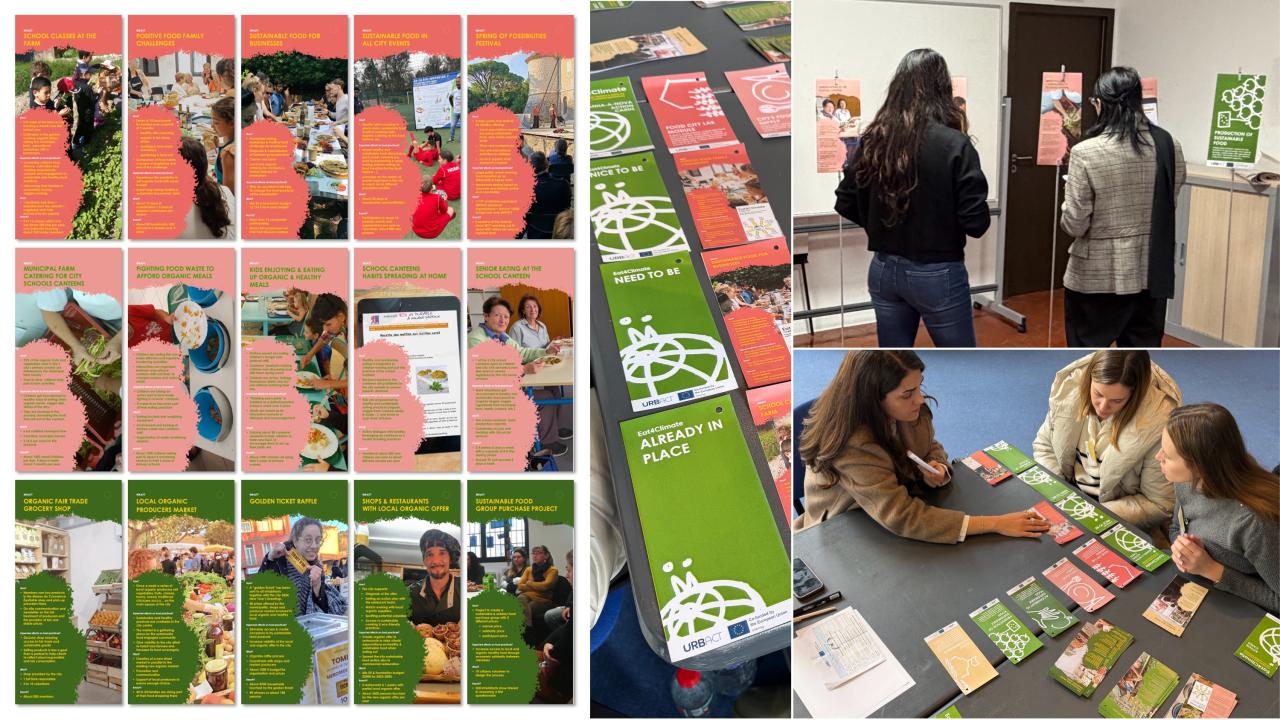
The Eat4Climate Sustainable Food Policy Cards translate the good practices of Mouans-Sartoux into a visual, modular and discussion-oriented tool. They are designed to support strategic conversations between heterogeneous stakeholders, build a shared understanding of sustainable food policies actions, and open informed debates about priorities, ambition and feasibility.
Food City Lab: A place dedicated to sustainable food and a program dedicated to raising awareness and supporting residents, a sustainable food project structured by the municipality, sustainable food events in the city etc.
City's Food Supply: School catering, other collective catering (daycare centres, retirement homes, hospitals, social centres...), protocols etc.
Accessibility to Sustainable Food: Physical accessibility to sustainable food (stores, markets, cooperatives...), social accessibility to sustainable food, enabling all residents, even the most precarious and fragile, to eat healthily… understanding and comparison between actions.
Production of Sustainable Food: Preservation of land, support for the transition to agroecology and organic farming, partnerships with agricultural structures, self-production by citizens, collective vegetable gardens etc.
- Food Governance: Structuring of a food department within the municipality - cross-departmental work between the various concerned departments of the city (education, social, urban planning, culture...), indicators and impact evaluations of food projects, steering committee or local food council etc.
Used as a colour chart, the cards display a broad palette of actions for food transition. They help cities search for inspiration, question complementarities, and think systemically about balanced mixes and fruitful synergies. Detached from their ring, the cards can be arranged into a transfer matrix: policy categories in columns, levels of transfer intention in rows (already in place, to be implemented, desirable if resources allow).
Through discussion, negotiation and reshuffling, partners balance ambition and realism, from short-term actions to longer-term transformations. A simple snapshot captures the result until the next re-evaluation.
The ultimate ambition is to build a living catalogue of sustainable food policy actions, enriched not only by Mouans-Sartoux but also by the six Eat4Climate partner cities. Designed as a stand-alone tool, the Eat4Climate Sustainable Food Policy Cards aim to support any city of the URBACT community and beyond, in shaping an impactful food transition - reducing climate impact while strengthening health, social justice and territorial resilience.