
Discovering Europe through heritage
Each city revealed a different story and a different understanding of what heritage means today.
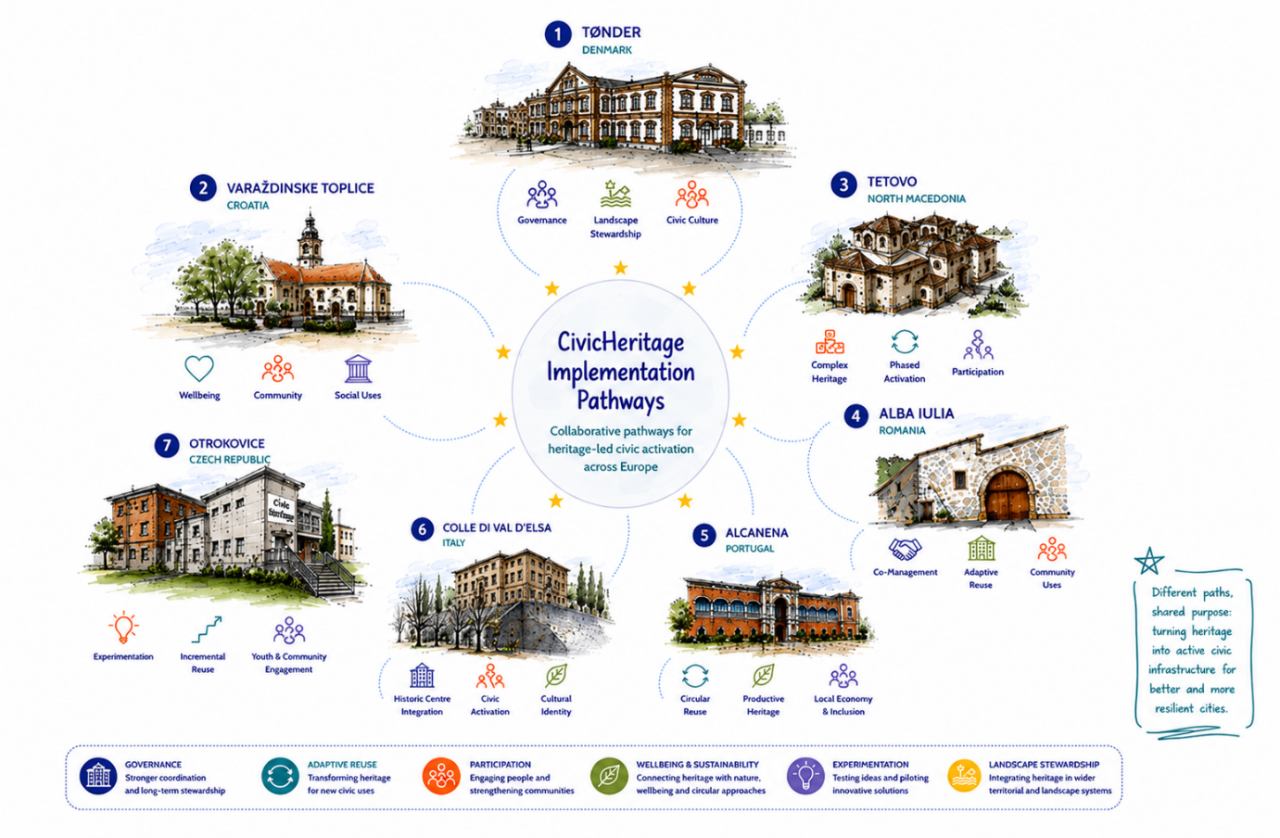
In Alba Iulia, standing above the Caponiera fortifications created one of those moments when history suddenly feels tangible and alive. Yet local discussions moved beyond tourism and preservation towards participation, accessibility and civic use. Through the ULG, the municipality, youth organisations, cultural institutions, technical experts and community stakeholders are exploring how the site could support learning, creativity and social innovation.
In Alcanena, heritage appeared through craftsmanship and industry. Visiting workshops and observing how bags and leather products are still made connected the network directly to local economies and industrial memory. Heritage there is still touched, produced and carried into everyday life. The selected Fábrica da Cultura offers a place to test cultural programming, artistic residencies and community uses while rehabilitation continues.
Colle di Val d’Elsa offered another perspective. Walking through the city revealed the richness of its historical fabric, but also the awareness that beautiful environments alone are not enough. Schools, associations, young people, cultural actors, businesses and technical experts need a meaningful role in deciding how heritage spaces remain socially alive.
In Otrokovice, another memory emerged: the legacy of Baťa. Across Eastern and Central Europe, Baťa was part of everyday life and an industrial culture that shaped cities and generations. The Sokolovna and Baťa House now offer opportunities for sport, exhibitions, education and intergenerational activities.
Tønder introduced another dimension: governance culture and long-term thinking. Its strong associations and festival ecosystem offer a foundation for participation, although the Transferability Study notes that informal actors and everyday users still need a stronger voice in heritage governance.
Tetovo revealed perhaps the most multilayered urban reality in the network. The Castle has enormous cultural and civic potential, yet physical deterioration, limited accessibility, complex ownership and dependence on national approvals make large-scale transformation difficult. Instead, the city is working through its ULG to improve institutional coordination, broaden participation and develop a phased pathway based on achievable pilot activities.
Meanwhile, Varaždinske Toplice offered one of the most striking historical experiences of the journey. Traces of Egyptian blue pigment remain visible on the ancient Roman baths, making Europe’s layered history feel physically present. At the first ULG meeting, stakeholders from education, architecture, civil society, finance and municipal departments worked alongside the Mayor and the Croatian URBACT National Contact Point. Their discussion connected conservation with the need for flexible spaces for associations and community programming.
Across the visits, every city revealed different forms of heritage: monumental, industrial, archaeological, social and cultural. Together, they demonstrated that heritage can support local identity and contemporary civic life when connected to communities and everyday realities.
Leadership, hospitality and human encounters
What made the network remarkable was not only the heritage, but the people opening their cities with generosity and curiosity: the hospitality, regional food, conversations after meetings and drives across landscapes revealing Europe’s diversity.
Mayors did not simply welcome the network ceremonially. They engaged directly in discussions about governance, adaptive reuse and the future role of heritage. Many spoke openly about ageing populations, youth outmigration, limited resources, participation fatigue and the challenge of balancing preservation with contemporary needs.
Important discoveries often happened informally - during walks, dinners or spontaneous conversations. The dynamic changed when participants realised that another city faced similar struggles in a different context. That recognition created trust. And trust created exchange.
From learning to local action
The Transferability Study organises the next phase around three connected steps: UNDERSTAND, ADAPT and RE-USE. Cities first map stakeholders, review their ULG composition, assess the heritage asset and identify barriers. They then adapt the Onda principles through participatory design, governance options, funding scenarios and pilot concepts. Finally, they test temporary uses or community programming, monitor what happens and adjust their transfer plans.
The approach is practical. A city does not need to wait for a complete restoration or perfect masterplan. It can identify one usable area, invite schools, associations, cultural organisations, businesses and residents to propose activities, and learn from who participates and what support is required. A workshop, exhibition or community event can reveal operational needs that architectural drawings alone cannot show.
ULGs are therefore more than consultation panels. They can become coordination spaces where municipal departments, cultural institutions, educational actors, technical experts and civil society share responsibility. The study also recommends attention to gender, age, accessibility and groups traditionally underrepresented in urban planning.
Rebuilding civic life through heritage
Across Europe, regeneration is increasingly understood as more than restoring buildings and public spaces. It is also about rebuilding trust, participation and local identity. This is precisely where CivicHeritage enters a much larger European conversation.
Over the coming months, partner cities will continue working through local transfer plans, ULGs and collaborative learning processes. They are not simply transferring physical projects. They are exploring how heritage can once again become part of everyday life through participation, governance, learning and shared responsibility.
What is emerging is not a fixed model, but a European process of adaptation rooted in local realities. And perhaps that is the most meaningful lesson of the journey so far: across very different urban, political and cultural contexts, heritage becomes truly alive when communities are able to shape it, use it and recognise themselves within it once again.
This text was written by IVANA UNKOVIC, Lead Expert