Düsseldorf: one map, one shared goal
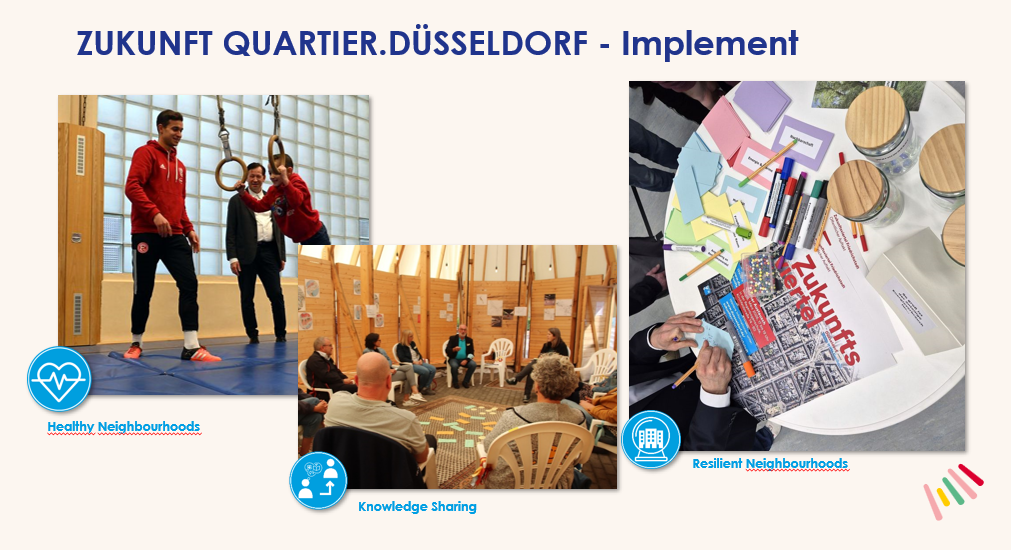
Andreas Schmitz of the Urban Planning Office presented Zukunft Quartier.Düsseldorf. Its goal is simple: all residents should have similar life and development opportunities across neighbourhoods and benefit equally from the city's dynamic. The approach rests on nine process elements, ten tools, twelve Areas of Action and a Neighbourhood Atlas.
The starting problem will sound familiar to many cities. Different departments were active in the same neighbourhoods without knowing it. The Atlas, developed together with the city's statistics colleagues (work began in 2017 and results were first published in 2019), gives everyone the same factual basis. The city is divided into 10 districts, 50 city quarters and around 180 smaller social areas, and each social area gets a profile compared with the city-wide average. Indicators cover socio-demographic challenges, population fluctuation, children's health, access to green space and playgrounds, social infrastructure, housing and living conditions, and climate and pollution. The map turns red where the need for action is greater.
An area becomes an Area of Action when there is need in at least one category. This definition was developed by an interdepartmental working group and a steering committee chaired by the mayor and was then approved by the city council. Düsseldorf is also open about the gaps: economic data and mobility are not yet part of the Atlas.
Data is only one part of the picture. Düsseldorf reviews the nine process elements qualitatively, looking back over six years at which tools and participation activities were used. In Garath, which receives state funding, a goal-achievement matrix tracks measures such as new green space and climate-resilient trees, and the city reports on it every year. An annual conference with around 300 participants keeps stakeholders involved and helps check that the city is on the right track.
Ghent: evaluation built into the programme from day one
Nele Vanhooren of Ghent's urban renewal service presented the evaluation framework the city uses for long-term, area-based renewal programmes, which often run for about 20 years. The framework was developed with a research unit of a Flemish university and is linked to the phases of the programme: mandate, proposal and plan. It combines monitoring, evaluation, learning and collective reflection. Its three questions are what has changed in the neighbourhood, whether the objectives and interventions were the right ones, and how the city can do better next time. As Nele put it, evaluation is not only about accountability but just as much about learning.
In practice, this means:
- Set indicators and a baseline at the start. You cannot measure change later if you did not record the starting point.
- Keep an output log. It records objective facts, such as a new park opening, each linked to a programme objective.
- Keep an outcome log. It captures the changes that staff and stakeholders observe, which are by nature more subjective.
- Use outcome harvesting. Residents and stakeholders are asked what change they have seen, and whether it was intended.
- Make sense of it together. Every three years, city services and stakeholders reflect on what the data says, why, and what to adjust.
Ghent also shared an honest case: Ledeberg. After 20 years the city believes the objectives have been met, and wants to close the programme, but there was no baseline and no interim evaluation. The team reformulated the objectives, worked only with existing indicators and data, and relied on the memory of colleagues and NGO workers for outcome harvesting. It was still possible to run a sensemaking workshop, house calls and in-depth interviews. The conclusion is clear: the framework works, and it works best when applied from the beginning.

What we take away
The questions from the group sparked a lively discussion. These are the lessons we want to share with other cities:
- Start by bringing colleagues to one table. Before building tools, Düsseldorf created one shared map, a process plan, and a working group with a steering committee. A common factual basis is the foundation for integrated work.
- Define indicators and a baseline before you start. Ghent's Ledeberg case shows how hard it is to evaluate afterwards.
- Combine numbers with stories. Output is what happened; outcome is what changed, and people experience it differently. In one Ghent example, a new bridge was well used (a positive outcome) but became too crowded to be safe for pedestrians (a negative one). Hearing every voice, and then discussing the interpretation together, is what makes an evaluation honest.
- Use existing data and know its limits. Ghent relies largely on a recurring city-wide resident survey that allows comparison with other cities and areas, although online surveys may under-represent some groups. Düsseldorf relies more on geographical data from the Atlas. Data placed next to people's perceptions makes the discussion more objective.
- Make monitoring a team habit. Keeping logs, workshops and interviews takes time, but the Ghent team finds it worthwhile. Their next step is to put the log on the agenda of the regular neighbourhood action-team meetings, so that everyone working in the neighbourhood contributes, not just the programme director and communicator.
- Mind the rhythm. A three-year interim evaluation can feel tight when projects take up to six years. Small changes still deserve to be evaluated.
- Evaluation also helps you to close a programme. Looking critically at your own work is hard, especially politically. A scientifically grounded, shared framework gives cities a fairer way to decide when a programme has done its job.
Questions we take forward
The discussion also left us with questions that we will keep exploring as a network:
- How can resident perception and attachment to a neighbourhood be reflected when statistical units are mainly administrative?
- How can data on the local economy and mobility be brought into integrated neighbourhood analysis?
- How can cities with limited resources start small and still build a useful evaluation habit?
This first webinar showed how much partners can learn from each other's approaches, whether they are more data-driven, as in Düsseldorf, or more process-driven, as in Ghent. We look forward to continuing the conversation as Urban Echo develops.