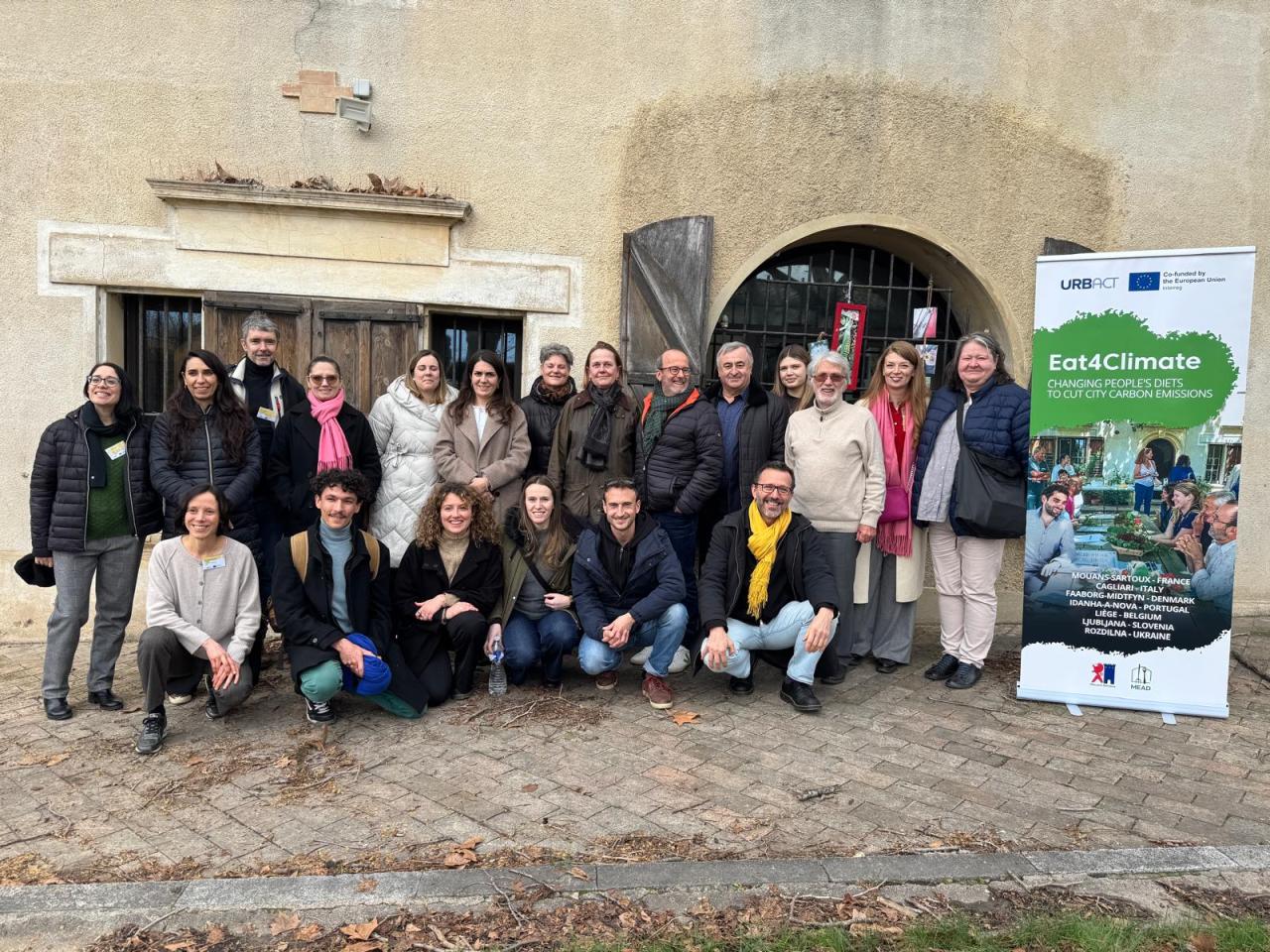
Following the kick-off meeting, held in Mouans-Sartoux in February 2026, which officially launched the network and introducted partners to the Good Practice, the Lead Expert and Lead Partner carried out a series of city visits between February and March 2026, either in person or online. These visits helped gain a deeper understanding of each city's local context, challenges and ambitions, while laying the foundations for the development of City Profiles and Transfer Intentions.
Eat4Climate City visits summary :
The Metropolitan City of Cagliari (MCC) represents 70 municipalities across a diverse urban and rural territory, offering significant opportunity to scale food-related climate actions through its multiple stakeholder networks. While agriculture remains a key economic sector together with tourism, both face increasing environmental and social challenges. Through innovation, education and participatory governance, MCC aims to make sustainable food systems a driver of climate action, social cohesion, and resilient local development.
Faaborg-Midtfyn (FMK) is a rural municipality that places citizen participation and local collaboration at the heart of its development strategy. Building on South Funen’s reputation as Denmark’s “food garden,” it combines strong local food tradiction, sustainable food innovation and partnerships with businesses and regional food actors. FMK is committed to achieving net-zero emissions by 2050, the municipality aims to use local food culture as a lever to promote healthier, more sustainable and locally sourced diets.
Recognised as the Best Bio-district in 2023, Idanha-a-Nova combines strong agricultural heritage with ambitious sustainability goals. The municipality is transofmring its territory into a living laboratory for food innocation. Idanha-a-Nova aims to strengthen the social dimension of its food strategy, notably by developing a Food Literacy Centre that connects food, health, education and sustainability.
Liège benefits from more than a decade of experience in developing a sustainable food ecosystem. With a strong commitment to food sovereignty development, Liège shows strong commitment to sustainability and food sovereignty, a dynamic network of stakeholders and well-established partnerships, the city has built a solid foundation for food transition. Liège seeks to further strengthen coordination and scale up actions that encourage sustainable food habits across the territory.
Ljubljana, as a largely rural city, has developed an ambitious food policy supporting organic and integrated farming, short supply chains and public procurement. The city actively connects local farmers with schools and kindergartens while promoting healthy and low-waste meals through training and education programmes. Ljubljana continues to reinforce the links between sustainable production, public catering and food education, with the ambitiou to reach 45 % food self-sufficient.
Rozdilna is a growing municipality with a diversified economy rooted in agriculture, logistics and local services. Despite the challenging geopolitical context, the city demonstrates strong political commitment and a clear ambition to advance its sustainability agenda. Rozdilna aims to adapt and implement the Eat4Climate good practice as a pathway towards healthier, more resilient and climate-friendly food systems.
Accross all partner cities, common themes emerged, helping to shape the Eat4Climate journey and the development of our first output : the Transferability Study.