
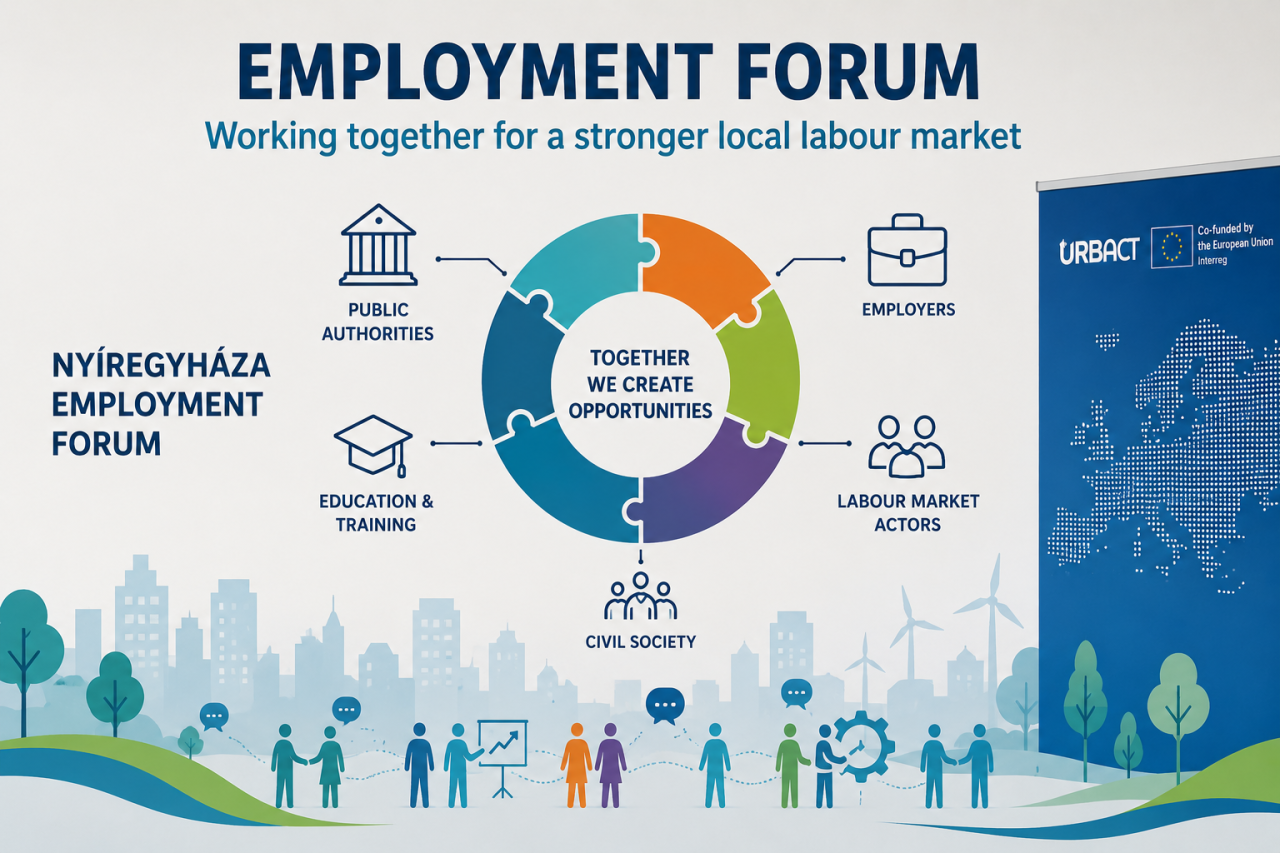
The URBACT Good Practice at the heart of Network4Work
Many cities face similar labour market challenges: skills mismatches, labour shortages, unemployment among vulnerable groups, workforce ageing and the outmigration of young talent. While these challenges are complex, the solutions are often fragmented. Public authorities, employers, education providers and civil society organisations frequently work on the same issues without sufficient coordination. In Nyíregyháza, this challenge led to the creation of an innovative governance model that has since become an URBACT Good Practice and the foundation of the Network4Work Transfer Network.
From Employment Partnership to Employment Forum
In 2016, the Municipality of Nyíregyháza launched an Employment Partnership with support from the European Social Fund. The objective was clear: improve the local labour market through cooperation rather than isolated interventions. Before the initiative, labour market actors often lacked opportunities to jointly identify challenges, exchange information and develop common solutions.
The cornerstone of the initiative became the Employment Forum, a consultative body that brings together public authorities, employers, education and training providers, labour market institutions, NGOs and other relevant stakeholders. Today, the Forum consists of 38 members representing the broadest possible range of organisations influencing or affected by local employment issues.
More than a discussion platform
What makes the Employment Forum unique is that it goes beyond dialogue.
The Forum meets regularly to discuss topics such as labour market trends, talent retention, vocational training, digitalisation, workforce mobility, the employment of vulnerable groups and the changing expectations of different generations of workers.
Over time, participants moved from discussing problems to developing solutions. Four stakeholder-led working groups were established focusing on:
labour market dynamics,
career orientation,
modern training structures,
and workforce mobility.
These groups generated concrete actions and recommendations, helping local stakeholders jointly address challenges that no single organisation could solve alone.
Decisions based on evidence
A key element of the model is its strong evidence base.
The Employment Forum process starts with a comprehensive assessment of labour market needs and expectations. Employers, education providers, labour market professionals, employees and jobseekers all contribute information through surveys, interviews, workshops and focus groups. This enables stakeholders to distinguish between symptoms and root causes before designing solutions.
The collected data supports labour market analyses, forecasting exercises, strategic planning and the development of targeted actions that respond to real local needs.
Tangible results for residents and employers
Between 2017 and 2023, the Employment Forum organised more than 120 events involving over 5,000 participants. The initiative produced a range of practical outputs, including company surveys, labour market analyses, career orientation events and online platforms aimed at retaining skilled workers and young talent.
Importantly, the benefits extend beyond jobseekers and residents. Employers also gain from the model through improved access to labour market information, stronger cooperation with education providers, more targeted workforce development measures and a larger pool of qualified candidates. By helping align labour supply with labour market demand, the Forum contributes to a more competitive local economy.
A model with European relevance
The success of Nyíregyháza's Employment Forum lies not in a single project or action, but in a way of working. It is a sustainable, integrated and participatory governance model that brings together all actors with a stake in the local labour market and encourages them to take shared responsibility for its future.
This is precisely why the model was selected as an URBACT Good Practice and why six European partner cities are now adapting it through the Network4Work project.
Over the coming years, partners in Bulgaria, Greece, Portugal, Spain, Sweden and Bosnia and Herzegovina will work together to transfer the principles of the Employment Forum to their own local contexts, helping more cities build stronger partnerships for stronger local employment.