
Project proposal by
- Institution : JÕELÄHTME RURAL MUNICIPALITY
- City : JÕELÄHTME
- Country : Estonia
- Type of region : Transition
- Population : 8 999
Looking for Project Partners
LONGER SUMMARY
1. Project Overview
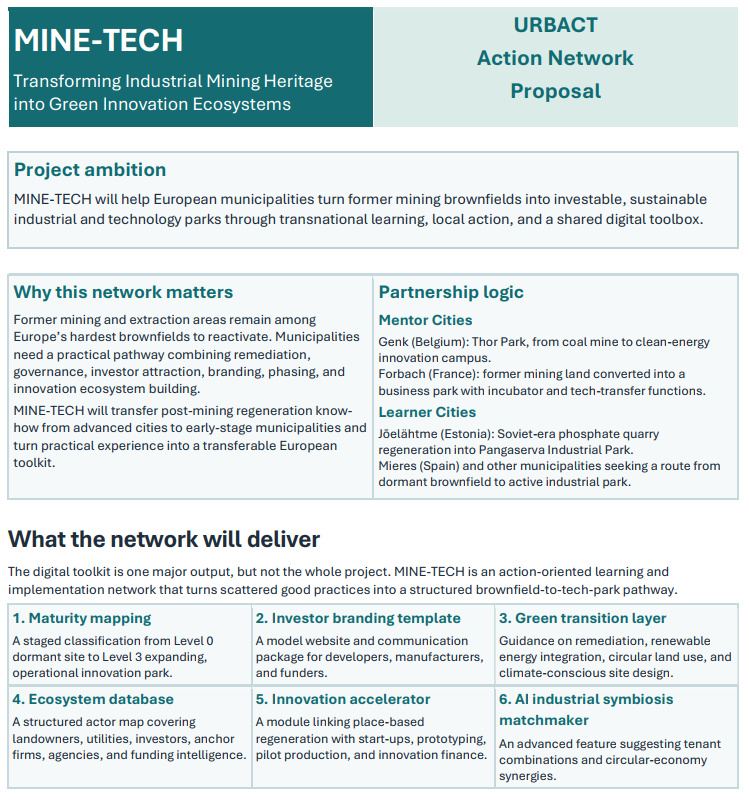
MINE-TECH is a proposed URBACT Action Network that will help European municipalities reclaim, reactivate and reposition former mining areas as future-oriented industrial and technology parks. The network is built around a practical challenge shared by many local authorities across Europe: how to move from an abandoned or underused extractive brownfield to a functioning, investment-ready, sustainable innovation ecosystem.
The project brings together two complementary groups of cities. The first group consists of Mentor Cities with proven experience in post-mining transformation, where former mining land was converted into a business park supported by incubator and technology-transfer functions. The second group consists of Learner Cities that are still in earlier phases of regeneration and need a structured pathway from brownfield status to implementation.
The core purpose of the network is not only to exchange experience, but to co-develop actionable methods, test local solutions and structure practical knowledge into a transferable model. A major output of this work will be a Knowledge-Based Digital Toolkit: a modular roadmap and digital support package that can guide municipalities anywhere in Europe from Stage 0: dormant brownfield to Stage 3: active and expanding innovation-oriented industrial park.
2. The Challenge
Across Europe, former mining and extraction areas remain among the most difficult brownfields to regenerate. These sites are often large, environmentally sensitive, spatially fragmented, visually unattractive to investors, and burdened by unclear development logic. In many cases, municipalities do not lack ambition, but rather a workable transformation pathway: a step-by-step model that combines land reuse strategy, governance, investor communication, environmental upgrading, innovation programming and implementation sequencing.
This creates a persistent policy and delivery gap. While some cities have already developed impressive post-mining business or innovation locations, many others are still at the very beginning. They need more than inspiration. They need structured peer learning, tested tools, realistic phasing models, and local capacity to act.
MINE-TECH responds to this gap by focusing on the municipal process of transformation: how a local authority, together with landowners, businesses, residents, investors and support institutions, can turn a difficult post-industrial liability into a productive, green and future-oriented local asset.
3. Core Objectives
Knowledge transfer
The network will transfer practical know-how from advanced post-mining transformation cases to municipalities that have not yet managed to activate their brownfields. This includes lessons on land remediation, site positioning, governance models, infrastructure sequencing, investor relations, branding, and integration of innovation functions.
Capacity building and local action
Each partner city will mobilise local stakeholders through an URBACT-style co-creation approach and develop a practical local action pathway. The project is intended to support real local progress, not only discussion, which is fully consistent with the Action Network model where partners have budget for concrete local actions and implementation-oriented learning.
Digital standardisation of the regeneration pathway
The network will convert dispersed experience and fragmented good practice into a coherent Digital Toolkit that standardises the brownfield-to-tech-park journey. The aim is to make practical transformation knowledge reusable for future municipalities beyond the partnership.
European replication potential
MINE-TECH is designed as a transferable model for municipalities across Europe that face similar post-mining or post-extractive regeneration challenges. The final result should be not just a set of individual local stories, but a shared European methodology.
4. The MINE-TECH Digital Toolkit
The Digital Toolkit is one important output of the network, but not the project’s only purpose. Its value lies in capturing, organising and scaling the knowledge generated through the network’s practical work.
The toolkit could include the following layers: Maturity Mapping, Investor Branding and Communication Template, Green Sustainability Analysis Tool, Ecosystem Database, Innovation Accelerator Module, AI-Driven Industrial Symbiosis Matchmaker.
5. Expected Results
By the end of the network, participating cities should have:
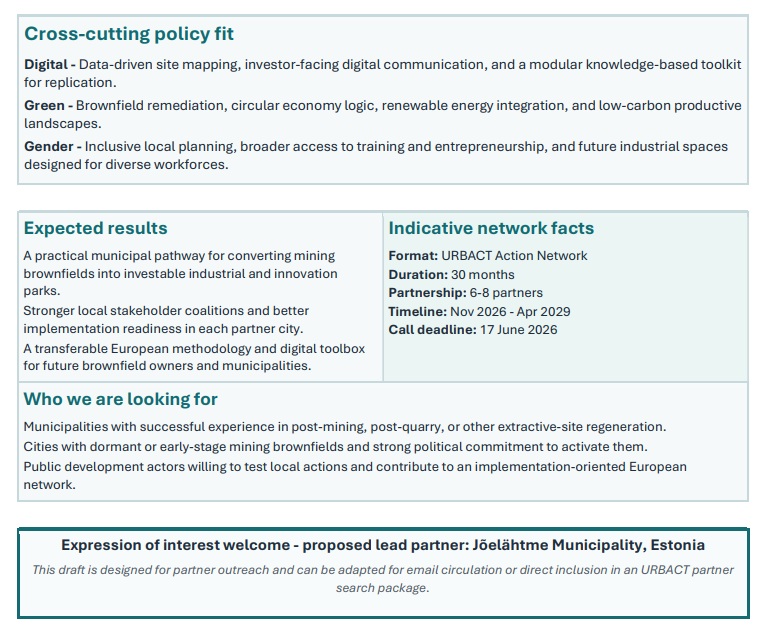
• a clearer and more realistic municipal pathway for turning mining brownfields into industrial or innovation parks;
• stronger local stakeholder coalitions and implementation capacity;
• tested approaches for governance, communication, environmental upgrading and investor engagement;
• a shared European knowledge base on post-mining regeneration;
• a modular Digital Toolkit that can be used by future municipalities and brownfield owners across Europe.
The long-term ambition is to make MINE-TECH more than a single project. It should become a reference framework for brownfield-to-innovation-park transformation in Europe.
6. Partnership Invitation
We are looking for municipalities and public development organisations that fit one of the following profiles:
• cities with successful experience in transforming former mining or extractive sites into business, technology or innovation parks;
• cities with mining-related brownfields still in early-stage or dormant condition, but with strong political interest in developing them;
• partners willing to contribute to a practical, implementation-oriented network that combines transnational learning, local action and digital knowledge transfer.
We are particularly interested in building a balanced partnership that includes both experienced transformation cases and municipalities that can test and adapt those lessons under different territorial conditions.