A GOOD PRACTICE FROM THE GREEN HEART OF ITALY
PARKS Transfer Network builds on the good practice from Perugia, one of Europe’s cities cherishing the climate value of urban trees and the social benefits of green assets. Over the past decade, Perugia worked hard to re-define its approach to green in the city by involving four main target groups: building on the expertise planners and professionals, activating citizens, engaging students and youth, and mobilising businesses. A comprehensive tree inventory and the continuous collaboration with professionals in green development laid the ground for the drafting of a Green Asset Strategy that guides the city’s policy towards a greener cityscape. Citizens are invited to join the efforts by contributing their local knowledge and developing green spaces hands-on, according to their needs. Examples are the community gardens at San Matteo degli Armeni and the engagement of schools in a biodiversity testing site at Chico Mendez Park. In 2024, Perugia was awarded URBACT Good Practice for this comprehensive and continuing strategy of “urban forest optimisation”.
Based on the award, Perugia found six partners interested to embark on a two-and-a-half years journey towards the “shared governance for resilient urban green spaces”. Because this is what it is about: To unite administration and various local stakeholders in participatory actions for resilient and knowledgeable stewardship in order to create and sustain green assets of high social and ecological value together.
Using the resources provided by the URBACT programme, the PARKS Transfer Network provides an engaging environment to work through the three stages: to understand the different components of Perugia’s good practice, to adapt them to the partners’ local situation, and to test and re-use the most relevant aspects.
The partners from six European countries are as diverse as the continent: from Bulgaria’s capital city of Sofia to rural Monaghan County in Ireland, from historic Veszprém in Hungary to the emerging Galician city of Arteixo, from forested Valongo in Portugal to the river banks of Ukrainian Chernivtsi. Each of them brings individual priorities and needs to the group. Some already have a comprehensive policy background but lack the active participation of citizens. Some can build on professional partnerships but are missing a suitable inventory of their green assets – or the other way around.
By the end of summer 2026, with the end of the Understand Phase, the network and the partners have marked out the field of their planned activities until April 2028. They can be found in the partner profiles and the network’s growth plan in the PARKS Transferability Study.
LEARNING THROUGH TRANSNATIONAL EXCHANGE AND STAKEHOLDER ENGAGEMENT
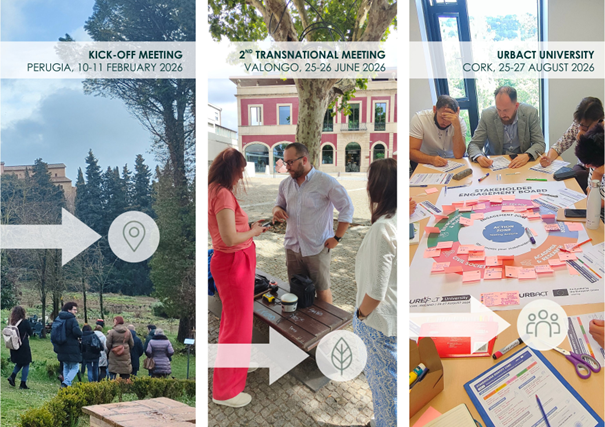
To this date, the PARKS network partners met three times on the international stage with each meeting contributing an important aspect to the network’s Understand Phase:
Kick-off Meeting in Perugia, February 2026
At the Kick-off Meeting, Perugia provided the partners with an inside view of the good practice to be transferred. The Lead Partner opened the treasure box of the various components that led to Perugia’s successful results, focusing on the four target groups of urban green development in their URBACT Good Practice: Planners and professionals, citizens, students and youth, and businesses. Talks with stakeholders and explorations on site brought the Good Practice to life and shed light on the underlying processes and strategies that will unfold in the five PARKS Transfer Topics: Tree Census, Green Council, Green Asset Strategy, Partreecipation and Awareness-Building.
2nd Transnational Meeting in Valongo, June 2026
The 2nd Transnational Meeting took the network to the next stage. It moved the focus to the partner cities and their individual starting points in the first Transfer Topic: Tree Census. Knowing and understanding the city’s green assets is key for knowledge-based decision making and for strategic green development. Perugia presented their comprehensive tree inventory, linked to the city’s digital twin, that combines professional expertise with local knowledge that is contributed by citizens using a mobile web application: Location and various parameters of 50,000 urban trees were mapped in a joint effort. Project partners presented their local and innovative approaches. For example, Sofia showcased its Green GIS register of the urban tree population and the use of emerging digital tools to detect urban heat islands. Valongo introduced their “All streets with trees” project and its activities to map the “green giants”. The input shows that the network builds on fruitful exchange with each partner being both on the giving and receiving end of the learning process.
URBACT University in Cork, August 2026
Finally, the URBACT Programme took the partners on a playful journey in search of missing stakeholders. The URBACT University in Cork encouraged the partners to take their local group to the next level towards testing actions to long-term implementation. For the PARKS network partners this is an extra challenge given the broad scope of the network’s five transfer topics and the large number of potential stakeholders. Also in this field, Perugia is leading the way with the formation of Consulta del Verde, the local Green Council. This component of Perugia’s Good Practice will be the thematic focus of the 3rd Transnational Meeting in Veszprém, November 2026.
The Adapt Phase begins in Veszprém from 3 to 5 November, and with it comes a question every partner city has to answer in its own way: who needs to be at the table, and how do we keep them there? Back home, the partners will bring their answers to their URBACT Local Groups and turn them into first testing actions, to be carried forward until April 2028.
Because it is at the local level that the numbers become real: the next park within 300 m, the shade of a 30 % tree canopy on an over-heated day, the three trees outside the window. So, take a look outside your window once more. Over the coming months, seven cities will work to make that view a little greener, and they will share what they learn along the way. Follow the journey at urbact.eu/networks/parks.
Parks belong to people. Let’s take care of them together.