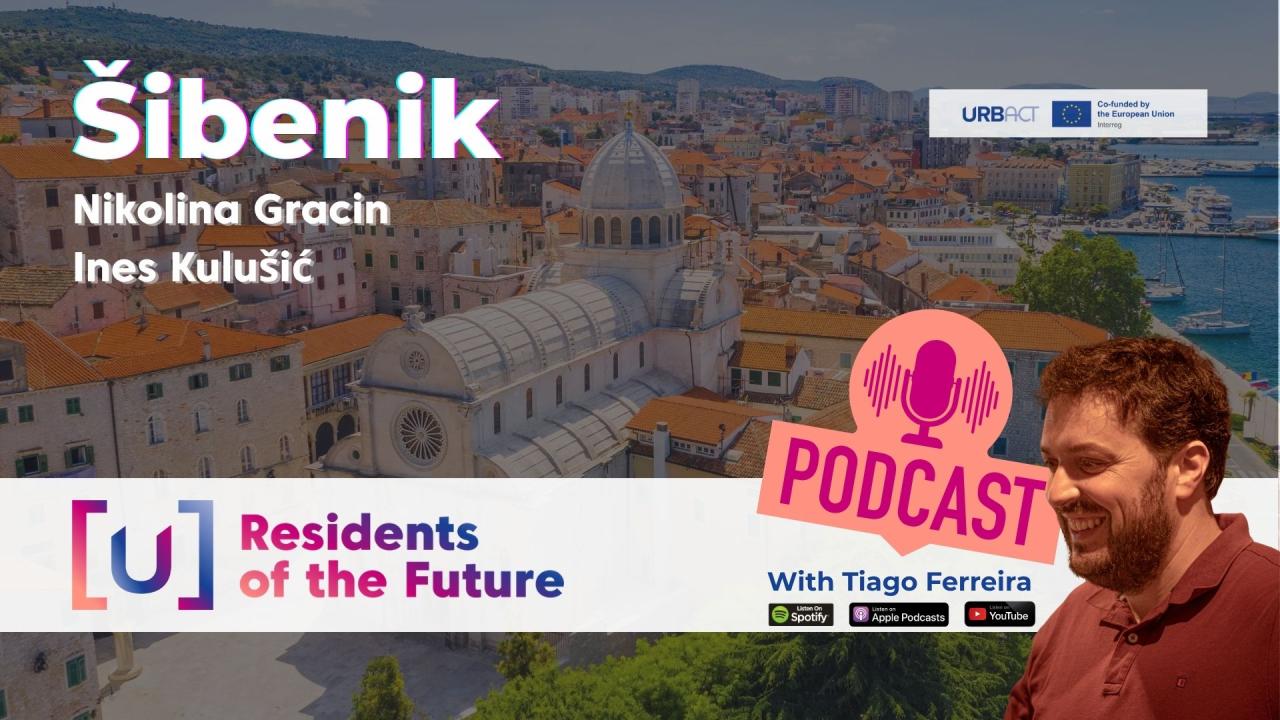
Šibenik is known for its medieval city centre, fortresses, cultural life and location on the Adriatic coast. At the same time, it faces demographic trends common to many small and medium-sized European cities. Between the 2011 and 2021 censuses, Šibenik lost more than 3,700 inhabitants, representing a population decrease of 8.1%. Alongside natural population decline and migration to other European countries, the city also faces the movement of residents towards larger Croatian urban centres.
These challenges were the starting point for the Residents of the Future network.
Nikolina Gracin and Ines Kulušić prepared the original URBACT application without external experts. As Lead Partner representatives, they then coordinated the network and supported the development of local responses in nine cities with different demographic, economic and geographical conditions.
Presenting smaller cities as places to live
One of the central lessons from Šibenik’s work is that smaller cities must actively present themselves as possible places to live, work and build a family. This became clear during a pilot action conducted with students at the Zagreb University of Applied Sciences. The activity explored how young people perceive smaller cities and introduced them to employment and lifestyle opportunities in Šibenik, particularly in the IT sector and creative industries. The survey showed that 70% of participating students were still undecided about where they wanted to live after graduation. Many had never considered Šibenik and had limited information about its professional, cultural and everyday opportunities The results highlighted the importance of visibility, perception and targeted communication. A city may provide good living conditions, but these advantages have little effect if potential residents do not know they exist. Smaller cities therefore need to communicate not only tourist attractions, but also employment opportunities, public services, housing conditions, cultural programmes and the practical experience of everyday life.
A Mediterranean-style work-life balance
A central concept in the episode is the Mediterranean-style work-life balance as a measurable advantage of Šibenik and similar coastal cities. For Nikolina and Ines, this balance is connected to the scale, safety and accessibility of the city. Daily services, workplaces, shops, restaurants and cultural events are generally within a short distance. The Adriatic Sea, islands and national parks are also close to the city. This creates a compact urban environment in which work, family life, culture and nature can be combined without the long commuting times associated with larger cities. Šibenik also has a developed cultural sector, year-round events and an economy shaped by tourism, services and emerging opportunities in creative and digital industries. Remote and hybrid work have created additional possibilities for people whose jobs are not tied to large metropolitan centres. The city’s size also supports a strong sense of community. Fewer crowds, lower noise levels and a feeling of safety can contribute to lower stress and a higher quality of everyday life. These characteristics are particularly relevant for families with children, remote workers and people seeking a different relationship between professional and private life. The project showed that these qualities should not be treated only as abstract lifestyle benefits. They can form part of a broader strategy for attracting and retaining residents.
Local knowledge and participation
The Šibenik URBACT Local Group played an important role in defining the city’s response to population decline. Through six focused meetings, representatives from different sectors identified local challenges, established objectives and proposed practical measures. ULG members also participated in pilot actions, transnational meetings and the Open Doors of the City activity.
This process brought different perspectives into the development of the Integrated Action Plan and connected demographic policies with housing, education, culture, employment, public services and infrastructure. The experience also confirmed that demographic challenges cannot be addressed through isolated financial measures alone. Support for newborns, school textbooks and families remains important, but long-term demographic stability depends on whether people can find housing, employment, education, healthcare, cultural activities and reliable public services in the same place.
From quality of life to long-term investment
Šibenik’s Integrated Action Plan focuses on improving the conditions that influence decisions to stay, return or relocate. Priority areas include housing, education, public services, cultural activities and sustainable infrastructure. Some investments are already moving towards implementation. Four elementary schools are expected to receive improved infrastructure and additional services, creating better conditions for pupils, teachers and families. The city is also involved in planning a new hospital. In addition to improving healthcare, this investment could create qualified jobs and attract professionals to Šibenik and the surrounding area. These projects show how demographic policy can be connected to wider urban development. Investments in schools, healthcare and infrastructure improve daily life for existing residents while also strengthening the city’s ability to attract new ones.
A shared lesson for smaller European cities
Although all nine Residents of the Future partners face population decline, their local circumstances are different. What they share is the need to identify their own advantages and translate them into practical measures. For small and medium-sized cities, the answer is not necessarily to reproduce the density, services or employment structure of major urban centres. Their strength may instead lie in safety, accessibility, community, lower stress, proximity to nature and a different balance between work and private life. These advantages must, however, be supported by housing, education, healthcare, employment and infrastructure. The final episode of the podcast summarises this central lesson from the Residents of the Future network: local authorities cannot control every demographic trend, but they can influence the conditions in which people decide where to build their lives.
As Lead Partner, Šibenik turned its own demographic challenge into a European learning process. The network concludes with nine Integrated Action Plans, tested local actions and a partnership that connected cities facing similar problems from different parts of Europe. Šibenik’s experience shows that a smaller city can lead at European level and use its scale, location and Mediterranean-style work-life balance as foundations for its future.