
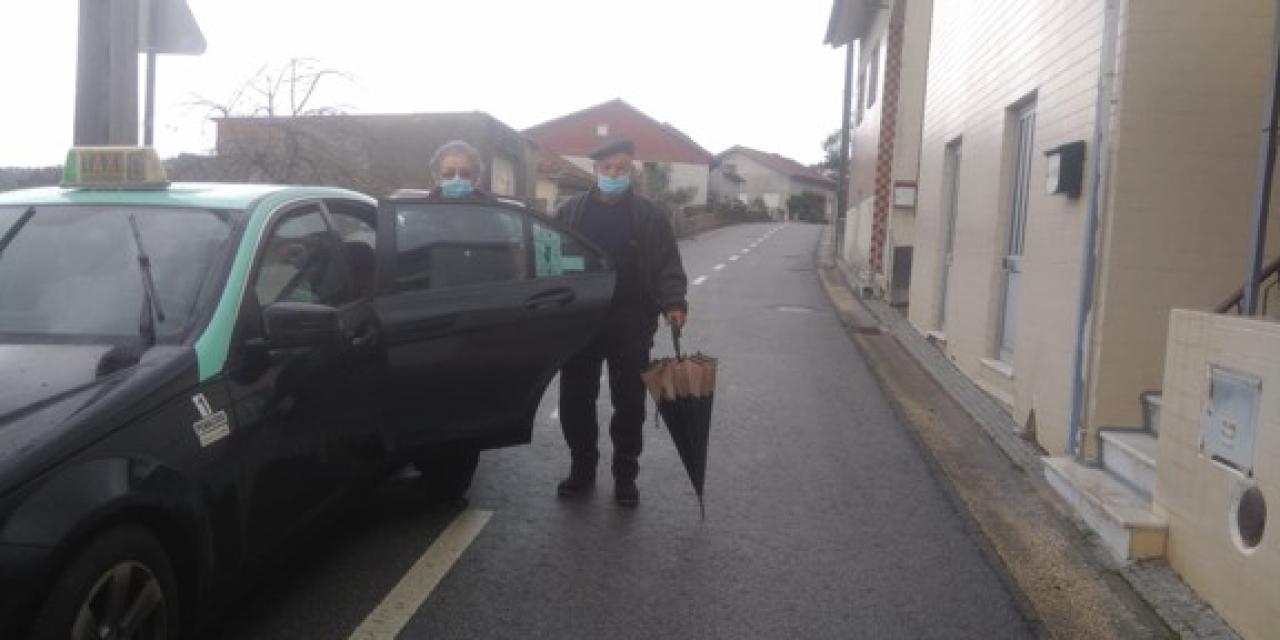
Residents call free of charge before 15:00. A central team groups the requests, plans the routes and assigns the journeys to local operators. The next day, people living in rural settlements can reach municipal centres, healthcare, shops and other essential services.
This is SIT FLEXI, the reservation-based public transport service developed by Coimbra Region (PT) and recognised with the URBACT Good Practice label. The URBACT S-MODE Network (Smart Mobility on Demand) has a different role. It brings Coimbra together with Cluj Metropolitan Area (RO), Užice (RS), Bijelo Polje (ME), Kiskunhalas (HU), Eurometropolis Strasbourg (FR), Thessaloniki Metropolitan Area (EL) and Mengeš (SI) to understand the practice, adapt it and decide what can be reused locally.
The aim is not to reproduce Coimbra. It is to make flexible transport work in each local context.
What Coimbra brings
SIT FLEXI grew step by step. Coimbra Region made inclusive and sustainable mobility a strategic priority by integrating a demand-responsive transport (DRT) solution into its Sustainable Urban Mobility Plan (SUMP) in 2016. This was followed by a technical feasibility study in 2017–2018, which analysed demographic trends and mobility needs across all municipalities and designed the DRT system for the entire intermunicipal territory. The service was first piloted in two municipalities, Góis and Pampilhosa da Serra, in 2020, and subsequently expanded to the remaining municipalities between 2021 and 2022, establishing a region-wide on-demand transport network (SIT FLEXI) that now covers all 18 municipalities in a territory of more than 4,336 square kilometres, with around 100 inhabitants per square kilometre.
The 2025 figures show the scale of the service: 13,804 bookings, more than 2,000 registered users and a 22.4% farebox cost-coverage ratio. The model complements the regular public transport network rather than competing with it. A national fund provides 96.5% of the core financing and the municipalities provide 3.5%, alongside fares and other support.
What Coimbra brings, therefore, is more than a mobility solution. It is a comprehensive service model that not only bridges a mobility gap but also strengthens territorial cohesion and inclusion. The model clearly defines target users and areas and combines an accessible booking process, central route planning, coordination with local operators, public funding and continuous dialogue with municipalities and sector stakeholders. More than 100 meetings since 2020 have helped refine routes, stops and timetables in line with the territory’s real needs, resulting in a continuously improving solution shaped by the integrated work of all relevant stakeholders.
Different cities, different transfer paths
The S-MODE Transferability Study confirms that the seven partners are not starting from the same point. Some already have trusted services. Kiskunhalas can build on its phone-booked Homestead Helper social service, while Strasbourg can use the network to improve accessibility, capacity and user evidence around Flex'hop and Mobistras rather than create a parallel service.
Other partners first need to test whether the idea is workable. In Kačer, the priority area in Užice, 83% of surveyed residents preferred phone booking. This is a useful signal, but the city still needs to confirm the legal route, subsidy logic and operating model. Mengeš is taking an even more incremental path: questionnaires and workshops with business users and employees will test demand before the municipality decides whether a small live service is justified.
Elsewhere, inclusion and geography shape the transfer. Cluj is exploring an inclusion-first option in Florești that could build on the Beard Brothers association's adapted transport experience. Bijelo Polje needs a gradual way to connect dispersed settlements with the town centre and essential services. In Oraiokastro, within Thessaloniki Metropolitan Area, a semi-flexible service with village meeting points is being considered, subject to agreement between the municipality, transport authority and operators.
Learning also travels back to Coimbra. The Lead Partner will use the seven local experiences to prepare an Improvement Plan for SIT FLEXI. A recognised Good Practice can still improve when other cities question how it works.
What can actually travel?
The most transferable elements are the principles and operating choices behind the service. Each city needs to:
identify where fixed public transport does not meet essential daily needs and who should be prioritised;
choose a service area and booking arrangement that people can actually use, including phone access where needed;
agree who will operate, contract, fund and manage the service;
connect the flexible service with the regular public transport network;
measure access, use, cost, quality and user satisfaction;
involve local stakeholders before the service is designed, not only after decisions have been taken.
The S-MODE transfer pathway
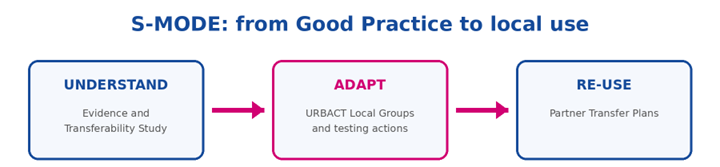
The Transferability Study is the common baseline. Local testing supports adaptation; partners produce Transfer Plans, while Coimbra prepares an Improvement Plan.
The difficult part: making flexibility practical
Flexible transport sounds simple until the practical questions begin. Who takes the bookings? Can a taxi, minibus, social-service provider or public operator deliver the journeys? Which public body can contract and fund the service? How will residents with limited digital access use it? And what happens when a small test ends?
These are not secondary issues. A city may have demand but no funding route, operators but no suitable contract, or a digital tool that excludes the people who need the service most. A useful testing action makes these constraints visible early enough to address them.
Each partner therefore sets up its own URBACT Local Group. Municipal departments, transport authorities, operators, social and health services, schools, community organisations and users bring different parts of the answer. The group validates needs, helps design the testing action and co-produces the city's Transfer Plan. Participation has been part of the transfer method from the beginning of the project.
What has been done so far
The first Transnational Network Meeting took place in Coimbra in February 2026. Partners saw how SIT FLEXI works and discussed what they would need to understand before considering a local test. Technical meetings and visits to all seven partner territories then helped identify target areas and users, map decision-makers and operators, review available data and define realistic transfer directions.
Partners also began setting up their URBACT Local Groups and collecting local evidence through surveys, service records and stakeholder feedback. The Transferability Study brings this material together as the common baseline for the network. The second Transnational Network Meeting, held in Strasbourg on 7 and 8 July 2026, included site visits, peer exchange and joint work on the local groups. Together, these were the main activities of the UNDERSTAND stage.
What comes next
S-MODE now moves into ADAPT. Each city will fill the remaining evidence gaps and test the part of the model that matters most locally. This may be a small transport service, but it may also be a booking process, an operator arrangement, a funding route or a demand test using questionnaires and workshops.
The third Transnational Network Meeting will take place in Kiskunhalas in November 2026. It will give partners the next opportunity to compare progress and refine the testing approaches together.
During RE-USE, each partner will turn the learning into a practical Transfer Plan: what can continue locally, who needs to be involved, how the service could be organised and funded, and how progress will be measured. Coimbra will capture the learning generated across the network in its Improvement Plan.
The phone call that starts a journey in Coimbra may become a different booking channel, operator partnership or service pattern elsewhere. S-MODE is keeping and learning from the principle - reliable access where fixed public transport falls short - and adapting the service to what residents actually need.
Eglantina Dani