
Few people know that, beyond my URBACT work, I am a Shakespeare buff. Accompanying the Hydro-Heritage Cities (HHC) ITN Network has been emotional, enriching and a great honour. These final reflections on the journey draw inspiration from some of the Bard’s most famous words.
All the City's a Stage
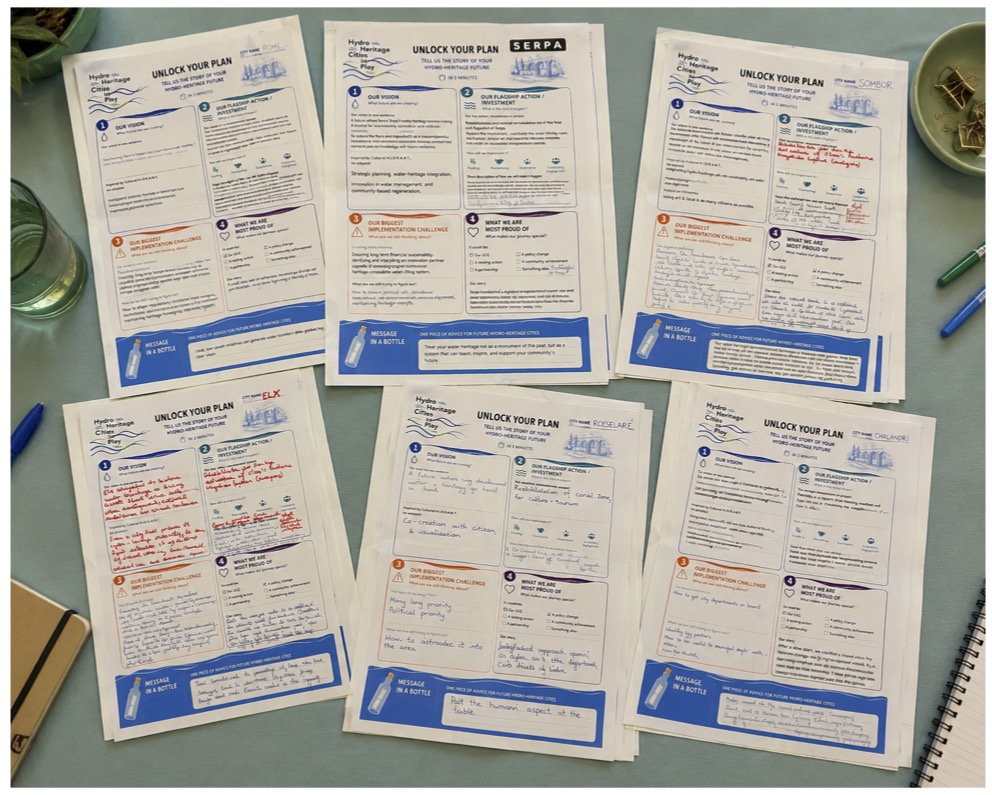
In the mediterranean setting of Villa Celimontana on the Celio hill in Rome, six cities are gathered for the final act of Hydro-Heritage Cities (HHC). Around the room, their investment plans reveal different ambitions and degrees of readiness, as partners share key actions and reflect on how far they have travelled from Chalandri’s Cultural H.ID.R.A.N.T.
Innovation transfer was an intense journey where cities had to understand what made the original work, identify what mattered locally and reshape it around their own places, institutions and communities. The Cultural H.ID.R.A.N.T.’s experience became a script for adaptation, generating five local interpretations in Serpa, Elche, Rome, Roeselare and Sombor before returning to Chalandri with a transformed perspective, as Stefania Giftopoulou – Project Manager for the Municipality of Chalandri (GR)- affirms: “Chalandri has gained institutional ambition, and the potential to mainstream an integrated approach across policy fields.”
Transfer’s Labour’s Lost - What is lost and gained in transfer
As innovation moves between urban contexts, some original coherence inevitably fades. In Chalandri, the original project combined an ancient aqueduct, non-potable water reuse, public-space regeneration and community governance in one integrated experiment.
What may have faded is Chalandri’s unique combination of actions around the Hadrian Aqueduct, backed by a strong partnership and major innovation-project resources. Some experimental boldness may also soften as new ideas enter established municipal structures.
Yet transfer has opened unexpected paths, extending the approach to landscapes of canals, waterwheels, irrigation systems, buried rivers, greenhouses and pumping stations. This wider hydro-heritage geography gives the cities new routes into resilience, local identity and public participation, showing how a shared principle gains relevance when shaped by local histories and needs.
Through these reinterpretations, the original innovation may be less recognisable as a fixed model, but its core idea is even stronger, as water heritage becomes an active resource when cities connect its history to present needs and future resilience.
As Carlos Janeiro project manager from the Municipality of Serpa (PT) puts it: “The main lesson learned from the HHC journey was the value that community participation, combined with URBACT good practices and the contribution of partner cities, can bring to a project, regardless of its nature”. Indeed, in the small town of Serpa, the transfer is converging around the Nora and its aqueduct, where an emblematic monument has become the focus of a practical sequence combining restoration, renewed water use, historical interpretation and cultural activation. The approach is translated to an entirely different scale in Elche (ES), namely the living hydraulic landscape of the Palmeral, where vestiges of El Andalus socio-economic infrastructures still characterise the city, pushing its plan to be embedded into a broad framework spanning major physical investment and smaller actions for citizen science, learning and collective memory.
As You Like It? - Participation without a single recipe
URBACT Local Groups (ULGs) embody the integrated, participatory pillars of the URBACT method. Across the journey, they varied in size, composition and influence: some centred on municipal departments, while others drew on universities, heritage experts, water managers, cultural organisations, schools or committed individuals. These constellations shaped how each city read the original practice and what it chose to develop, giving the transfer its local character.
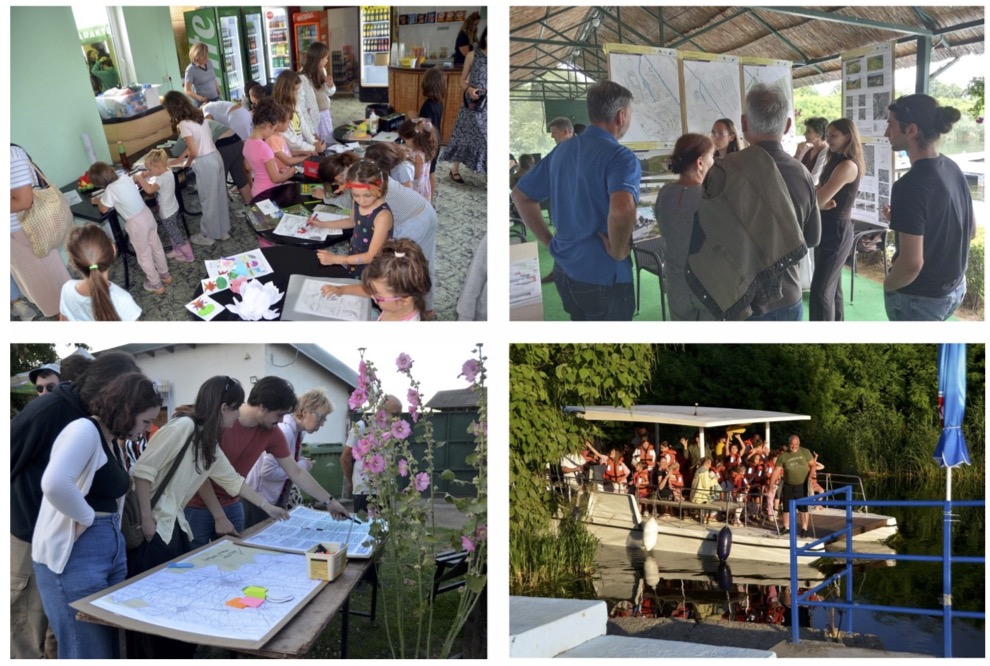
Testing actions took these ideas beyond meeting rooms to involve citizens and external stakeholders. In Sombor (RS), the ULG organised a photo contest with more than 350 images showing how residents perceived Great Backa canal heritage. In Roeselare (BE), cooperation led to a pragmatic test creating a mural above the buried Mandel, using art and storytelling to make invisible water visible again.
The Tempest (and What Comes After) - From heritage to urban resilience
Water heritage tells the story of how cities grew, yet its value becomes even clearer when they look ahead to hotter temperatures, drought, flooding, biodiversity loss and increasing pressure on public space. The Investment Plans bring cultural heritage, social innovation and nature-based responses into the same policy conversation, showing how historic water systems can inspire contemporary approaches to resilience.
In Rome (IT), the Aranciera di San Sisto links memories of water and cultivation with urban horticulture, social inclusion and the wider ambition for green-blue regeneration. “The intervention does not only aim to recover a physical space,” says Architect Maria Elena Lioy Responsible of the Green Areas Planning Office of Rome, “but to create an open, inclusive and intergenerational place, capable of hosting educational, cultural and social activities.” Sombor works at a broader territorial scale, connecting canals and pumping infrastructure with green corridors, cycling routes, tourism and public well-being. In both cases, heritage offers a point of connection between technical challenges and the everyday experience of places.
Measure for Measure — Six plans, different ambitions
Placed side by side, the six HHC plans reveal a striking range of scales, shaped by city size, institutional capacity, existing investments, available sites and political opportunity. Seen as a spectrum rather than a ranking, the plans offer different measures of ambition.
At one end lies Sombor’s broad canvas, with 35 actions. “From a purely traffic and economic perspective, we managed to experience the canal in a completely new way.” states Dragana Silјanović Kozoderović of the Department of Urban Planning in Sombor “In the plan we look at it socially, culturally, environmentally and to convey this to the citizens who now see it in a completely different light”. A similar systemic approach emerges in Elche (ES), where major hydraulic investments sit alongside regenerated water, digital monitoring, governance, education and interpretation throughout the Palmeral.
A more concentrated ambition defines Serpa’s plan, which focuses on the Nora and aqueduct. The specific site of the Aranciera di San Sisto also provides Rome with a starting point, while offering the potential to test an approach for other hidden or secondary water-related heritage sites.
In Roeselare, the route is more pragmatic, as artistic interventions and storytelling become connected with redevelopment and climate-adaptation processes already under way.
Having delivered the original innovation, Chalandri is seeking to sustain the method applied to Cultural H.ID.R.A.N.T. . As Stefania Gyftopoulou says “For the time being we are moving away from some of the tangible, place-based qualities that made Cultural H.ID.RA.N.T. powerful; qualities that are expected to re-emerge through the concrete projects supported by the Urban Lab.” This means applying the URBACT learned lessons to broader issues of urban planning that cross water use to other forms of resilience, creating the grounds for stronger governance and community participation through the creation of an urban lab.
Here’s the Rub — Continuity is harder than creativity
Over the past two years, cities inspired one another and ULGs tested many ideas. The harder task now is to protect and implement them over time. In Chalandri, this means turning the participatory energy around the aqueduct into lasting governance for the urban lab.
Serpa must coordinate restoration, heritage responsibilities and major funding, while Elche needs to align the institutions managing its hydraulic landscape and strengthen both political and community ownership.
Rome, meanwhile, must turn its action-research into an operational model for the Aranciera, Roeselare must translate experimentation into clear actions, roles and resources; and Sombor needs sharper priorities and stronger political support across levels of government.
The Readiness Is All — The policy horizon ahead
The network’s lasting contribution goes beyond its plans, advancing the idea that water heritage belongs to cultural, climate, environmental, social and well-being policy. Historic water systems become living infrastructure, carrying knowledge and identity while supporting water reuse, biodiversity, green-blue planning and climate adaptation.
This perspective asks municipalities to work across departments and broadens the meaning of the term “investment” because restoration and engineering must be matched by coordination, participation, interpretation and learning. These “soft” elements help residents see why change matters and build legitimacy for long-term action.
The cities leave with different levels of readiness, but all have clarified what progress requires. Their shared experience suggests that climate resilience is cultural as well as technical and people are more likely to care for water, landscapes and public spaces when they see them as part of their own story and future.
Our Little Life Is Rounded with a Dream
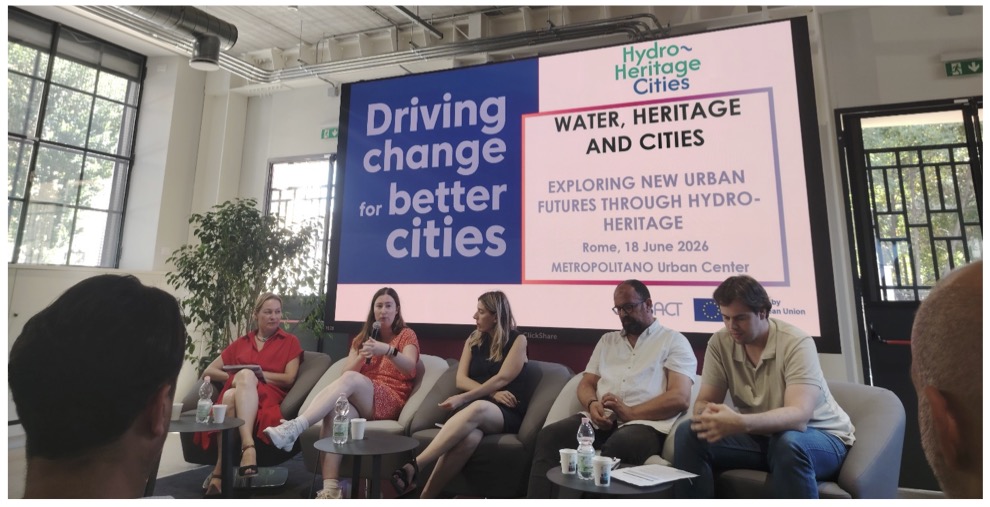
Back in Rome, this time at the METROPOLITANO Urban Center where we hold our final public event, the cities’ stories mark a moment of departure rather than an ending. We share changed perspectives, new alliances and choices that each city can now pursue, and we also leave space for circumstances, politics and communities to reshape what comes next.
Hydro-Heritage Cities in Play, the network’s final interactive booklet, carries this learning forward through a playful legacy of a serious process. It invites other cities to enter the dilemmas of innovation transfer, make decisions and explore their consequences, discovering that there is no single route from water-heritage to resilience.
The original script has travelled, and its next interpretations are still waiting to be written.
Sandra Rainero