YOUth Space Link — Network Article #1
Spaces for youth to grow as active citizen
Article by Kalle Ristikartano
Introduction
How do youth grow up as active citizens able to solve problems we all face? As a society we tend to believe in controlled, expert designed curriculums, AI-powered courses and methods, be it in school, hobbies or at home. But learning to solve real-life problems and take responsibility for the random real-real life consequences of one's actions can't really happen in risk-free environments. Youth need their own space to grow, space where they are trusted with leadership and where they have relationships to support them to deal with consequences. The URBACT YOUth Space Link Transfer network of 7 European cities is developing this kind of Youth Spaces.
Enter any one of the 10 Youth Spaces spread around the City of Lublin in East Poland and you find scenery pretty usual for Youth centers around Europe. 10-30 years old youth doing their homeworks, playing games, in the kitchen preparing a dinner together or a small group planning an upcoming event. The Spaces have their own identities, for example one has a stage for young artists, other offers a safe space for the LGBTQI+ youth, another organises international activities and some provide psychosocial support for youth in difficult situations. All invite a visitor in with cozy sofas, youth designed art, kitchen with free food, range of activities on offer and relaxed atmosphere.
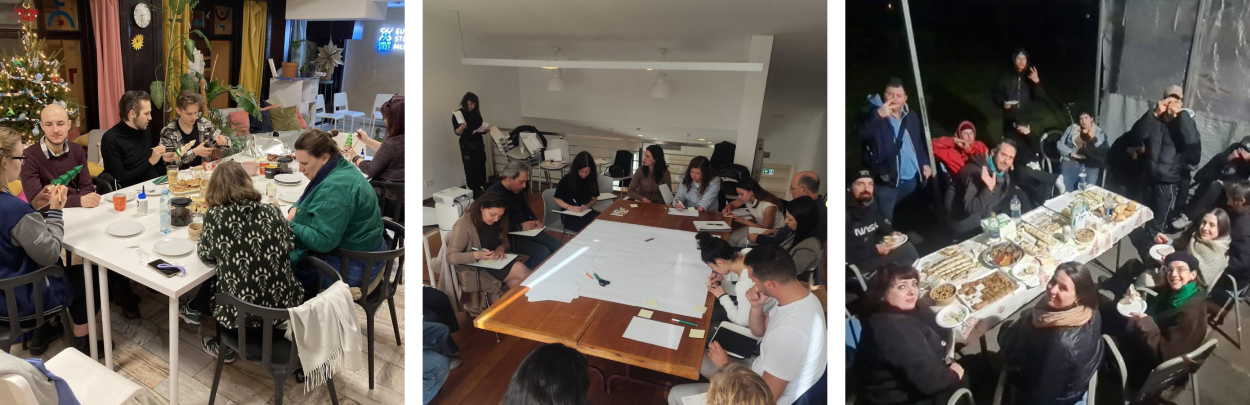
What makes Lublin Youth Spaces different from many other youth centers around Europe is that here the decisions belong to the youth. Ask Przemysław Celiński, one of the coordinators of Youth Space Hej!, and he tells firmly that the Youth group gathering users of the Space make the decisions, not the Ulica Krótka association officially running it. The Lublin Social participation office workers Magdalena Gnyp-Scigocka and Barbara Małyszczak-Piróg affirm this: Each NGO running the Spaces has to commit to the youth designed Youth Space Standards that require youth to lead the spaces. It's not an empty clause, the funding from the City depends on it.
The youth who designed the Standards came up with several other features, too, that ensure great grounds for growing into active citizens. All the Spaces are free, built to be safe and inclusive environments, where young people can spend time together, develop their passions, build relationships and plan together actions for their communities. This allows for diverse youth to learn from each other and grow to take more and more responsibility on their own time.
Youth Space Hej!, the first Space to open in 2022 as one of the early flagship initiatives of the Lublin European Youth Capital 2023 year shows this well. In the beginning Przemysław was just one of the youth coming to the space run then by Barbara as municipality youth worker. Time and space together led the youth of Hej! to found Ulica Krótka. Working closely together with the youth ensured that the municipality could trust the space and base operating funding for the youth, requiring them to find additional funding and resources when needed. As the model of youth led, NGO managed Youth Spaces was well received by youth and youth NGOs alike, the network has expanded fast and has since been recognised as an URBACT Good Practice.
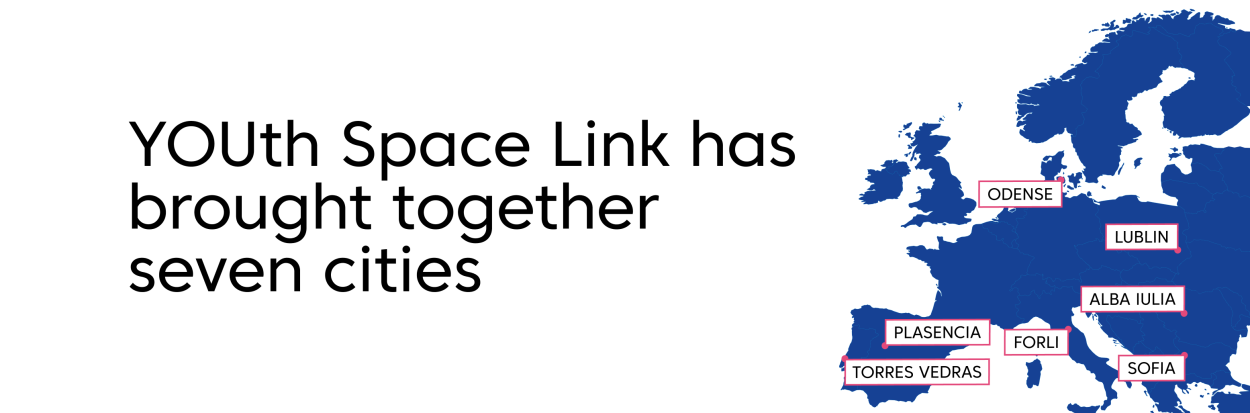
The seven cities of the YOUth Space Link: Alba Iulia in Romania, Forli in Italy, Odense in Denmark, Plasencia in Spain, Sofia in Bulgaria, Torres Vedras in Portugal, led by Lublin.
The cities see developing youth participation and close relationship of NGOs and municipality as parts of the solutions to multiple challenges they face:
- participation gaps of young people - the new generations of municipality citizen & decisionmakers;
- social and structural problems that youth face like loneliness, mental health issues, youth braindrain and unequal access to opportunities;
- limited resources for youth work, scattered projects and communication gaps with youth;
- fragile civil society, with aging members unable to fill the role of third sector as watch-dog of democracy and service provider by the people for the people.
The other cities of the network come to the cooperation from different local contexts. Alba Iulia, Sofia and Torres Vedras are in the process of renovating their first dedicated physical spaces for youth. Forli, Odense and Plasencia already have smaller and bigger networks of youth centers and through the partnership are exploring possibilities to increase the youth participation and cooperation with local NGOs. The cities also represent the wide variety of European urban areas, from the 40 000+ inhabitants small city of Plasencia in western Spain to the 1,23 million inhabitants capital city of Sofia on the European Union Eastern flank. Having equally diverse resources, political connections and other possibilities the network cities provide a great test bed for future development of the Youth Spaces.
Already the partners have recognised four main components of the Lublin model that they want to develop further and adapt to their local realities (deeper insight can be found in Transferability Study):
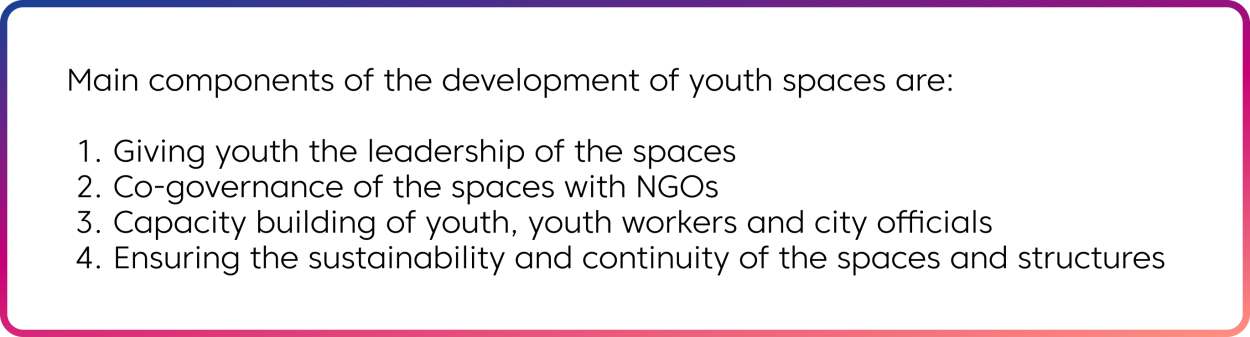
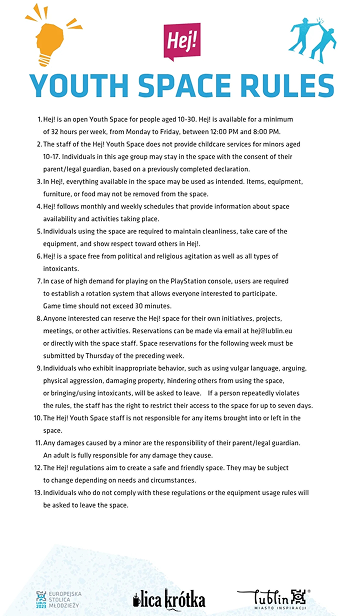
In practice giving leadership to the youth means different things in each Space. Though all the Lublin Spaces have to have a Youth group leading them, how the Youth groups meet and make decisions is up to the youth. In Youth Space Hej! the youth meet on a weekly basis, in Youth Space QLub decisions are made in social media group and many spaces collect youth initiatives for example on toilet mirrors and in informal discussions while cooking or playing games. The diversity of ways to participate includes importantly also freedom just to be. As required by the youth in the Youth Space Standards, all the spaces can have a maximum of 1/3 of their time filled with planned activities. The rest is for the users of the spaces to decide how they want to spend their time.
The Co-governance of the spaces by youth, NGOs and municipalities is also an important part of the model. NGOs as officially recognised civil society entities provide the legal partner for municipalities to provide funding and organise support. At the same time NGOs are more flexible and open for the diverse ways youth can and want to participate in running the spaces. But the real impact comes from close partnership where the initiatives of the youth, the troubles of the NGOs and official needs of the municipality are heard and solved together. In practice this happens in monthly gatherings of young and older workers of the Youth Spaces and municipality representatives with discussions continuing on social media groups between the meetings.
The last two components – capacity building and sustainability – are there to ensure continuity, development and quality. Youth is only a period in human life, meaning new generations of youth are continuously needing spaces as older move into adulthood. Each generation comes with their novel issues, so training youth to lead, youth workers to support and municipality officials to facilitate the services and decisions is an ongoing task. Thanks to the YOUth Spaces Link model neither municipalities or NGOs have to do this on their own, but they can benefit from each other's knowhow and different options for raising resources.
Youth today are growing in a world of more knowhow, resources and opportunities as ever before. It is also a more complex world requiring more skills of cooperation, management of diverse resources and information and facing uncertainty. These skills can't be taught in classrooms as real life decision making always comes with surprises. We must give spaces for youth to lead and learn.