
The workshop was conceived as a moment of joint reflection between the two URBACT networks on a theme that is often taken for granted: Communication. The discussion was framed in a way that challenged the conventional understanding of communication as a purely technical or administrative requirement. Participants were invited to consider communication as a strategic tool capable of generating long-term legacy. Far from being treated as a formal obligation, driven by predefined outputs and indicators, communication was approached as a core component of project design and impact generation.
In this sense a central idea emerged: projects should not be considered as isolated actions, but rather as chapters within a broader, ongoing process. Hence communication is not simply about reporting or promoting what has been or it will be done, but about creating continuity, building meaning over time, and preparing the ground for future developments. Communication, therefore, becomes a way to:
- consolidate and reinterpret results,
- engage stakeholders beyond the lifespan of a project,
- support the transition from experimentation to policy.
Methodological approach
Through a structured yet interactive methodology the workshop was organised around six guiding questions each addressing a different stage of the project experience; starting from the initial innovative action financed under the EUI/UIA initiative and following with the related URBACT network. In each round of questions the reflections from two concrete case studies (Getafe and Halandri) were followed by contributions from participants collected through digital tools and open discussion.
This approach allowed participants to move continuously between experience and reflection, grounding the conversation in real practices while collectively extracting lessons and insights.
Key takeaways
The workshop underlined that communication, when approached strategically, can play a central role in shaping the long-term impact of projects. It can support continuity, strengthen relationships, and facilitate the transition from experimentation to policy. However, this requires a significant shift in perspective, moving communication from being seen as a formal requirement to being recognised as a core component of project design and transformation. In this way communication can contribute to building the legacy that projects aim to achieve.
Main themes emerging from the discussion
1. From dissemination to relationships. One of the most consistent themes throughout the workshop was the need to move beyond a narrow understanding of communication as information dissemination. Effective communication emerged as a relational process, based on interaction, trust, and co-creation. The experience of Halandri clearly illustrated this shift. Communication was not limited to informing citizens about the project, but became a way to build long-term relationships, involving communities in the co-management of project outcomes. Activities ranged from direct, small-scale interactions (such as door-to-door engagement) to larger collective events, all contributing to the same objective: creating a shared sense of ownership.
2. A trajectory from local engagement to wider recognition (and back). Another important insight concerned the trajectory of communication impact. In both case studies, communication started at the local level, focusing on citizens and immediate stakeholders. Over time, however, these efforts contributed to a broader visibility at national, EU and extra EU level: external recognition helped produce effects also at a local level, enhancing the accountability, visibility and political standing of the initiatives. Hence, it can be underlined that recognition came progressively via many diverse routes and helped strengthen and embed the practice locally.
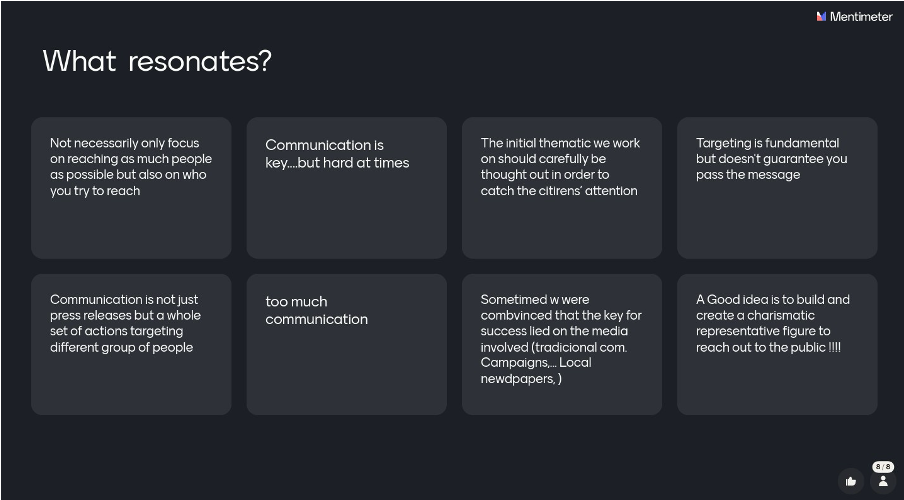
3. The limits of quantitative communication. Participants also reflected critically on the widespread tendency to measure communication in quantitative terms. Many European projects rely on indicators such as the number of posts, events, or publications. However, this approach was widely perceived as insufficient, problematic or lacking in effectiveness. Several participants highlighted the risk of producing “too much communication”, meaning an overload of content that fails to engage audiences. In this sense, the issue is not the quantity itself, but the lack of clarity about why and for whom communication is produced, shifting from a logic of output to a logic of impact and relevance.
4. The importance of targeting and narrative. Closely related to this point is the question of targeting. One of the key lessons emerging from the workshop is that communication is effective only when it is carefully tailored to specific audiences. Different stakeholders require different narratives. The way a project is presented to citizens, for example, cannot be the same as the way it is presented to policymakers or institutional actors. This does not imply inconsistency, but rather the ability to translate the same core message into different languages and perspectives.
5. Communication as a generator of opportunities. An important aspect of the discussion was the recognition that communication can open unexpected doors. Several participants noted that the most valuable outcomes of communication were not necessarily linked to large events or formal actions. Often, impact emerged in informal conversations after a meeting, through follow-up contacts weeks or months later, or, in the form of new collaborations and project opportunities. This highlights the cumulative nature of communication, where effects may appear over time and in unexpected ways.
6. Internal communication and institutional dynamics. The workshop also shed light on an often overlooked dimension: communication within the municipality itself. Municipalities are complex organisations, composed of different departments, roles, and perspectives: in this context, communication plays a role not only externally, but also internally, contributing to raising awareness of new approaches, fostering collaboration across departments and gradually influencing working methods. However, participants acknowledged that structural changes are slow: the most visible impact is often not immediate transformation, but a gradual shift in narratives and attitudes.
7. Engaging with the political dimension. Another significant part of the discussion focused on the relationship with politicians, defined as both a challenge and an opportunity. On the one hand, politicians operate with different logics compared to technical staff: they are generally more focused on results and visibility, and less on processes. On the other hand, they play a crucial role in ensuring that project outcomes are integrated into policies. Effective communication with political actors therefore requires adapting the narrative to their priorities, emphasising tangible results and providing clear, usable messages. At the same time, participants noted that it is essential not to see politicians as impediment, but as part of the ecosystem that needs to be engaged and understood.
8. Adaptability and context awareness. Communication strategies cannot be static; they need to respond to changing contexts, both locally and at the European level. The example of Halandri showed how a project initially focused on cultural heritage was later reframed in relation to broader debates on water management. This did not mean changing the substance of the project, but rather aligning its narrative with emerging policy priorities: reading the context and adjusting communication accordingly was identified as a crucial skill.
9. Learning through experience. Finally, the workshop highlighted that communication is inherently complex and cannot be fully planned in advance. It requires experimentation, adjustment, and learning over time. Participants acknowledged that results are often delayed, not all efforts lead to visible outcomes and success is rarely linear. In this sense, communication should be understood as a long-term, iterative process, rather than a set of predefined actions.