1. The RECUP network and partner cities
1.1 What RECUP is about
REinventing Culture in Urban Places — “RECUP” — is an URBACT Innovation Transfer Network funded by the URBACT programme aimed at exploring how culture and creativity can help cities rebuild connection, strengthen participation and activate urban places. The network brought together six European partners: Újbuda, the XI District of Budapest, as Lead Partner and original good practice city; Dubrovnik Development Agency, “D.U.R.A.” in Croatia; the City of Amersfoort in the Netherlands; Mancomunidad de l’Horta Nord in Spain; the City of Bielsko-Biała in Poland; and Sandyford Business District in Ireland.
RECUP’s journey started with a crucial and challenging question: what happens when cities do not treat culture as something to be “offered” to audiences, and start using it as a way to involve people, activate places and create new relationships?
The network started from the recognition that many European cities face forms of social fragmentation that are not always visible in traditional urban indicators. Loneliness, weak neighbourhood ties, limited cultural participation, lack of belonging, generational divides, but also pressure on heritage spaces, or the absence of shared community places can all affect the quality of urban life. These challenges are different in each city, but they have one common thread: they cannot be addressed only through physical regeneration or isolated cultural events.
For this reason, RECUP worked on culture as a non-conventional form of urban infrastructure. This means not only theatres, festivals and museums, but also everyday opportunities for people to meet, take part, express themselves and recognise places as their own. Over two years, partners worked both at European level and in their own local contexts through a wide range of learning, exchange and experimentation activities. The aim was to develop Integrated Investment Plans — and, for the Lead Partner, a Continuity Plan — in an innovative, integrated and participatory way, translating a new cultural policy paradigm into practice.
1.2 From CUP4Creativity to URBACT ITN RECUP
The starting point of the network was CUP4Creativity, the Urban Innovative Actions project developed by Újbuda. The original project was designed to address loneliness, including digital loneliness, by reactivating social connections through culture, arts and creativity. Its deeper innovation, however, was broader than a single response to loneliness. CUP4Creativity introduced a shift in cultural policy: from citizens as consumers of culture to citizens as producers, co-creators and active participants.
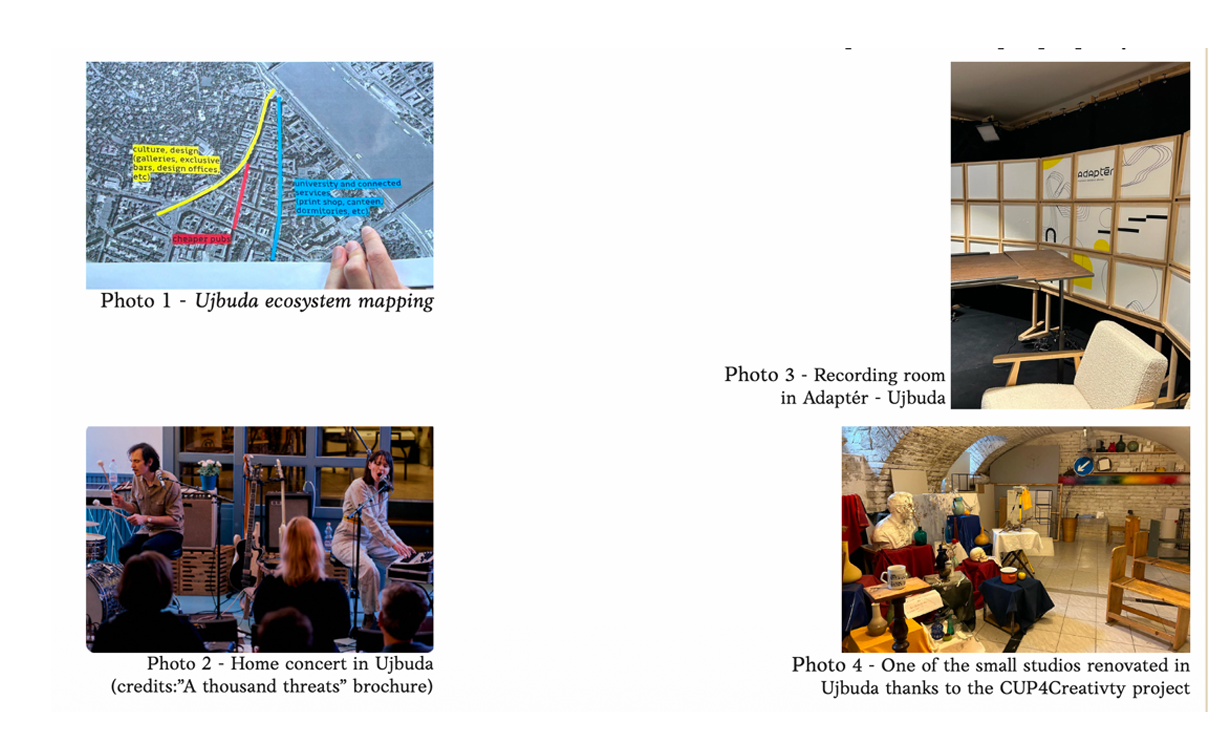
This shift took shape through different elements: the mapping of the cultural and creative ecosystem; support to grassroots cultural initiatives; the INSERT programme; the activation and renovation of cultural and creative spaces; the involvement of businesses and local organisations; and the creation of participatory governance structures such as the Béla Bartók Roundtable. Together, these components showed that cultural policy can become a method for community building.
The URBACT ITN RECUP was created to adapt and transfer this experience to other European contexts. However, the process was not just a “copy-and-paste” exercise. RECUP mostly transferred a set of principles and questions: How can residents become co-producers of cultural life? How can underused or symbolic places be reactivated? How can cultural actions become financially and organisationally sustainable? How can cities measure not only participation numbers, but also belonging, trust and social connection?
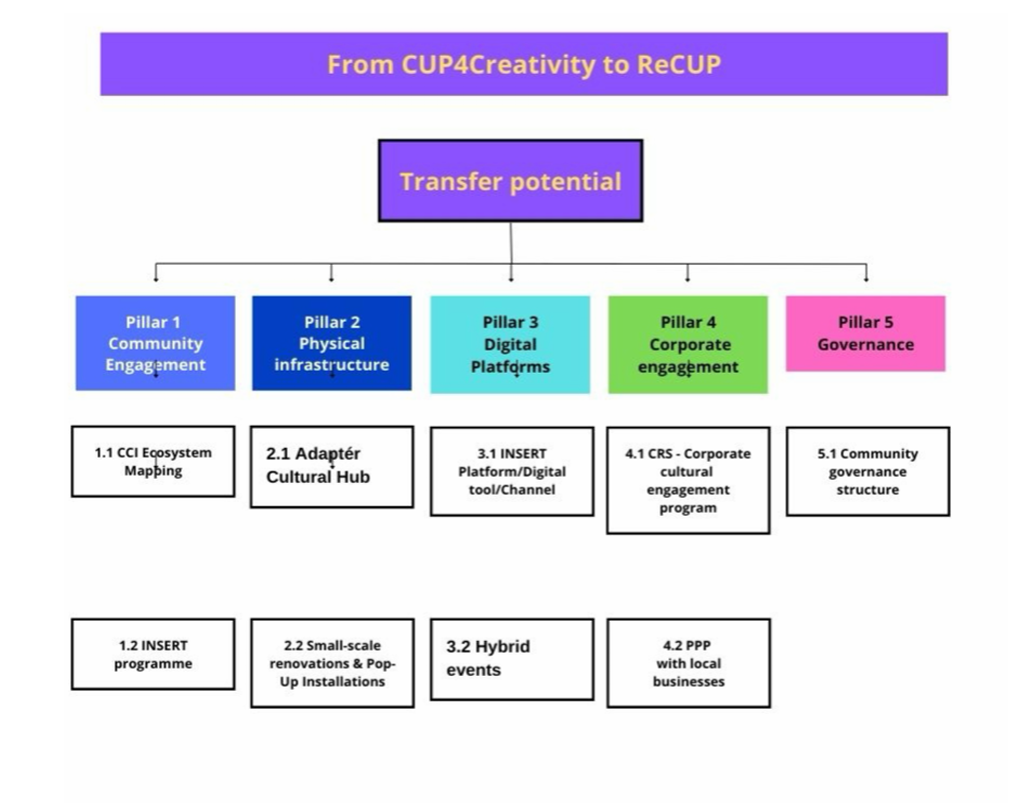
To guide this process, the original practice of CUP4Creativity was translated into five transfer pillars: community engagement and cultural ecosystem mapping; physical infrastructure and creative spaces; digital access and hybrid participation; corporate engagement and public-private cooperation; and community governance and policy frameworks. Each partner adapted these pillars according to its own needs, capacities and local challenges.
In this sense, URBACT ITN RECUP became a collective learning process on how culture can help cities become more reflective: able to listen before acting, test before scaling, and invest in the social conditions that make people feel connected.
1.3 Six partners, six urban challenges
One of the strengths of RECUP lies in the diversity of its partners. The network brought together historic cities, growing urban areas, peri-urban municipalities, a business district, and cities facing very different demographic, social and economic pressures. This diversity made the transfer process more complex, but also richer.
In Újbuda, the challenge was to build on the legacy of CUP4Creativity and explore how its principles could continue beyond the original project, especially in neighbourhoods such as Gazdagrét. The question was how an experimental cultural policy could become a long-term community-building model.
Dubrovnik offered RECUP the chance to work in a city where world-famous heritage coexists with strong pressure from tourism. The challenge was to ensure that cultural life remains connected to residents, not only tourists. A new form of “decentralisation of cultural policy” took place around the former TUP Factory in Gruž.
In Amersfoort, a prosperous and well-connected Dutch city, the network focused on loneliness and social connection. The challenge was not related to a lack of cultural resources, but to the need to connect culture, care, community centres and informal support in ways that can prevent isolation before it becomes a crisis.
A very different case was Mancomunidad de l’Horta Nord, where ten municipalities in the north of Valencia worked on a shared territorial challenge: how to connect fragmented cultural initiatives and build a stronger common identity across different towns. Here, RECUP supported the idea that cultural coordination can become a tool for territorial cohesion.
In Bielsko-Biała, a city with a strong industrial and cultural heritage, the challenge was linked to demographic change, youth engagement and intergenerational connection. Culture, nature, memory and public institutions became key resources for reconnecting people with the city and with each other.
RECUP entered a very different context in Sandyford Business District: a highly diverse and business-oriented urban area where many people live and work side by side without necessarily meeting. The challenge was to transform a business district into a place of community life, using storytelling, corporate engagement and public space activation to bridge parallel societies.
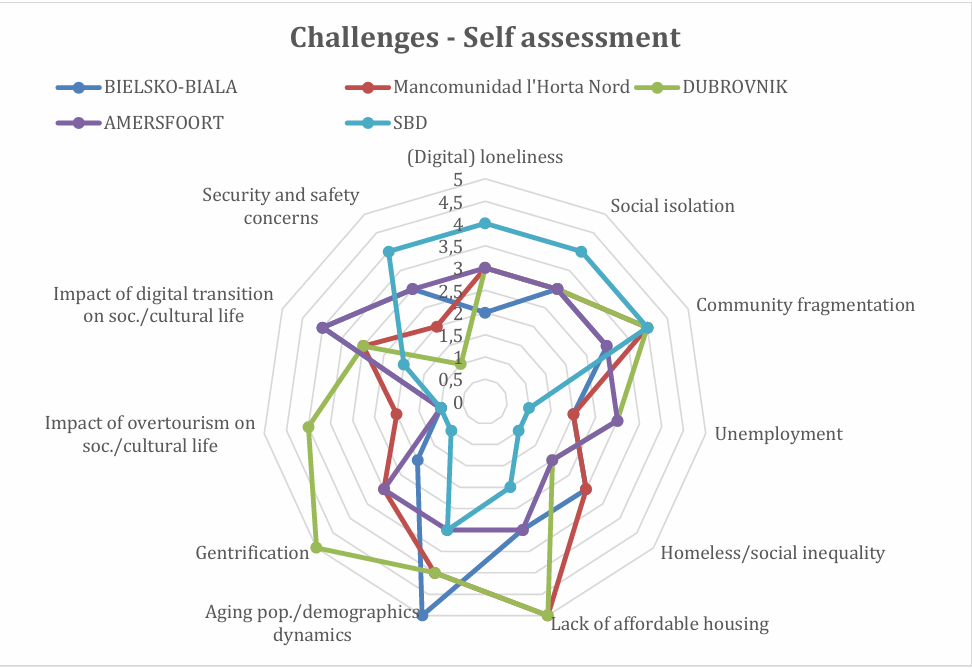
Across these six contexts, RECUP showed that cultural participation is never abstract, but it always takes place somewhere: in a factory, a neighbourhood, a library, a community centre, a business district, a digital platform.
2. Network thematic focus and methodology
2.1 Culture as non-conventional urban infrastructure
Culture is not a luxury, but a tool to improve the well-being of our society. The URBACT ITN RECUP Network was built around a deeper and original understanding of culture as urban policy. Culture was explored as a non-conventional form of urban infrastructure: something that can create the conditions for people to meet, express themselves, build trust and feel part of a place.
This perspective was particularly important because the network worked on challenges that are often difficult to address through traditional urban policies alone. Social isolation, loneliness, weak local identity, fragmented communities and limited participation do not always appear clearly in urban statistics. Yet they strongly affect citizens’ daily lives and can be difficult to observe, understand and address through data alone.
In this sense, RECUP used cultural actions as a way to explore, better understand and respond to these phenomena. A storytelling event, a community platform, a pop-up activity or the temporary activation of a former industrial space can become part of the social infrastructure of a city when it creates repeated opportunities for connection. These actions can help people recognise one another, take part in shared experiences and feel that their presence matters.
This approach also changed the way partners looked at investment. Investing in culture did not only mean investing in events, buildings or cultural programmes. It also meant investing in relationships, governance, trust, participation and the capacity of local ecosystems to continue acting after the end of the project.
2.2 The five transfer pillars
The Transferability Study played a central role in translating the original CUP4Creativity experience into a framework that could be adapted by other cities. Five transfer pillars were identified for the transfer and adaptation process. These pillars helped partners understand which elements of the original practice were relevant to their own context and how they could be adapted.
I Pillar: community engagement and cultural ecosystem mapping. Before designing actions, cities needed to understand who their cultural actors were, which communities were already active, which groups were less visible, and what kinds of relationships already existed among institutions, residents, artists, businesses and local organisations.
II Pillar: physical infrastructure and creative spaces. This included both larger regeneration processes and smaller forms of spatial activation: cultural hubs, former industrial sites, community spaces, pop-ups, temporary uses and underused buildings. The key question was not only how to renovate spaces, but how to activate them in ways that create ownership and social value.
III Pillar: digital access and hybrid participation. The original CUP4Creativity project included a digital component, but RECUP partners treated digital tools with a practical and critical perspective. Digital platforms, online channels and hybrid formats were considered useful only when they responded to real community needs: improving access, supporting coordination, widening participation or connecting fragmented territories.
IV Pillar: corporate engagement and public-private cooperation. This was particularly important for exploring sustainability beyond short-term public grants. Partners reflected on how businesses could contribute not only through funding, but also through spaces, skills, communication capacity, volunteering, sponsorship or long-term partnerships.
V Pillar: community governance and policy frameworks. RECUP placed strong emphasis on participatory governance through URBACT Local Groups and other local structures. The objective was to ensure that Investment Plans become shared commitments supported by local stakeholders.
Together, these five pillars provided the methodological backbone of the network. They allowed each partner to build a tailored pathway while remaining connected to a common transfer logic.
2.3 The RECUP journey: understand, adapt, reuse
The RECUP methodology followed the URBACT Innovation Transfer Network logic: Understand, Adapt and Reuse. These three phases structured the network journey and helped partners move gradually from inspiration to implementation.
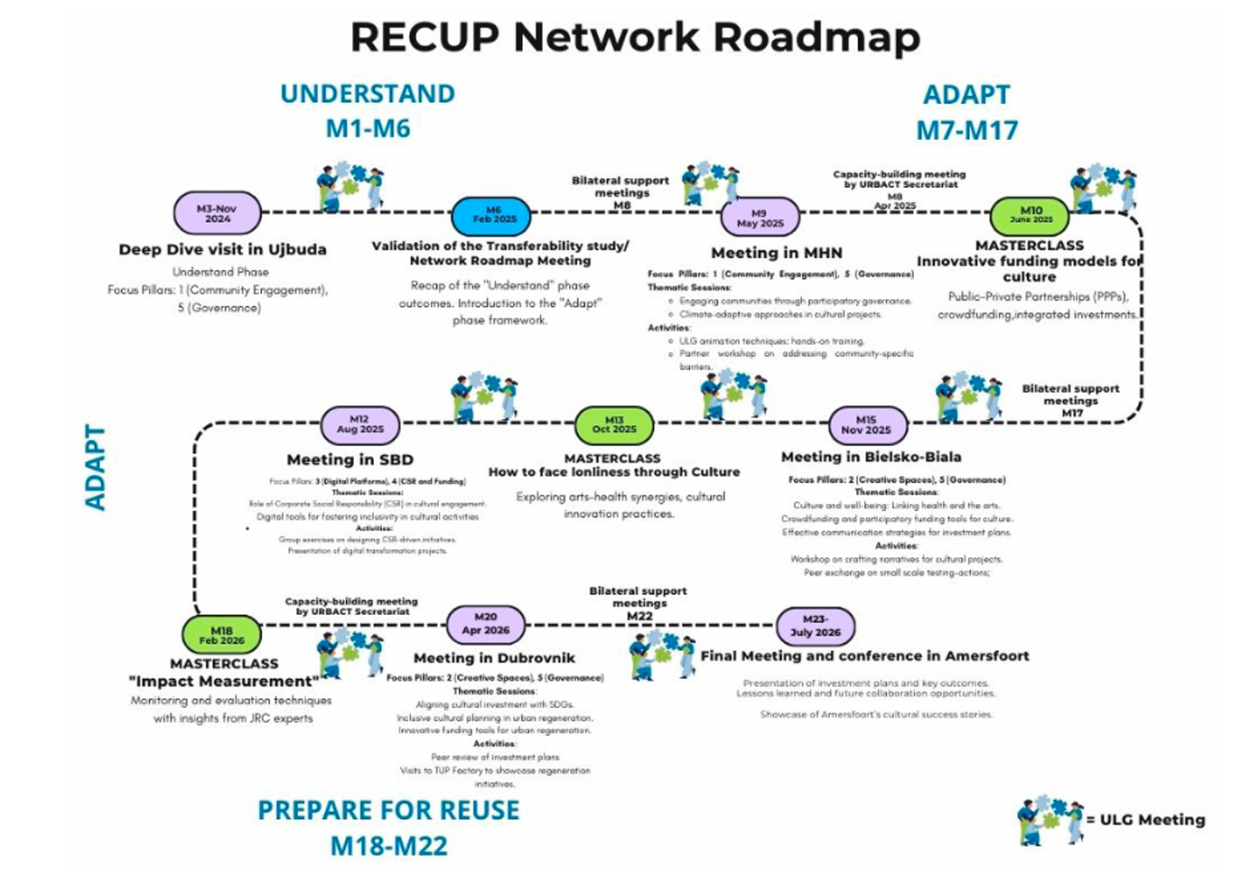
The Understand phase focused on diagnosis. Partners explored the original good practice in Újbuda, analysed their own local contexts, built their own URBACT Local Group and identified the specific challenges that RECUP could help address. This phase was essential because transfer begins with understanding: what the original practice achieved, what conditions made it possible, and what needs to change when it is applied in a different place.
The Adapt phase was the most experimental part of the network. Partners worked with their URBACT Local Groups to translate RECUP principles into local testing actions. These actions were intentionally small-scale, but strategically important. They allowed cities to test assumptions, involve stakeholders, observe participation, identify barriers and generate evidence for future investment. The Adapt phase also included intensive work on budgeting, funding, roadmap building and storytelling, helping partners move from ideas to more structured proposals.
The Reuse phase focused on consolidation. The lessons emerging from testing actions, peer reviews, masterclasses and local discussions were progressively integrated into the Integrated Investment Plans and the Lead Partner’s Continuity Plan. During this phase, partners were invited to stress-test their plans: Are the actions clear? Are target groups well defined? Is the governance credible? Is the funding strategy realistic? Can the expected impact be measured? Can the plan be communicated in a way that mobilises support?
Across these phases, RECUP helped cities take a step back before investing: partners were encouraged to diagnose, listen, test, measure and adapt.
2.4 The Masterclasses
As part of the RECUP capacity-building journey, three thematic Masterclasses supported partners in moving from experimentation to more mature and implementable Integrated Investment Plans. Each Masterclass addressed one of the key conditions needed to turn cultural actions into long-term urban policy: funding, social relevance and impact measurement.
“Grants and Beyond: Rethinking how we fund culture and creativity in cities”. This Masterclass helped partners reflect on the financial sustainability of culture-led urban initiatives. The key message was that cultural projects cannot rely only on short-term grants or isolated public subsidies. Cities need to build more diversified and resilient funding ecosystems, combining municipal resources, EU programmes, private contributions, community assets, in-kind support and impact-oriented approaches. The session also showed that funding culture increasingly means demonstrating its wider social value: culture as a contribution to inclusion, well-being, heritage activation and local development.
The second Masterclass “Loneliness: Exploring Cultural and Urban Solutions,” deepened the network’s understanding of loneliness and social isolation as urban challenges. Partners explored how loneliness is not only an individual experience, but also a phenomenon influenced by urban conditions: lack of accessible public spaces, weak community infrastructure, fragmented neighbourhoods, limited opportunities for meaningful encounters and barriers to participation. The key message was that culture cannot “solve” loneliness directly, but it can create situations where people feel invited, expected and recognised. Addressing loneliness requires integrated strategies, combining cultural initiatives, community engagement and inclusive urban policies.
The third Masterclass, dedicated to monitoring and evaluation of cultural impact, helped partners reflect on how to measure the effects of their actions beyond simple output indicators. Counting participants, events or spaces activated is important, but it does not fully capture the changes RECUP aims to generate: stronger belonging, trust, community ownership, new social relationships, inclusion of less engaged groups and long-term behavioural change. The key message was that measuring culture means deciding what kind of change matters. For this reason, partners were encouraged to combine quantitative indicators with qualitative evidence, stories, observations and feedback from stakeholders.
Together, the three Masterclasses helped RECUP cities take a step back before investing: to understand how culture can be funded, why it matters socially, and how its impact can be made visible.
2.5 Tools and methods used across the network
To support this process, in the URBACT ITN RECUP Network the Lead expert and the partners combined transnational exchange with a set of practical tools. They helped partners structure reflection, improve the quality of their actions and prepare more credible Investment Plans.
The Transferability Study provided the initial analytical framework. It assessed the original good practice, analysed the profile of each partner and identified the five transfer pillars. It gave the network a common language and helped partners position their local challenges within a shared methodology.
ULG mapping and animation supported the participatory dimension of the network. Partners used their URBACT Local Groups to involve municipal departments, cultural actors, community organisations, residents, businesses, knowledge institutions and other stakeholders. The ULGs were the main spaces where transfer was translated into local ownership.
Testing Action design helped partners move from broad ambitions to concrete experiments. Each testing action was used to prototype one element of the future Investment Plan, whether related to community activation, digital coordination, cultural space activation, storytelling, youth engagement or loneliness prevention.
The Costing Estimation Challenge helped partners give ideas a financial dimension. Cities were invited to identify real cost components, distinguish between different types of costs and reflect on what would change if a small action were scaled up.
The Funding Matrix supported partners in thinking about the right financial mix. Instead of relying only on municipal budgets or single grants, cities explored how public funding, EU programmes, private contributions, sponsorship, in-kind resources and community assets could be combined.
The Climber, or backcasting technique, helped partners build their roadmap by starting from the final objective and working backwards. This made it easier to translate long-term ambitions into milestones, responsibilities and decision points.
The “How to make things worse?” exercise used a reverse logic. By imagining how an Investment Plan could fail, partners identified risks, blind spots and weaknesses before they became implementation problems.
Personas Cards and the Peer Review Scorecard were used to strengthen the quality of the Integrated Investment Plans. The personas invited partners to read their plans through the eyes of different stakeholders, such as a municipal finance officer, a cultural worker, a community activist, a vulnerable resident or a journalist. The scorecard translated this qualitative reflection into a structured review based on criteria such as problem clarity, feasibility, governance, inclusion, financial sustainability and impact measurement.
The Funding Clinic provided targeted support to partners on potential funding opportunities and scaling strategies. It helped cities identify which actions could be strengthened through additional resources and what conditions would make them more fundable.
The Cultural Impact Monitoring Grid helped partners reflect on what they already measure, what they would like to measure and what remains difficult to capture. It encouraged them to combine quantitative indicators with qualitative evidence, especially for outcomes such as belonging, trust, community ownership and social connection.
The IIP Quality Check Lab helped partners stress-test their Investment Plans through key implementation lenses: scalability, sustainability, integration and transferability. It supported the transition from promising ideas to more mature and implementable proposals.
Finally, storytelling and public speaking exercises helped partners communicate their plans more effectively. RECUP treated communication not as a final add-on, but as part of implementation. A plan must be technically credible, but it also needs to be understandable, memorable and able to mobilise people around a shared direction.
Together, these tools supported the main methodological lesson of RECUP: cities should not invest only after deciding what they want to do, but after understanding why it matters, who needs to be involved, what has been tested, what evidence has been collected and how the action can be sustained over time.
3. From testing actions to Integrated Investment Plans
3.1 Testing actions as evidence labs
A central step in the RECUP journey was the development of local Testing Actions. They were used as practical “evidence labs”: limited, concrete experiments through which partners could test assumptions and hypotheses, involve stakeholders, observe and collect learning.
This approach was particularly important because RECUP worked on complex and often intangible challenges, such as loneliness or fragmented communities, that cannot be fully understood from behind a desk. They need to be explored through action.
Testing Actions allowed partners to move from general intentions to real situations. Who comes when an activity is proposed? Who does not come? Which spaces feel accessible? What kind of communication reaches people? What is needed to scale up an idea? By asking these questions through practice, partners were able to transform small-scale experimentation into strategic learning.
3.2 What partners tested locally
Each RECUP partner designed a Testing Action responding to its own local challenge, while remaining connected to the common transfer logic of the network. The formats were different, but all actions explored how culture and creativity can become tools for participation, connection and place activation.
In Újbuda, the Advent event series tested how a dense and diverse programme of local activities could engage different target groups in Gazdagrét, from children and families to seniors, volunteers and local partners. The action helped explore how the principles of CUP4Creativity could be continued and adapted in another neighbourhood of the district.
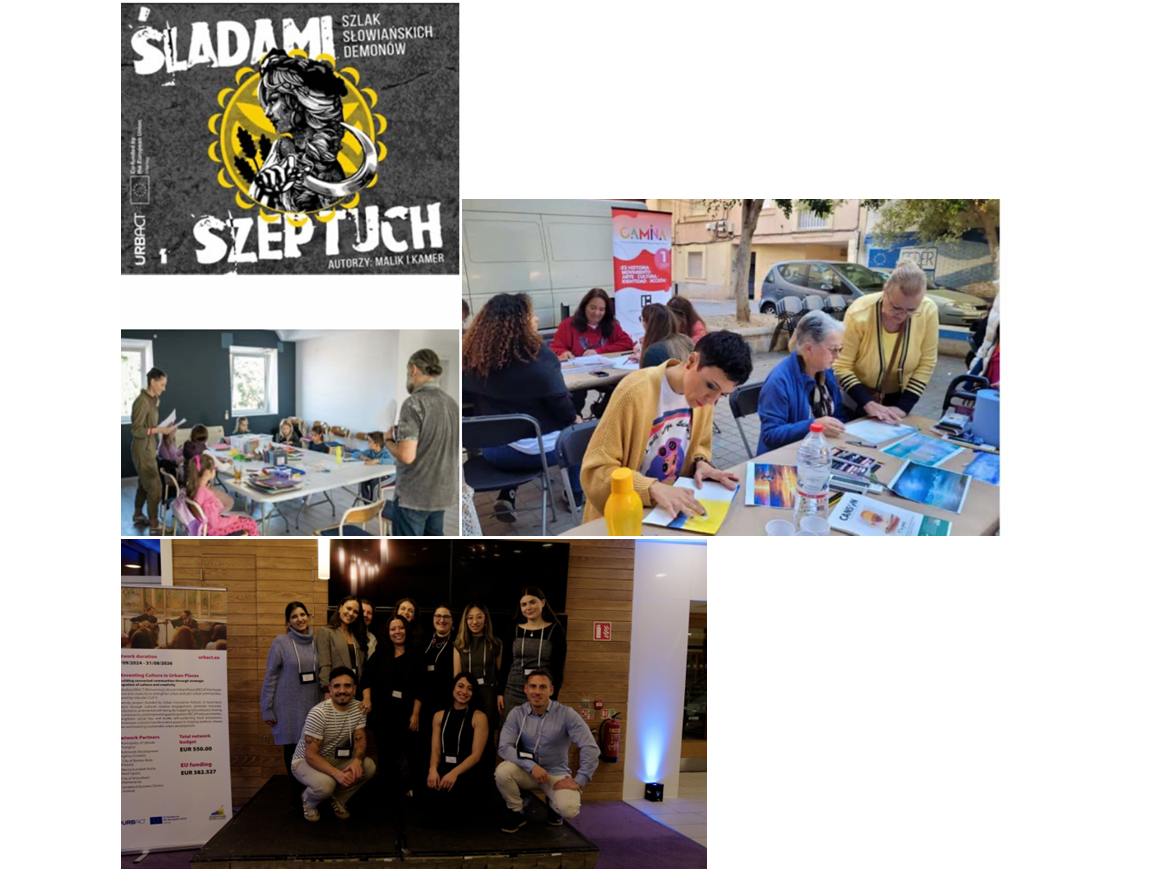
In Dubrovnik, the Testing Action focused on the former TUP Factory. Through cultural and creative activities connected to the “Grad od riječi” festival, the city tested how this former industrial site could become a community cultural hub for residents, beyond the tourism-oriented cultural offer of the historic centre.
In Amersfoort, the Maatjesfoort buddy model tested a community-based response to loneliness. By connecting vulnerable residents with local volunteers through informal weekly contacts and small shared activities, the city explored how culture, care and community support can work together as early prevention.
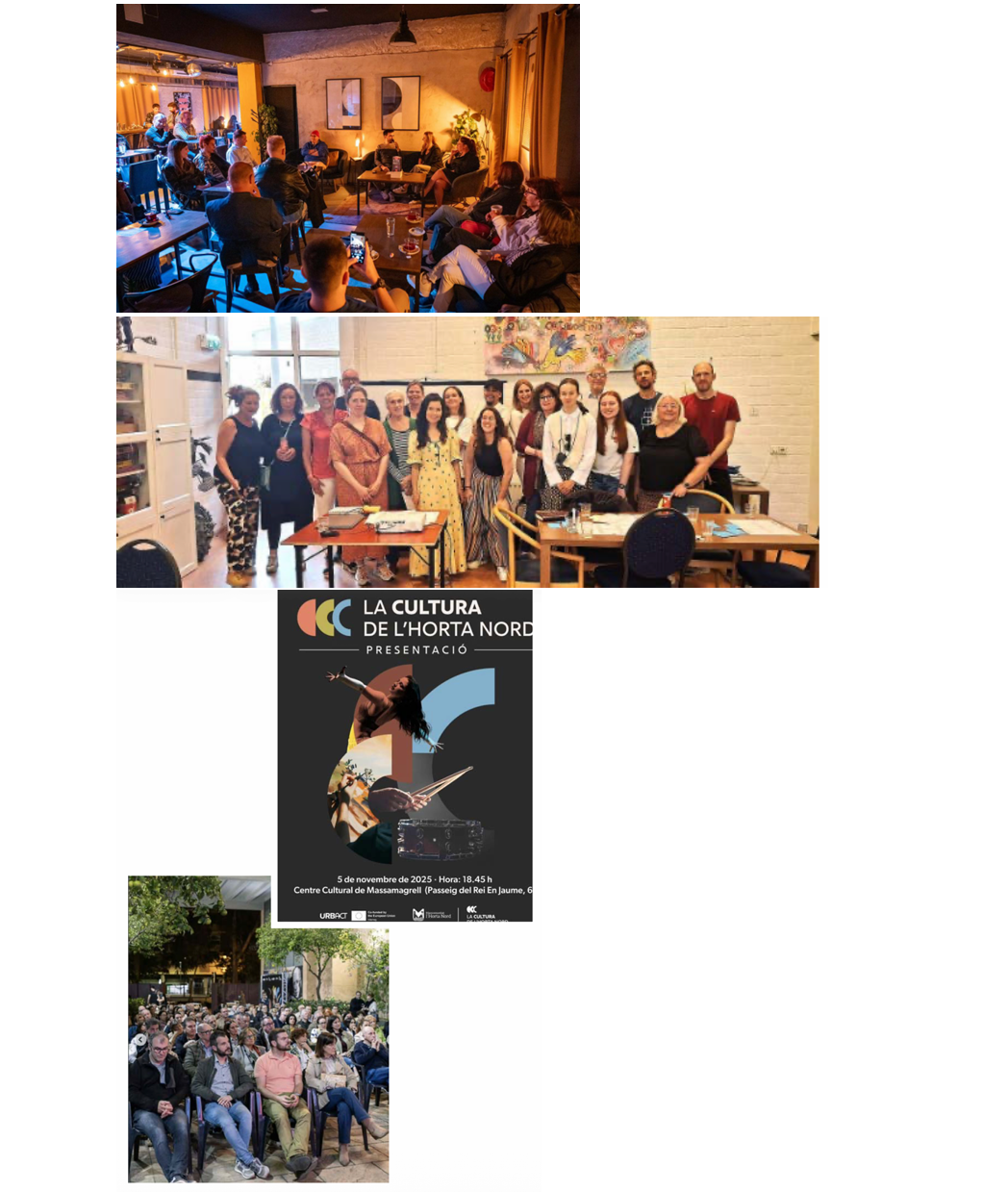
In Mancomunidad de l’Horta Nord, partners tested “Cultura Horta Nord”, a shared digital platform and communication channel designed to make cultural activities across the ten municipalities more visible and better coordinated. The action responded to the need to overcome fragmentation and build a stronger shared cultural identity.
In Bielsko-Biała, the Testing Action combined nature, memory, youth engagement and digital storytelling. Through the Loneliness Tree and a digital trail connected to local legends and street art practices, the city tested how creative formats can reconnect young people with places, heritage and public space.
In Sandyford Business District, the storytelling action tested whether personal stories could help reveal the experiences of a highly diverse population and bridge “parallel societies” living and working side by side. Through preparatory workshops and a public storytelling event, the action explored belonging, identity and community in a business district context.
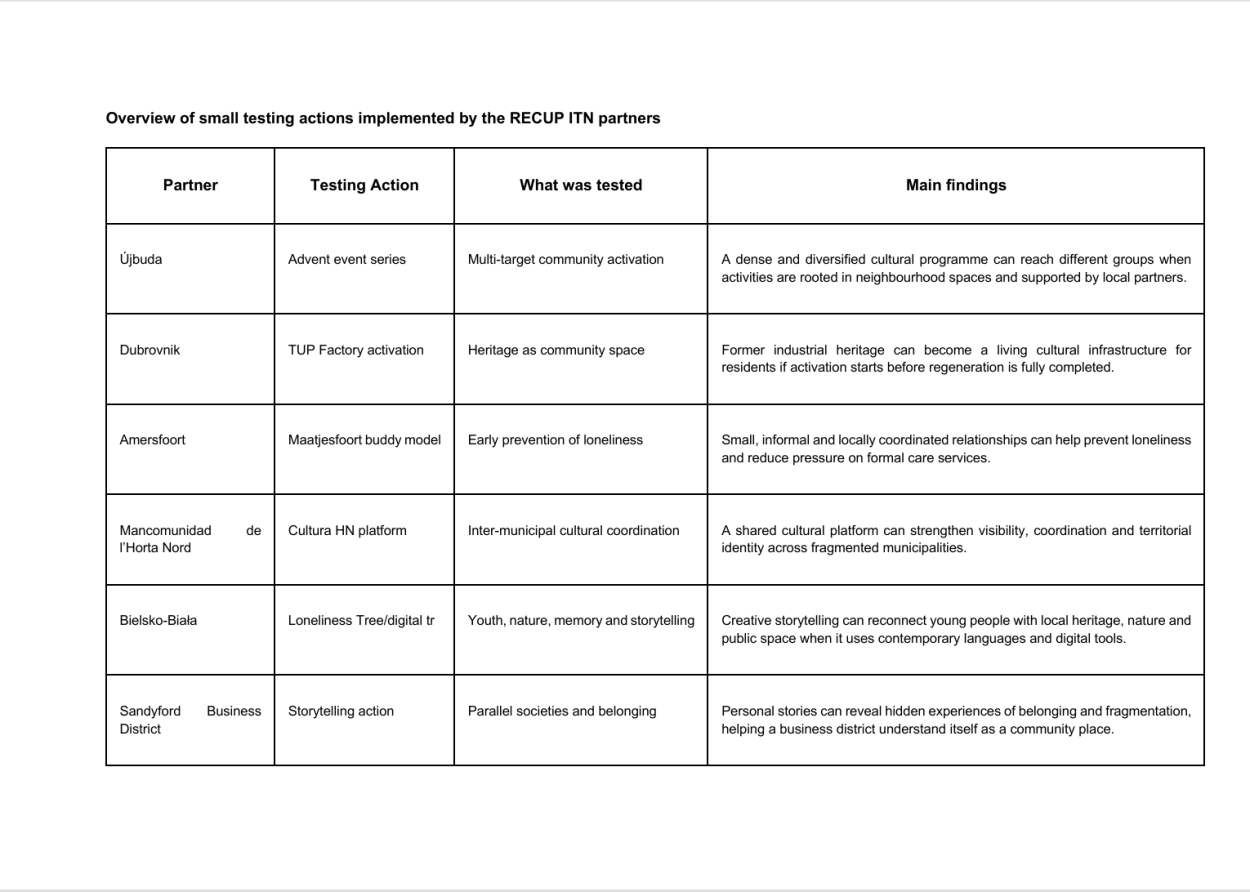
3.3 What the testing actions revealed
Across the network, the Testing Actions revealed several common lessons.
First, partners confirmed that small cultural actions can generate significant knowledge when they are well designed. A one-day event, a workshop, a digital platform, a storytelling session or a buddy activity can reveal needs, barriers and opportunities that would otherwise remain invisible. Testing helped cities understand not only whether people participate, but also how they participate, what makes them feel welcome, and what kind of relationships can emerge.
Second, the actions showed that participation requires more than an invitation. People engage when activities are meaningful, accessible and connected to their daily lives. In several cases, the success of the Testing Actions depended on trusted intermediaries: community centres, cultural workers, volunteers, local organisations, schools, artists, or municipal staff able to reach specific groups.
Third, the testing process highlighted the importance of places. Former factories, libraries, community centres, public spaces, neighbourhood venues and even digital platforms can become spaces of connection when they are activated through clear purposes and inclusive programming. The value of a place does not come only from its physical qualities, but from the relationships and memories that can be built around it.
Fourth, partners learnt that cultural experimentation can support governance. Testing Actions brought stakeholders together around concrete activities, making collaboration more practical and visible. In this sense, they helped strengthen URBACT Local Groups and created a bridge between discussion and implementation.
Finally, testing made the limits of each idea more visible. Partners could better understand what would be needed to scale up an action: staff time, funding, communication, partnerships, monitoring, political support and administrative coordination. This was essential for transforming promising experiments into more credible investment proposals.
3.4 How testing shaped the IIPs
The main purpose of the Testing Actions was to inform the Integrated Investment Plans and the Continuity Plan. They helped partners move from broad ambitions to more concrete, realistic and locally grounded actions.
In practical terms, testing shaped the IIPs in four main ways.
First, it helped refine the problem definition. Through direct experimentation, partners could better understand which target groups were most relevant, which barriers were most important and which local needs were more urgent.
Second, it helped clarify the intervention logic. Testing Actions allowed partners to see which activities could realistically contribute to wider objectives, such as reducing isolation, strengthening belonging, activating spaces, improving cultural coordination or engaging businesses and residents.
Third, it strengthened local ownership. By involving stakeholders in concrete activities, the Testing Actions helped transform the IIPs from technical documents into shared processes. The plans became more credible because they were connected to people, places and partnerships already mobilised during the project.
Fourth, testing supported implementation planning. Partners could identify costs, risks, funding needs, governance arrangements and monitoring questions before finalising their plans. This made the IIPs more mature and more closely connected to real implementation conditions.
The Testing Actions therefore acted as a “bridge between inspiration and investment”. They made it possible to move from “this could work” to “this is what we have tested, this is what we have learnt, and this is how we want to continue”.
3.5 Overview of the six Investment and Continuity Plans
In the framework of the RECUP journey five Integrated Investment Plans have been developed by the partner cities and organisations, together with the Continuity Plan prepared by Újbuda as Lead Partner and original good practice city. These plans are the main legacy of the network. They translate two years of exchange, testing, peer review, local engagement and capacity-building into future-oriented strategies for implementation.
Taken together, the plans show a mature and diverse adaptation of the original Újbuda innovation. CUP4Creativity has not been replicated as a fixed model. Instead, each partner has translated the RECUP approach into its own local reality, addressing different but connected challenges.
A common achievement across the plans is the way the partners position culture as more than an events programme. Culture is increasingly understood as a tool for social change: from community-building to local democracy and territorial identity. This represents one of the strongest outcomes of the network. In this perspective, RECUP helped partners move away from a narrow understanding of cultural policy and towards a broader idea of culture as social and urban infrastructure.
Another shared feature is the attention given to “soft infrastructure”. Many plans recognise that social cohesion does not depend only on physical spaces or cultural programmes, but also on facilitation, animation, trust-building, skills, volunteer engagement, and the capacity to make participation easier. This is particularly important for actions addressing loneliness and social fragmentation, where the quality of relationships often matters as much as the activity itself.
For Újbuda, the Continuity Plan focuses on consolidating and adapting the legacy of CUP4Creativity, particularly in Gazdagrét. The plan explores how community activation, local cultural programming and participatory governance can continue beyond the original UIA experience and inform future neighbourhood-based cultural policies.
In the case of Dubrovnik, the Integrated Investment Plan is closely connected to the long-term activation of the TUP Factory and the wider cultural ecosystem of Gruž. The plan positions the former industrial site as a resident-oriented cultural infrastructure and as a way to rebalance cultural life in a city strongly affected by tourism pressure.
The plan of the city of Amersfoort builds on the relationship between cultural participation, community centres and loneliness prevention. It aims to strengthen culture as a bridge between care, well-being, informal support and community connection, with particular attention to early prevention and low-threshold participation.
For Mancomunidad de l’Horta Nord, the plan focuses on inter-municipal cultural coordination and shared territorial identity. The Cultura Horta Nord platform and the mapping of cultural actors represent a first step towards a more integrated cultural strategy across the ten municipalities.
In Poland, the plan of the city of Bielsko-Biała connects culture, youth engagement, nature, memory and public institutions. It builds on the city’s strong cultural ecosystem and its role as Polish Capital of Culture 2026 to strengthen participation, intergenerational connection and the relationship between residents and places.
In the case of the Sandyford Business District, the plan explores how a business district can become more than a place of work and residence. Through storytelling, public space activation and corporate engagement, it aims to support belonging and community life in a highly diverse urban environment.
At the same time, the review of the plans conducted by the Lead expert and the Ad Hoc Expert Sally Kneeshaw also highlighted areas for further strengthening and common “challenges”.
In some cases, a possible improvement is to make more explicit how participation will continue during implementation, and in particular the role of ULG members and stakeholders in influencing future governance, as well as political and cross-departmental ownership. Also, corporate and business engagement remains a field with further potential, especially in relation to sponsorship, corporate social responsibility and in-kind contributions.
Not all plans are fully ready to be implemented in all the actions foreseen, but they are based on scalable, modular and pilot-based approaches. For this reason, the Integrated Investment Plans and the Continuity Plan should not be understood as final documents in a static sense. They are living implementation tools. Their value lies in the learning process they capture: what was tested, what was adapted, which partnerships were mobilised, which forms of participation emerged, and which conditions are needed to move from cultural experimentation to long-term urban change.
Together, the six plans show that RECUP did not produce a single model. It produced six locally grounded pathways, each adapting the same core idea: culture can help cities become more reflective, more participatory and more capable of investing in the relationships that make urban places live.
4. Common challenges in the journey
As highlighted in the RECUP journey, cities are full of ideas, cultural energy and committed local actors. In all partner contexts, it was possible to imagine cultural activities capable of engaging residents, activating places and opening new conversations around loneliness, belonging and participation.
However, the most challenging part of the journey was not imagining cultural actions, but making them implementable, fundable, measurable and collectively owned. This section presents the main challenges that emerged across the network. They should not be considered as failures, but as learning points. They helped partners move from inspiration to more realistic and mature Integrated Investment Plans and Continuity Plans.
4.1 From inspiration to implementation: a reality check
Transferring a good practice is inspiring at the beginning: partners can see what worked elsewhere, discover new ideas and imagine how similar approaches could be adapted locally. In RECUP, Újbuda’s experience with CUP4Creativity offered a strong source of inspiration, from community engagement and cultural ecosystem mapping to micro-grants, creative spaces, public-private cooperation and participatory governance. The original good practice was funded by the previous UIA project and Ujbuda had more than 4 million euros to realise it. The same amount of money wasn't available for RECUP Partners. So the initial challenge was turning inspiration into transferable and implementable actions. Across the network, partners had to move from broad ambitions to concrete intervention logics: who will do what, with which resources, in which place, with which partners, for which target groups, and with what expected results. Testing actions helped make this transition more realistic, allowing partners to understand what worked in practice, what needed adjustment and which conditions were necessary for scaling up.
4.2 Keeping ULG engagement alive
URBACT Local Groups were one of the main engines of the RECUP process, helping partners understand local needs, design testing actions and shape their Integrated Investment Plans. At the same time, keeping ULG engagement alive over time was a common challenge. Participation is not automatic: people may be interested at the beginning, but their involvement can weaken if meetings are too abstract or if they do not clearly understand their role. RECUP confirmed that stakeholder engagement requires a set of skills and actions such as continuous care, good facilitation and visible feedback loops. This is especially important when working on loneliness and community ownership, which require trust and continuity.
4.3 Measuring intangible outcomes
Another major challenge concerned impact measurement. RECUP worked on outcomes that are essential for urban life but difficult to measure such as belonging, intergenerational dialogue or the capacity of people to feel part of a place. Counting participants or events is useful, but it does not fully capture what the network was trying to change. A large event may generate limited connection, while a small workshop may create meaningful relationships and long-term engagement. For this reason, partners were encouraged to combine quantitative and qualitative evidence, using numbers together with stories, observations, feedback and stakeholder reflections. RECUP helped partners understand that measuring cultural impact is not only a technical exercise: it is also a strategic choice about what kind of change a city considers important.
4.4 Funding beyond short-term grants
Funding was a recurring challenge across the network. Cultural and community-based initiatives often depend on short-term grants, temporary projects or limited municipal resources, which makes continuity difficult, especially when the aim is to build trust, relationships and ownership over time. Through the network activities and the Masterclass “Grants and Beyond,” RECUP partners reflected on the need to move towards more diversified funding ecosystems, combining municipal budgets, EU programmes, regional or national funds, private contributions, corporate social responsibility, in-kind resources and community assets. The real challenge here is to design actions that are relevant and able to demonstrate their social value. Funding therefore needs to be considered from the beginning of the planning process, together with governance, implementation and monitoring.
4.5 Balancing ambition and feasibility
RECUP partners were encouraged to be ambitious and rethink the role of culture in urban life. At the same time, ambition had to be balanced with feasibility. An Integrated Investment Plan needs to inspire, but it also needs to be implemented. If it is too broad, it risks remaining a vision document, but if it is too cautious, it may fail to generate real change. Tools such as the Costing Estimation Challenge, the Funding Matrix, the Climber technique, the Peer Review Scorecard helped partners connect ideas with budgets, timelines, responsibilities and risks. The key message was clear: feasibility is needed to give ambition to the conditions to become real.
4.6 Securing political and administrative ownership
RECUP showed that cultural innovation needs ownership at different levels. Community enthusiasm is essential, but for actions to continue after the project, they need political support and administrative capacity. In several contexts, the challenge was to connect different municipal departments, such as culture, social policy, urban regeneration, health, economic development or communication, while also involving actors beyond the municipality. The Integrated Investment Plans and the Continuity Plan were therefore developed as tools for alignment between political vision, administrative implementation and community participation.
5. Added value of the URBACT transnational network
The added value of URBACT was to enable both exchange and disciplined reflection. RECUP gave partners the time and tools to look at their local challenges from a different perspective. Cities did present what they were doing, but they also listened, tested, compared and improved before investing. This made the network become a shared learning environment where cultural policies could be questioned, adapted and made more implementable.
5.1 Addressing ordinary challenges with extra-ordinary tools
The challenges addressed by URBACT ITN RECUP were ordinary in the sense that many European cities face them every day: loneliness, fragmented communities, underused spaces, funding constraints and difficulties in sustaining local engagement. What URBACT added was an extra-ordinary way of working on them. Through transnational meetings, URBACT Local Groups, testing actions, peer reviews, masterclasses and practical tools, partners were able to move beyond routine responses. The network created a space where familiar problems could be reframed, explored and addressed with more creativity, structure and courage.
5.2 Learning from peers: we are all in the same boat
One of the strongest lessons of RECUP was that cities are different, but their questions are often similar. A business district in Ireland, a heritage city in Croatia, a Dutch city working on loneliness, they all faced different local realities. Yet they all had to deal with participation, trust, ownership, funding and implementation. Peer learning helped partners realise that they were not alone. Seeing how others struggled, tested and adapted created confidence. It also made learning more practical: partners did not receive abstract recommendations, but concrete examples from cities facing comparable tensions.
5.3 Developing capacities, not isolated projects
RECUP’s value was not limited to the testing actions or the final plans. The network also strengthened the capacity of partners to work differently. Partners developed skills, for instance in stakeholder engagement, cultural ecosystem mapping, testing action design, funding strategies, monitoring, storytelling. These capacities will remain useful beyond the end of the project. In this sense, RECUP helped cities build a more mature way of designing culture-led urban policies: more integrated, participatory, evidence-based and oriented towards implementation.
5.4 Improving the quality of the Investment Plans
The Integrated Investment Plans and the Continuity Plan were shaped through repeated moments of exchange, review and refinement. Peer review sessions, personas exercises, scorecards, funding clinics, monitoring tools and quality checks helped partners test the clarity, feasibility and sustainability of their plans. This process made the plans stronger. It helped partners clarify problems, target groups, actions, governance, risks, budgets and expected impacts. URBACT’s added value was therefore also methodological: it created a structured process through which plans could become more realistic, more coherent and more strongly connected to local ownership.
5.5 Creating a community of reflective cities
Perhaps the most important legacy of RECUP is the creation of a small community of reflective cities. Reflective cities are not cities that already have all the answers. They are cities willing to ask better questions. Who is missing from cultural life? Which spaces create connections? What does participation really mean? What should be measured? Who should own the process? What needs to be tested before scaling up? Through RECUP, partners learned to slow down before investing, to observe what happens in practice, to listen to stakeholders, and to adapt their plans accordingly. This is the deeper value of the URBACT transnational network: helping cities become more capable of learning before acting, and more confident in turning learning into change.
6. Voices from the stakeholders
Stories of connection, participation and change
RECUP took place not only between municipalities and experts, but it was also experienced by residents, cultural workers, community organisations, artists and people who used culture to open new spaces of connection. Their voices help explain what changed, what was difficult and why these actions matter.
These stories can also be read as qualitative evidence.
6.1 Pataky Szabolcs, Újbuda
The resident who gave the street back to the community
Pataky Szabolcs lives in Sasad, a green residential area of Újbuda. Over the years, he saw his neighbourhood change. Streets that had once felt safe for children became increasingly dominated by traffic and parked cars. His response was simple: to create the Szedersor Street Festival and Garage Sale, a local event designed to give the street back to children, neighbours and community life, at least for one day.
Through RECUP, this local initiative became part of a wider European conversation on loneliness and urban places. Pataky was surprised that such a small, resident-led action could be noticed within an international project. For him, this was one of the strongest lessons of the process: small things can truly move mountains.
His experience also changed the way he understood loneliness. At the festival, he spoke with people who described how alone they felt in everyday life, and how important it was to have a reason to come out, meet others and feel part of something. Through RECUP, he realised that loneliness is not only an individual issue, but a broader urban and social challenge.
Key message for other cities: streets can become community spaces when they are designed for people too.
6.2 Petra Marčinko, Dubrovnik
The cultural worker linking heritage, participation and urban policy
Petra Marčinko works at Art Workshop Lazareti in Dubrovnik, at the intersection of culture, urban development and participatory governance. Her professional background in sociology and cultural anthropology allowed her to bring a strongly analytical perspective to the RECUP process. She contributed to ULG meetings, stakeholder mapping and discussions on how cultural infrastructure can support participation, inclusion and social cohesion.
For Petra, Dubrovnik’s challenge cannot be separated from the pressure of tourism. The city is constantly balancing between being a destination and being a city. Cultural and social 7 activities are often pushed towards destination branding, while the needs of residents, young cultural professionals and local communities risk becoming less visible.
In her perspective, one potentially impactful measure in Dubrovnik would be building a database of private-sector actors willing to collaborate with the cultural sector (institutional, independent, creative) in financing and developing projects and programmes aimed at addressing the pressing challenges of participatory cultural development in Dubrovnik. And at the same time, organising matchmaking sessions between cultural stakeholders and private sector actors could also be a useful and effective tool.
Her reflection is important because it makes loneliness visible as a structural urban issue. Social isolation is also connected to access to public space, cultural infrastructure, participation opportunities and the way local policies respond to these conditions. For this reason, she sees RECUP’s future impact in stronger cooperation between cultural actors, civic spaces, public institutions and the private sector.
Key message for other cities: heritage and cultural infrastructure become meaningful for residents when they support participation, not only preservation.
6.3 Alba Luz, Mancomunidad de l’Horta Nord
The technician who helped turn fragmentation into a shared platform
Alba Luz is a project technician at the Municipality of Rafelbunyol, one of the ten municipalities of Mancomunidad de l’Horta Nord. Her role in RECUP was operational and strategic at the same time: coordinating with cultural managers and technicians across municipalities, supporting the mapping of cultural resources and associations, contributing to the shared digital platform and helping to translate political ambitions into concrete actions.
For her, one of the biggest challenges was building trust and a common working method among municipalities that had never collaborated on cultural projects before. Each town had its own rhythms, resources and priorities. Alignment required patience, communication and a willingness to listen to different local realities.
The launch of the Cultura de l’Horta Nord platform was a turning point. After months of meetings, coordination and technical work, the project became something visible and usable: a shared cultural agenda bringing together activities from ten municipalities in one accessible place. For Alba, this moment showed that intermunicipal cooperation can become tangible when people build something together.
RECUP also changed her professional perspective. It pushed her to think beyond the boundaries of a single municipality and to see culture as a territorial tool for social cohesion. The platform is a first step towards a shared cultural identity.
Key message for other cities: territorial cohesion begins when scattered cultural resources become visible, accessible and shared.
6.4 Gerard Keijzer, Amersfoort
The storyteller breaking the taboo of loneliness
Gerard Keijzer is a journalist, author and publisher in Amersfoort. He joined the RECUP Local Group through a personal connection and soon developed his own contribution to the process: Faces of Loneliness, a project based on portraits, photographs and interviews with people who have experienced loneliness.
For Gerard, the main challenge was finding people willing to speak openly about such a private and often painful experience. Loneliness is still surrounded by silence and stigma. Yet through the support of local networks, he was able to collect stories that reveal how deeply rooted loneliness is in society.
RECUP changed his view. He came to understand that loneliness is so widespread that almost everyone may encounter it at some point in life. His question became simple and difficult: if loneliness is so common, why is it still such a taboo?
Through storytelling, Gerard’s work makes loneliness visible. It gives a face and a voice to experiences that often remain hidden. It also shows that culture can help people recognise themselves and others, opening a public conversation around something usually kept private.
Key message for other cities: stories can break silence and make invisible experiences part of public life.
6.5 Ksenija Brajković, Sandyford Business District
The resident looking for deeper community connections
Ksenija Brajković is originally from Croatia and has lived in Sandyford for the past five years. She became involved in RECUP after attending a storytelling event that inspired her and made her interested in the initiative. As a resident, a remote worker and a mother, she brought a personal perspective on belonging in a highly diverse urban area.
Her definition of loneliness is particularly relevant for Sandyford. Loneliness, for her, is not necessarily about being physically alone. A person can be surrounded by people and still feel isolated, as if everyone is living in their own separate world. Conversations may remain superficial, and deeper connections are not always easy to build, even when people live close to one another.
Ksenija’s experience in RECUP made her more aware of the importance of intentional community-building. Events are important, but they are not enough if they remain only activities on paper. What matters is creating spaces and opportunities where people feel included, welcomed and able to contribute.
For this reason, she sees accessible community spaces as one of the most important future actions for Sandyford. A physical place where local activities, gatherings and ideas can come to life could help transform a business district into a stronger community.
Key message for other cities: diversity becomes community only when people have real spaces and opportunities to meet meaningfully.
6.6 Agnieszka Kowejsza, Bielsko-Biała
The local space where relationships come first
Agnieszka Kowejsza speaks from the experience of Pasmanteria, a local space in Bielsko Biała. She describes Pasmanteria above all as a meeting place. People come there for events, conversations, or simply to spend time together. Its value lies less in formal structures and more in relationships.
For Agnieszka, RECUP was important because it focused on themes that are central to her everyday work: building social connections, activating residents and counteracting loneliness. She underlines the importance of small local initiatives. They may not always produce spectacular change immediately, but they can gradually strengthen trust, encourage residents to become more active and create a sense of community.
One of the lessons she drew from RECUP was that projects should not always create everything from scratch. They can also recognise, support and strengthen grassroots initiatives that already exist. This is particularly important in places like Pasmanteria, where a simple coffee meeting can become the beginning of wider social engagement.
The RECUP process also helped generate concrete local follow-up. A group connected with Pasmanteria and the local community started organising picnics and meetings in public urban spaces. These are simple activities, but they help people get to know each other and build relationships from the ground up.
Key message for other cities: small local spaces can also become powerful social infrastructure if they help people move from isolation to participation.
What these voices tell us
These stakeholder stories show how URBACT RECUP’s impact can be shown in the way people started to see their city differently.
These voices confirm one of RECUP’s central lessons: culture-led urban development is not only about producing cultural activities, but it is also about creating the conditions for people to be seen, to take part and to feel that they belong.
7. Manifesto of Reflective Cities - Nine learnings from the RECUP journey
7.1 Loneliness is personal, but cities can influence it
Urban conditions can make isolation stronger — or create opportunities for connection.
7.2 Culture becomes infrastructure when it creates relationships
A cultural action matters when it helps people meet, participate and belong.
7.3 Heritage is powerful when it is activated
Heritage should not only be preserved. It should be “activated” and lived by use.
7.4 Participation is a system, not a meeting
It needs trust, roles, facilitation, feedback and continuity.
7.5 Small actions become strategic when they prepare investment
Testing actions are valuable when they reveal needs, test assumptions and build ownership.
7.6 Digital tools work when they respond to real community needs
A platform is useful only if it improves access, visibility, coordination or participation.
7.7 Measuring cultural impact means deciding what matters
Indicators make visible the kind of change a city wants to recognise.
7.8 A plan needs a story
An Investment Plan must be credible, but also clear, memorable and able to mobilise support.
7.9 Reflective cities learn before they invest
The strongest cities are not those with all the answers, but those able to listen, test, revise and improve.
8. Practical recommendations and next steps
The end of URBACT ITN RECUP is not the end of the journey. It is the moment when testing, learning and planning need to become implementation. The Integrated Investment Plans and the Continuity Plan provide a strong basis, but their value will depend on what happens next.
The following recommendations are intended to support partners in the first phase of implementation.
8.1 General recommendations for partners
Secure political, administrative and community ownership
Implementation needs ownership at different levels. It will be crucial for the partners to clarify who is responsible for each action, which departments are involved, which stakeholders will remain active, and how decisions will be taken after the end of the network.
Start with one visible and realistic action
The first step after RECUP should be concrete. Partners should avoid trying to implement everything at once. A visible, realistic and well-communicated first action can create confidence and show that the plan is not only a document. This first action should be easy to understand, visible and capable of mobilising stakeholders again.
Keep the ULG alive as a lighter community of implementation
URBACT Local Groups should not disappear once the plans are finalised. They can evolve into lighter communities of implementation. This does not necessarily mean frequent formal meetings. It can mean a smaller core group, thematic working groups or informal coordination moments. The aim is to keep trust and stakeholder commitment alive while making participation realistic and sustainable.
Define monitoring before implementation starts
Monitoring should not be added at the end. Partners should define from the beginning what they want to observe and measure. This includes basic indicators, such as number of activities, participants, partners and spaces activated, but also qualitative evidence. For RECUP, measuring impact means paying attention not only to what is delivered, but to what changes for people and places.
Diversify funding and include in-kind resources
Many cultural and community-based actions cannot rely only on short-term grants. Partners should explore a mix of both private and public resources, including grants and in-kind 12 contributions. Spaces, equipment, communication channels, staff time, volunteer work and technical expertise should also be recognised as part of the funding ecosystem.
Communicate progress as a story of change
Communication will be crucial. Partners should tell the story of what is changing: who is participating, which spaces are being activated, which barriers remain, and what has been learned. This is particularly important for actions dealing with loneliness, belonging and participation, where change is often gradual and not always visible through numbers alone. A good story can help maintain political support, attract partners and make citizens feel part of the process.
9. Lead expert final reflection
When the URBACT ITN RECUP Network started, I was personally very enthusiastic, but also aware of the ambition of the journey ahead. The network was addressing a complex theme, loneliness and social isolation, which is deeply human, personal and difficult to measure through traditional policy tools. In addition, I was also struck by the diversity of the partnership.
As a political scientist and urban expert, my main questions were clear: can cities really work at systemic and policy level on such an individual experience as loneliness? And how can we create a common thread in such a diverse network?
As the network progressed, these questions found concrete answers in the experience, reflection and courage of the partner cities.
Together, we discovered the power of small testing actions as “provocations”: modest in scale, but able to open new questions, reveal hidden needs and generate new relationships. We learnt that changes in urban conditions — spaces, accessibility, opportunities — can influence how people experience connection and belonging. We also learnt that diversity was not a constraint for the network. It was one of its greatest sources of inspiration.
From a programme perspective, RECUP confirmed the value of URBACT for cities and local stakeholders. It showed how transnational exchange, when combined with local participation and practical experimentation, can help cities improve the quality of their policies before investing.
But from a personal perspective, RECUP probably did even more. As Lead Expert, this journey helped me and the partners to engage with creativity not only as a policy field, but as a learning tool. It pushed us to think beyond conventional approaches and to support cities in finding new ways to understand and address complex urban challenges. It also exposed me and all the partners to different cultures, histories and stories.
From a silent Jewish cemetery in Bielsko-Biała, where some Muslims also rest together with Jews, to a volunteer-created museum of history of former Yugoslavia in Dubrovnik; from 13 renovated basements transformed into art studios along the beautiful Béla Bartók Boulevard to a contemporary international community in the heart of Dublin; from a network of small but vibrant municipalities with their own music schools, festivals and dances in Spain to a Dutch city using art to explore loneliness: through RECUP, we discovered Europe.
And we rediscovered what Europe means.
United in diversity. Freedom, inclusion, respect. Values that matter today more than ever.
Throughout this journey, RECUP cities have been true ambassadors of these values. Thanks to the support of URBACT, and above all thanks to their own motivation, generosity and commitment, they are now ready to transform plans and desires into realities.
Elisa Filippi
URBACT ITN RECUP Lead Expert