
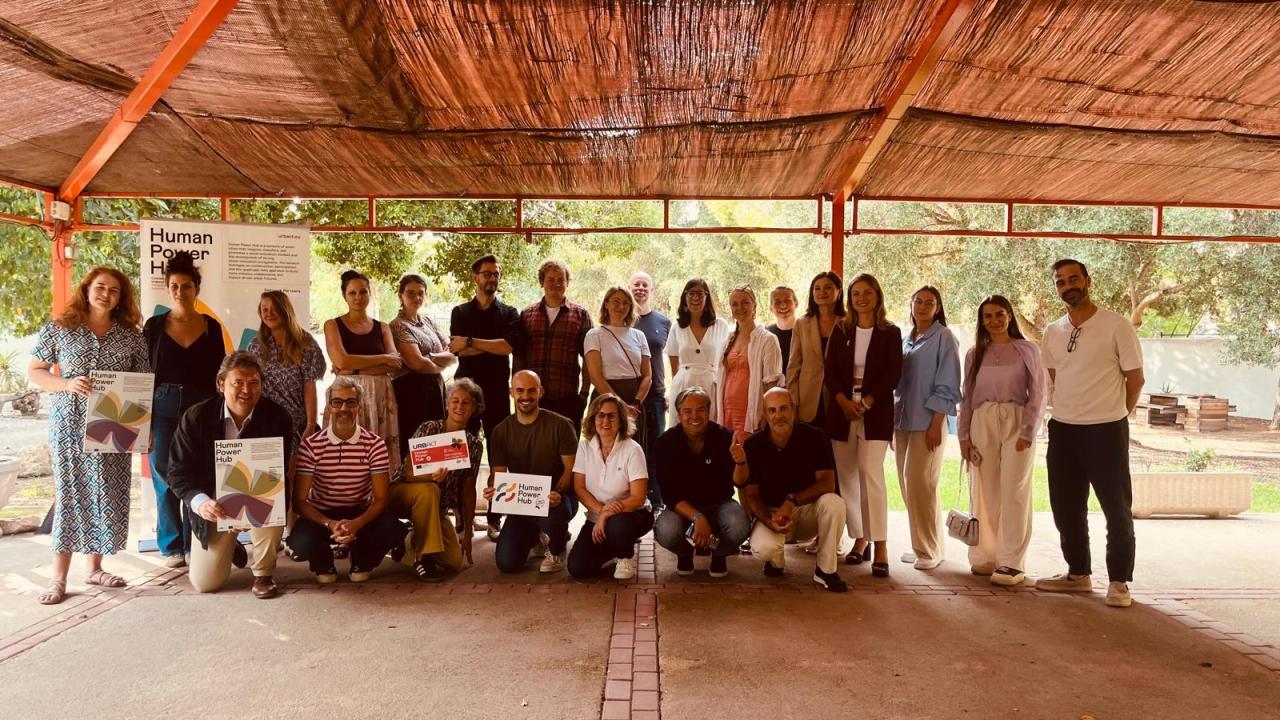
From 5 to 7 October 2026, Málaga hosted the second Transnational Network Meeting of the URBACT Human Power Hub Transfer Network, bringing together representatives from Braga, Bologna, Espoo, Gdańsk, Kyiv, Leipzig and Málaga.
More than another meeting in the network calendar, Málaga marked an important transition.
Following the first Transnational Meeting in Braga, where partners developed a shared understanding of the Human Power Hub Good Practice, the network is now entering a new stage: moving from understanding the model towards adapting it to different local realities.
That shift matters.
The objective of Human Power Hub is not to reproduce the Braga model seven times. It is to understand which elements generate impact, identify the conditions that make them work and enable each city to develop its own locally relevant version of the Human Power Hub.
As the network moves deeper into its Adapt phase, Málaga provided the right environment to start testing that principle in practice. The official network roadmap identifies this second TNM as a key moment for exploring the social entrepreneurship and private sector dimensions of the Human Power Hub model.
Transfer does not produce replicas. It produces new knowledge.
Where we are: from understanding the Good Practice to adapting it
The Human Power Hub Transfer Network builds on the Human Power Hub developed in Braga and recognised as an URBACT Good Practice in 2024.
The network brings together seven European cities committed to adapting and institutionalising a human centred social innovation model based on cooperation between public authorities, civil society, academia and economic actors.
The first Transnational Meeting in Braga focused on understanding how the Human Power Hub works as an ecosystem, governance framework, methodology and public policy instrument.
Málaga represented the next step.
Here, the conversation moved increasingly towards implementation.
How can cities activate social entrepreneurship ecosystems?
How should incubation and acceleration programmes respond to local realities?
What role can businesses, foundations and investors play without weakening the social purpose of innovation?
How can cities measure impact rather than simply count activities?
And perhaps most importantly, how can existing organisations and resources be connected instead of creating another isolated structure?
These questions shaped two intensive days of exchange, field visits, roundtables and collaborative working sessions.
Málaga as a living social innovation ecosystem
The meeting gave network partners direct access to Málaga's social innovation landscape.
Visits and working sessions at Centro Innosocial and La Noria enabled participants to explore different approaches to supporting social entrepreneurship, community innovation, incubation, collaboration and territorial development.
Both organisations are particularly relevant to Málaga's transfer process.
Centro Innosocial, operated by the City of Málaga in cooperation with social and community actors, already provides a strong operational base for the city's emerging Human Power Hub model.
La Noria, managed at provincial level, complements this ecosystem through its experience in social innovation, entrepreneurship and cooperation across the territory.
The Human Power Hub Transferability Study identifies these existing assets as one of Málaga's major strengths. Rather than starting from zero, Málaga has the opportunity to connect existing organisations and programmes through a more coherent social innovation ecosystem.
This is one of the wider lessons emerging from the network.
Transfer does not necessarily mean creating new infrastructure. Sometimes innovation begins by connecting what already exists.
Political commitment matters
The programme also demonstrated that social innovation cannot become sustainable public policy without institutional commitment.
On 5 October, representatives of the Human Power Hub network were received at Málaga City Hall by Francisco de la Torre Prados, Mayor of Málaga, providing an important moment of political recognition for the transfer process. The Mayor's official agenda confirms the meeting with the European Human Power Hub delegation.
The official opening of the working programme on 6 October also brought together different levels of public administration.
Participants included Mar Torres, Councillor for Citizen Participation of the City of Málaga, Laura Valle, Territorial Delegate for Social Services, Families and Equality of the Regional Government of Andalusia in Málaga, and Antonia Ledesma, Vice President for Citizenship and Territorial Balance of the Provincial Council of Málaga.
Their participation illustrated another essential principle of the Human Power Hub approach: complex social challenges rarely belong to one department or one level of government.
Building stronger social innovation ecosystems requires coordination across institutions, sectors and territories.
What is emerging: from individual organisations to ecosystems
One of the strongest themes emerging from Málaga was the need to move beyond fragmented innovation.
Many European cities already have incubators, community organisations, entrepreneurship programmes, universities, foundations and public innovation initiatives.
The challenge is often not the absence of activity.
It is the absence of connection.
Málaga is a particularly relevant example.
Its ecosystem includes Centro Innosocial, La Noria, academic and innovation actors, business organisations, social organisations and municipal programmes. The Transferability Study identifies significant potential in bringing these assets together through a stronger quadruple helix governance model.
For the Human Power Hub Europe network, this raises a fundamental question:
Can a social innovation hub become less about a building and more about the relationships, governance and shared purpose that connect an ecosystem?
The discussions in Málaga suggest that it can.
Learning through people, not presentations
The programme combined institutional moments with visits, conversations, roundtables and direct exchanges with people working inside Málaga's social innovation ecosystem.
This matters because transfer cannot happen through documents alone.
Cities need to see how different models operate, speak with the people implementing them, understand the constraints behind successful initiatives and question which elements could work in their own contexts.
Roundtable discussions enabled partners to compare experiences around entrepreneurship, public policy, financing, collaboration and impact.
The presence of local practitioners, public authorities, social innovation organisations and European expertise transformed the meeting into a shared learning environment rather than a conventional conference.
The City of Málaga itself framed the meeting around social innovation responses to challenges including unemployment, exclusion and environmental sustainability, reinforcing the relationship between innovation and concrete territorial needs.
What we are learning: impact must become part of the system
Another important dimension of the Málaga transfer process concerns impact measurement.
Málaga has identified this as both a local development need and a contribution it can make to the wider Human Power Hub network.
The Transferability Study identifies Málaga's ambition to develop stronger approaches to social impact measurement, potentially creating methodologies and knowledge that can later be reused by other partner cities.
This illustrates the reciprocal nature of the network.
Braga is transferring a Good Practice, but knowledge does not travel in only one direction.
As Bologna, Espoo, Gdańsk, Kyiv, Leipzig and Málaga adapt the framework, they are also generating new approaches, tools and evidence.
Those adaptations can eventually return to Braga and strengthen the original model.
The transfer process therefore becomes a form of collective research and development for European social innovation.
From activities to evidence
The Málaga meeting also reinforced an important distinction for the network.
Success cannot be measured only through the number of meetings organised, participants involved or visits completed.
Those are outputs.
The deeper question is what changes because those activities happened.
Did a city identify a new governance model?
Did organisations that previously worked separately begin to collaborate?
Did a municipality change how it measures social impact?
Did a local programme become more inclusive?
Did the network help a city test something it would not have tested alone?
These are the questions that will increasingly guide Human Power Hub as the transfer process evolves.
What comes next: turning learning into testing
Málaga also created the bridge towards the next phase of work.
According to the network roadmap, this second TNM provides part of the foundation for the testing actions that partner cities will now develop during the Adapt phase.
Each partner will continue working locally with its URBACT Local Group, translating shared European learning into actions shaped by its own institutions, communities and challenges.
The ambition is therefore not to arrive at seven identical Human Power Hubs.
It is to create seven locally rooted interpretations of a common framework, connected through shared values, methodologies, evidence and continuous learning.
Málaga showed why this distinction matters.
A successful transfer does not begin by asking:
How can we copy what another city has done?
It begins by asking:
What can we learn from it, what already exists in our city and what should we change to create impact here?
That is where transfer becomes transformation.
A network built through generosity
The Human Power Hub network would like to express a special thank you to the City of Málaga, its municipal teams, Centro Innosocial and La Noria for the warm welcome, generous exchange of knowledge and commitment to creating a meaningful learning environment throughout the meeting.
Their openness allowed partners not only to observe Málaga's ecosystem, but to question it, learn from it and reflect on how those experiences can inform the next stage of the transfer process.
Because the most valuable resource in a transfer network is not a methodology or a building.
It is the willingness of cities to share what they know, including what works, what does not and what they are still trying to understand.
And that is precisely what happened in Málaga.
Human Power Hub
Human Power Hub is an URBACT IV Transfer Network led by Braga and BragaHabit E.M., bringing together Bologna, Espoo, Gdańsk, Kyiv, Leipzig and Málaga.
The network is transferring and adapting the Human Power Hub Good Practice developed in Braga, exploring how cities can build stronger, more inclusive and sustainable social innovation ecosystems through collaboration between public authorities, civil society, academia and economic actors.