
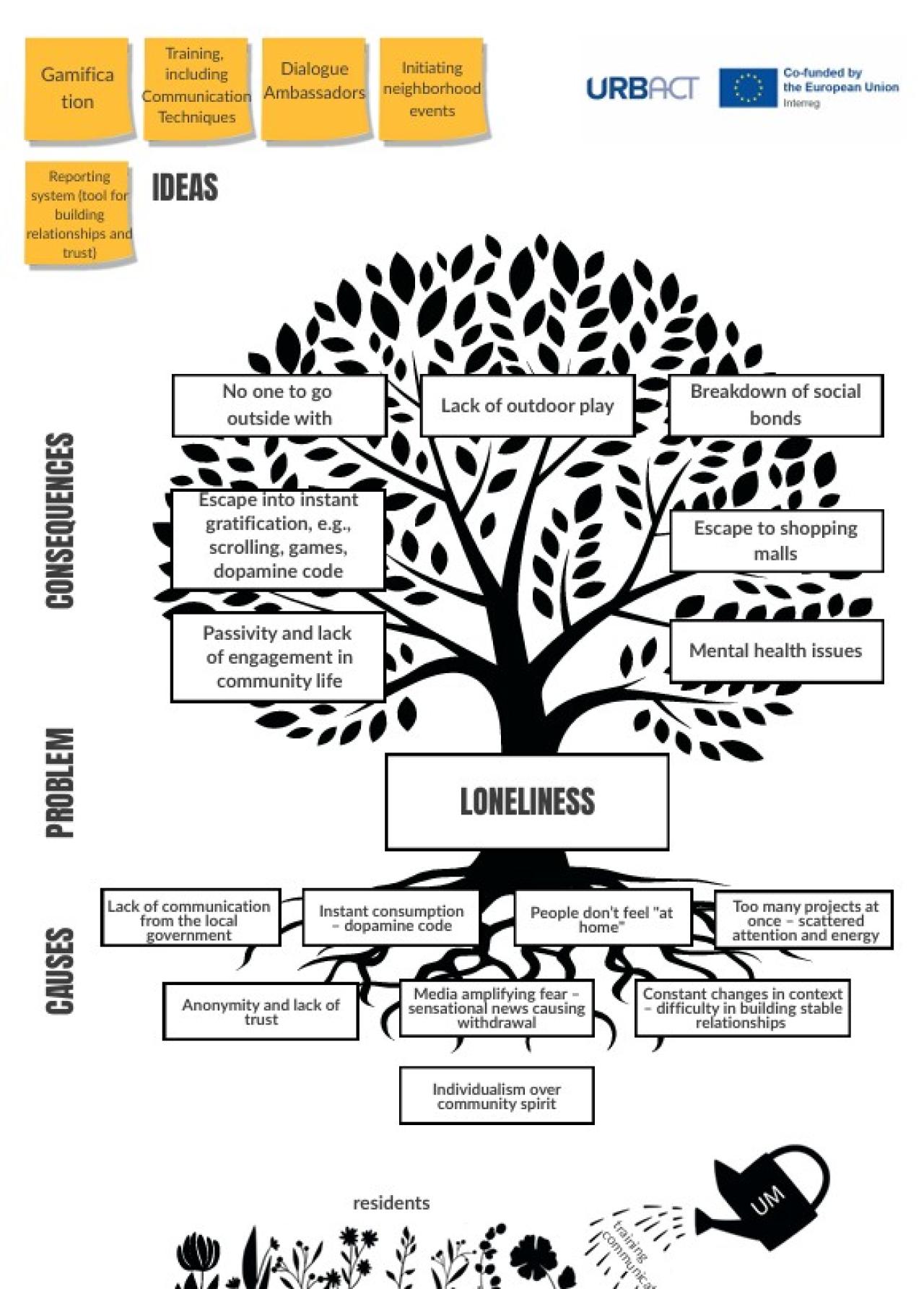
From Diagnosis to Action
Bielsko-Biała translated this learning into two complementary Testing Actions. Both were small-scale prototypes, co-created locally and enriched through European exchange. Together, they explored how culture can strengthen belonging, wellbeing and active citizenship.
- Reclaiming Public Space Through Stories and Street Art
The first action built on an existing local initiative: a street art trail featuring twelve characters inspired by Slavic mythology, created in cooperation with local street artist Malik and Punkt 11. This artistic route had already transformed parts of the city into spaces of discovery and storytelling. It later evolved into the city game, Following the Whisperers: The Trail of Slavic Demons, inviting residents to explore Bielsko-Biała through stories, movement and collaboration.
Building on this successful foundation, the Testing Action introduced participatory workshops that allowed residents to become creators rather than observers. Participants discovered the meanings behind the mythological figures and transformed them into simple visual symbols such as icons and logos. Using street art methods, they learned how to translate complex narratives into accessible images.
The final outcomes were small magnetic artworks that participants could take home – tangible reminders of their contribution to the city’s cultural landscape.
The strongest result, however, was social. Participants began to perceive public space differently. Places once seen as anonymous or “not ours” became familiar and shared. Residents experienced that they could shape their surroundings, strengthening ownership, belonging and responsibility.
The action also supported the digital transition through the online platform SplotBB, where the experience could continue beyond physical space. This allowed the city to test how digital tools can expand participation and community engagement rather than replace face-to-face contact.
- Treeline: Reconnecting People with Nature
The second Testing Action focused on the green transition and emotional wellbeing.
Treeline emerged through international cooperation and inspiration from British composer Graham Fitkin. The concept gave Bielsko-Biała an opportunity to combine artistic practice with ecological awareness.
Residents, artists and experts first joined online workshops and then met in natural urban areas such as Cygański Las and Park Włókniarzy. During guided artistic walks, participants selected individual trees and created their “portraits” through sound recordings, photography, drawing and reflective writing.
They were invited to slow down, listen, observe and connect with nature through all senses. In doing so, the city tested whether green spaces can also become places of encounter, calm and collective wellbeing.
Treeline showed that environmental awareness can be built not only through information, but through emotional experience, creativity and shared presence.
What Was the Impact?
The impact of the Testing Actions was visible not only in activities delivered, but in how people experienced their city.
Participants began to see Bielsko-Biała not as a place to pass through, but as a place to engage with, interpret and co-create. Culture became a form of social infrastructure, creating natural opportunities for meetings, conversations and cooperation.
The city game encouraged interaction between residents who had never met before. The workshops transformed passive audiences into active creators. Treeline reconnected people with urban nature and highlighted the wellbeing value of slowing down together in green public spaces.
The actions also demonstrated an integrated URBACT approach. Rather than treating social inclusion, culture, digital transition and green transition separately, Bielsko-Biała linked them through one coherent local process.
As local musician Ghostman reflected: “Participation in the artistic walk with the local community was an inspiring experience, showing how art can support dialogue with people, space and nature.”
Was It a Success?
Yes – because the Testing Actions created more than outputs. They created momentum.
They built new relationships between institutions, artists and residents. They introduced practical tools that can be repeated and adapted. They increased participants’ confidence that they can influence their city.
Most importantly, they showed that loneliness can be addressed not only through services, but through participation, creativity and shared ownership of place.
As Przemysław Smyczek, Head of Culture and Promotion Department, stated: “We believe that the best form of development lies in projects carried out together.”
What’s Next?
The Testing Actions were designed as prototypes for long-term change.
Materials collected through Treeline will be used by Graham Fitkin to create a new musical composition, to be presented in June 2026 as part of the city’s Polish Capital of Culture programme.
The tools developed through the mythology workshops and city game can now be adapted for schools, neighbourhood initiatives, tourism and future participation processes.
Most importantly, Bielsko-Biała now has tested methods for embedding culture into long term urban policy: not as an add-on, but as a driver of wellbeing, belonging and sustainable development.
A City That Listens – and Responds
The story of Bielsko-Biała shows that culture does not need to be spectacular to be transformative. It needs to be shared, rooted in local context and open to participation.
By combining diagnosis, creativity, digital tools and ecological awareness, the city has shown how Testing Actions can lead to real urban change.
Because culture is not only something people attend.
It is something people build together.
What happened in Bielsko-Biała is more than a local success story. It shows how cities can transform everyday spaces into places of trust and connection. When cities listen, involve people and use culture as a tool for change, they can turn isolation into connection. At a time when many European communities search for belonging, Bielsko Biała proves that the future of urban development is built with relationships.