A local story with European potential
At the heart of ReDAN is the Ormož Basins Nature Reserve, developed on the site of the former wastewater basins of the Ormož Sugar Factory. What was once a degraded industrial area is today a nature-rich space with strong value for biodiversity, environmental education, interpretation, recreation and awareness-raising.
The transformation was led by DOPPS – BirdLife Slovenia, together with a wide range of local and national stakeholders. The reserve is now an important habitat for birds, amphibians, dragonflies and wetland vegetation, and a clear example of how nature-based solutions can help reshape places that have lost their original function.
For the ReDAN partners, the Ormož Basins are not presented as a model to be copied exactly. They are a source of learning. Each partner will need to understand what made this Good Practice successful and then translate relevant elements into its own local reality.
Learning by seeing, asking and discussing
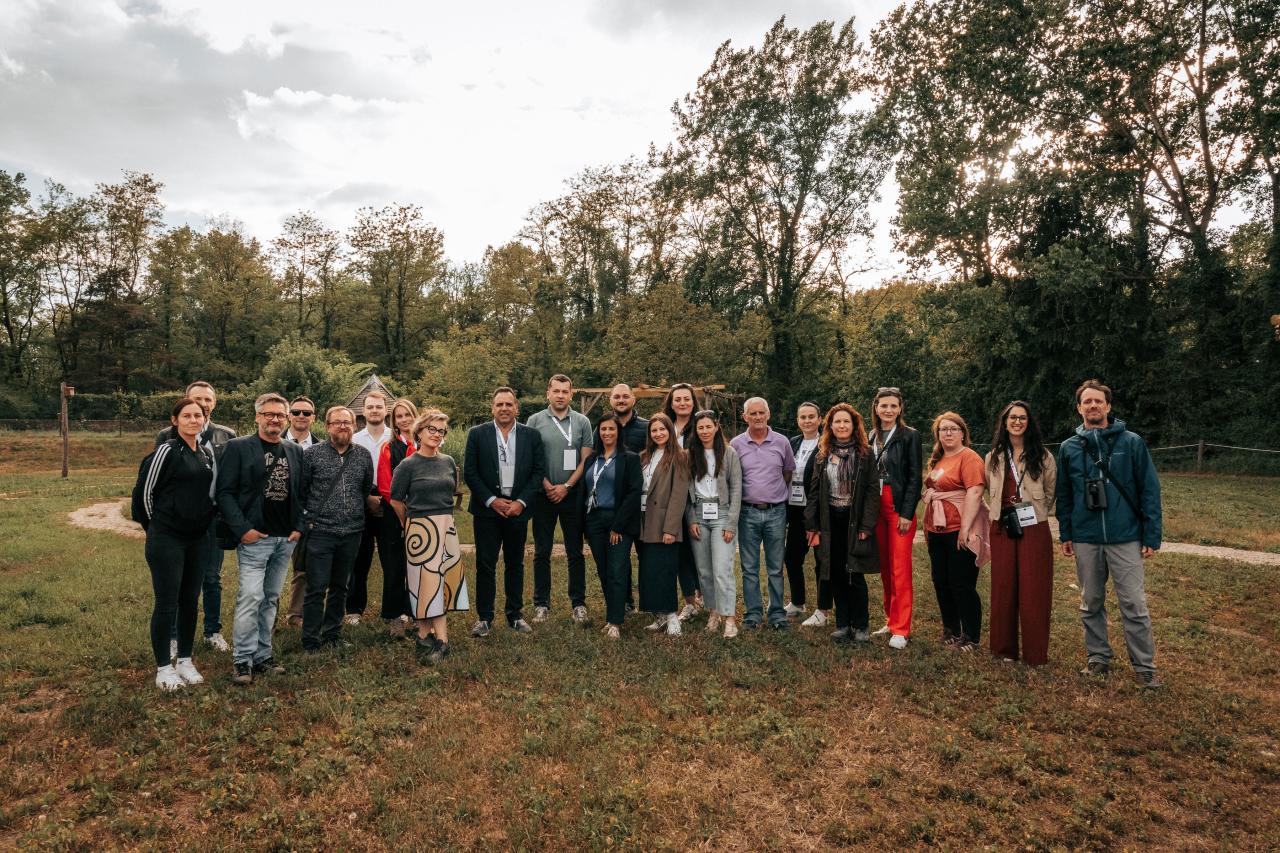
One of the most valuable parts of the kick-off meeting was the study visit to the Ormož Basins Nature Reserve. Guided by Luka Božič from DOPPS – BirdLife Slovenia, partners had the opportunity to see the area on site and discuss how the transformation was planned, implemented and managed.
The visit made the Good Practice more concrete. Partners could better understand how stakeholder cooperation, long-term management and a nature-based approach contributed to the transformation of the area.
This was especially useful because the ReDAN partnership includes very different types of degraded and vulnerable areas — from wastewater treatment surroundings and riverbanks to lakes, canals, mountain areas and underused spaces. Seeing the Ormož example helped open practical questions: What can be transferred? What needs to be adapted? Who needs to be involved locally? And what are the first realistic steps?
Transfer is not copy-paste
The kick-off meeting was also an important working moment for the partnership. Partners presented their local contexts, discussed their challenges and started identifying which parts of the Ormož Good Practice could be relevant for their territories.
Workshops and peer-learning activities focused on transferability, stakeholder mapping and future project steps. The Transferability Study will play a central role, supporting partners in understanding the conditions, opportunities, and barriers to adapting the Good Practice locally.
This is where the URBACT approach is particularly important. ReDAN is not about transferring a finished solution from one place to another. It is about shared learning, local adaptation and stakeholder involvement.
Each partner will work through its URBACT Local Group, bringing together municipalities, public bodies, schools, environmental organisations, tourism actors, local communities and other stakeholders. These groups will help ensure that the transfer process is realistic, participatory and connected to local needs.
Building the partnership
The meeting in Ormož also helped partners build a common understanding of how the network will work in practice. Discussions covered project management, reporting, communication, roles and responsibilities, as well as the next steps in the preparation of local transfer activities.
The event was opened with a welcome address by the Mayor of the Municipality of Ormož, Danijel Vrbnjak. The meeting also benefited from the participation of Irina Rotaru from the URBACT Secretariat, Lead Expert Maja Kireta, Luka Božič from DOPPS – BirdLife Slovenia, and representatives of the URBACT National Point Slovenia – IPoP, Institute for Spatial Policies, Rachela Škrinjar and Blaž Gamse.
Their contributions helped connect the local experience in Ormož with the wider URBACT framework and the practical needs of the partner cities.
Looking ahead
The discussions in Ormož showed that the partner cities face different local realities, but they are connected by a common ambition: to transform degraded areas into places that bring value to nature, people and local development.
In the coming months, partners will continue working on the Transferability Study, strengthen their URBACT Local Groups and start shaping their local transfer pathways.
The message from Ormož is simple but powerful: degraded areas do not have to remain forgotten or unused. With cooperation, care and nature-based solutions, they can become places of biodiversity, learning and community value.
Turning degraded areas into nature-rich places.