
Partnerships Turn Innovative Practices into Deliverable Projects
European cooperation is often associated with exchanging knowledge and sharing good practices. Cities 4 Co-Housing demonstrated that this is only the beginning. Over two years, the network created something much more valuable than a collection of housing ideas: it built a web of interconnected partnerships.
• Partnerships between cities.
• Partnerships between municipal departments.
• Partnerships between local stakeholders.
• Partnerships between housing practitioners and European experts.
• Partnerships between cities and the organizations capable of financing implementation.
These relationships became the real infrastructure enabling innovation to move from inspiration toward concrete delivery. Throughout the network's lifecycle, cities challenged one another's assumptions, openly discussed obstacles, shared practical tools, and collectively searched for solutions that respected diverse legal, institutional, and housing contexts.
Rather than simply copying CALICO, each city progressively built the confidence and know how to develop its own locally adapted pathway. By the end of the URBACT ITN journey, partner cities were no longer asking how to reproduce CALICO; they were asking how to deliver affordable and collaborative housing within their own native systems.
From Exchanging Innovation Knowledge to Building Investible Housing Plans
One of the most significant achievements of Cities 4 Co-Housing was the development of Investment Plans that translated two years of exchange, testing, and peer learning into locally owned implementation strategies.
Partner cities moved beyond exploring collaborative housing as an abstract concept and began addressing the practical questions required for delivery. The Investment Plans challenged cities to define not only what they wanted to achieve, but how these ambitions could realistically be implemented, governed, and financed locally.
This required an integrated type of collaboration. Through URBACT Local Groups (ULGs), municipalities brought together housing, urban planning, social services, legal experts, community organizations, residents, and local decision-makers to jointly shape future projects. In many cities, departments and stakeholders that had rarely interacted established new lines of cooperation around a shared housing vision.
The process also demonstrated that preparing investible housing strategies is not simply a technical exercise. It requires building the governance arrangements, institutional partnerships, and implementation capacity that give confidence to future investors, funding institutions, and delivery partners. In this respect, the Investment Plans became roadmaps for actual delivery.
Looking beyond the lifetime of the network, the Lead Partner Continuity Plan reinforces this CALICO legacy by ensuring that the governance that enabled its rise continue to operate long term. Together, these two deliverables represent an important shift in the network's ambition: from transferring an innovative housing model to strengthening the long-term local capacity needed to deliver collaborative and affordable housing.
Governance is the Infrastructure of Implementation
One lesson became increasingly clear as cities developed their Investment Plans: delivering innovative housing is not simply about designing projects; it is about designing the governance structures that allow projects to happen.
Throughout the network, discussions increasingly shifted toward critical governance questions: identifying the right partners, onboarding them, and building a sustainable structure with the capacity to deliver over the long term. However, at the end of the partnership, another set of questions became vital:
“How do different organizations continue working together once European funding comes to an end? How do we maintain engagement and governance over the long haul?”
These answers ultimately determine whether innovative housing projects can deliver community building and affordability sustainably. Cities 4 Co-Housing demonstrated that governance should never be viewed as a mere administrative requirement—it is the enabling infrastructure that transforms ambitious housing strategies into deliverable projects.
Beyond innovation, one of the most vital lessons participants took from the CALICO practice is the city's sheer determination to evolve its governance structures and keep up the engagement of the community and residents they spent so much time onboarding.
From their Continuity Plan, partners could glimpse the future—identifying what they should watch out for as they move forward. While the assumption is often that governance structures are a 'one-and-done' task that maintains itself, the Brussels team showed that a continuous pulse is necessary to keep structures functioning and unified. They especially highlighted the importance of ongoing community engagement. As immediate next steps, their efforts are focused on simplifying the governance arrangements in CALICO and optimizing them for future potential projects in Brussels region and beyond.
Building Bridges Between Cities and Investment
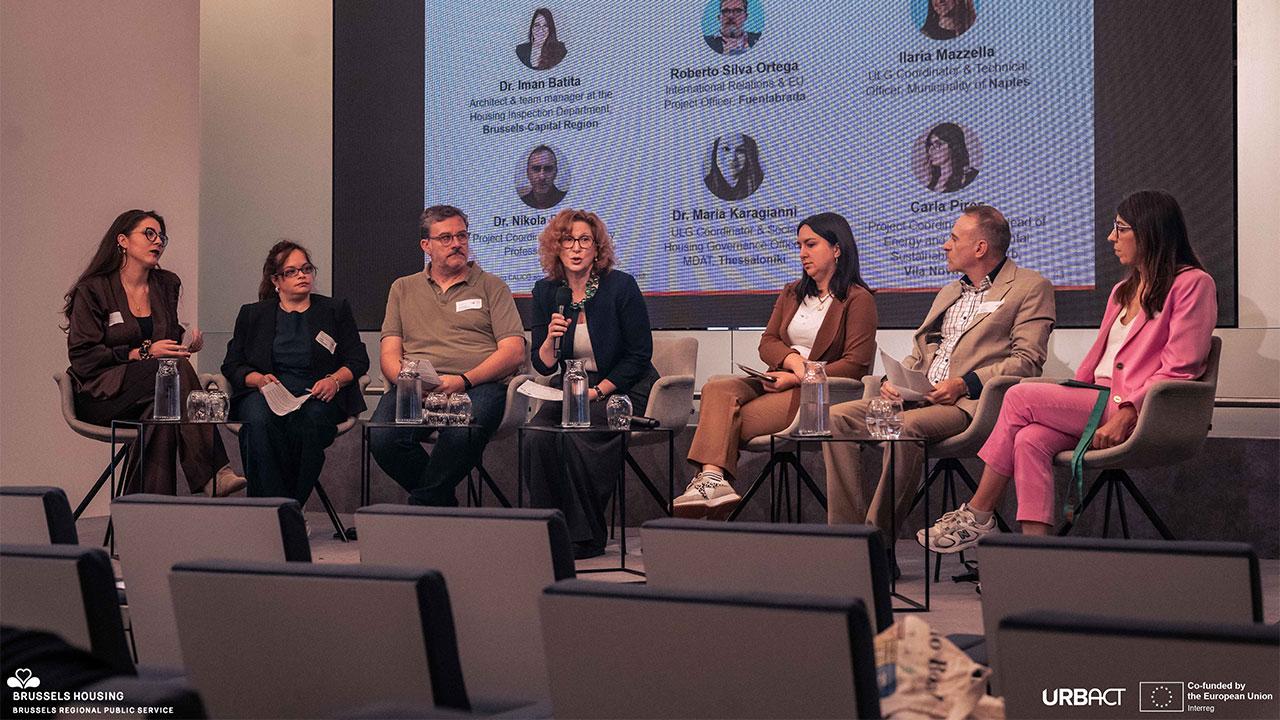
Over the past two years, Cities4Co-Housing partners worked hard to develop their investment plans. Rather than simply presenting these plans behind closed doors, the final conference in Brussels was designed as an open floor for dialogue between cities and sector investors.
Representatives from the European Bank for Reconstruction and Development (EBRD), Crédal, Community Land Trust Brussels, and other organizations shared their perspectives alongside city representatives.
• For partner cities: This was an unparalleled opportunity to pitch their strategies not only to peers, but to financial actors who intimately understand the realities of housing finance.
• For financial institutions: Investors were able to explain how they assess projects, where they see opportunities, what systemic barriers remain, and which conditions help innovative housing move smoothly toward implementation.
Too often, cities develop strategies for assessment, presenting them to potential investors only at the final stage of a formal financing application. Cities 4 Co-Housing explored a different approach. By bringing cities and financing actors together early for an open conversation, the network created a dialogue that allowed both sides to better understand each other's priorities, constraints, and expectations.
Most importantly, investors provided their vision and forward-looking recommendations. They shifted the discourse toward a new vision of affordable housing finance—one that is entrepreneurial, focused on standardizing investment applications, and even exploring the role of AI in the next steps. Scaling collaborative housing across the continent will require exactly these kinds of dynamic partnerships.
From Transferring a Housing Model to Strengthening Delivery Systems
Looking back, the legacy of Cities 4 Co-Housing extends far beyond the direct transfer of the CALICO model. The network demonstrated that collaborative housing is not simply a building type or a legal framework; it is an entire housing system built on governance, participation, affordability, care, and long-term partnerships.
Over two years, partner cities developed much more than local adaptations of an innovative practice—they strengthened their institutional capacity to deliver:
• Investment Plans became actionable implementation frameworks.
• Testing Actions turned into risk-management tools.
• Peer learning evolved into practical problem-solving.
• Local partnerships matured into delivery partnerships.
Perhaps most importantly, through URBACT Innovative Transfer Network cities developed greater confidence in translating European innovation into locally owned solutions. Alongside structural partnership-building, that newfound confidence may prove to be one of the network's most enduring outcomes.
The Real Work Starts Now
The formal URBACT journey of Cities 4 Co-Housing may have reached its conclusion, but its most critical phase is only beginning. The challenge now is to transform these strategies into affordable homes across Europe, turning European cooperation into a reality that tangibly improves people's lives.
Europe does not face a shortage of innovative housing ideas; it faces the challenge of delivering them. Cities 4 Co-Housing has shown that success requires more than transferring good practices. It requires building the partnerships, governance capacity, and investment dialogue capable of turning innovation into reality. This may well be the network's most important contribution to Europe's growing conversation on affordable, collaborative housing—and perhaps the most valuable lesson for the next generation of European urban cooperation.