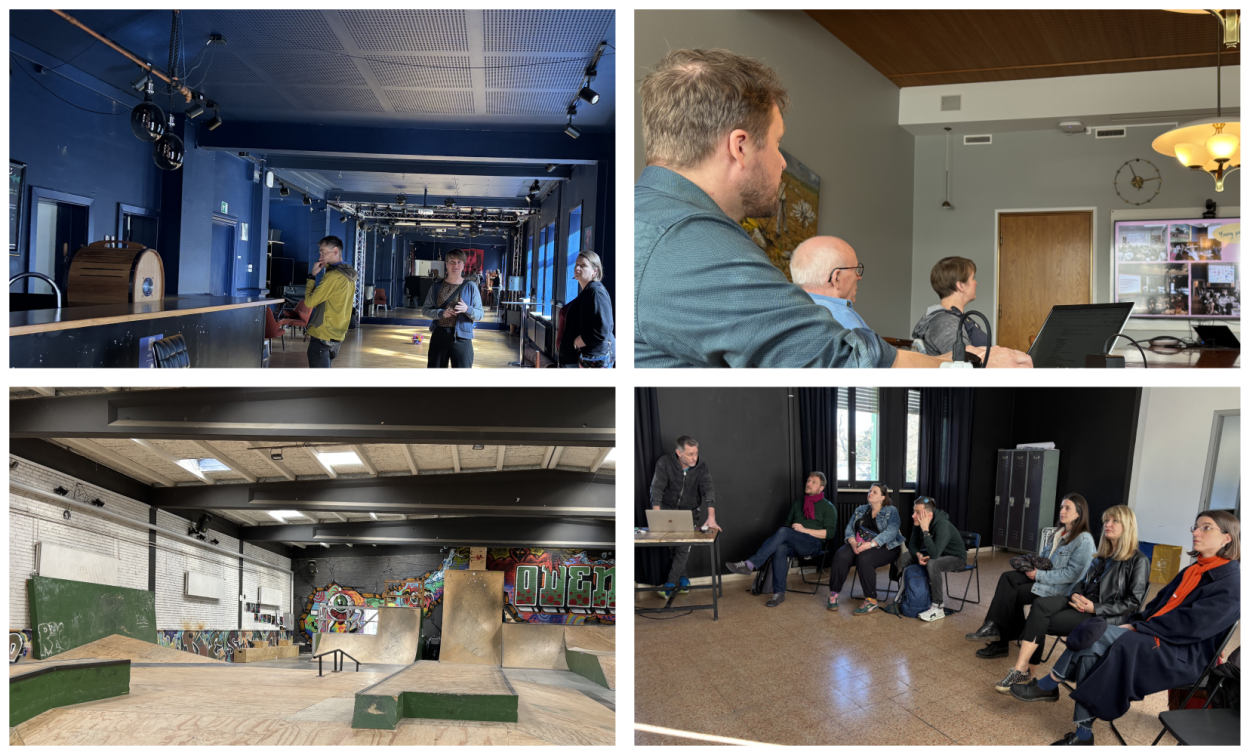
These visits marked an important milestone in the network’s learning process, helping partners better understand how the model could be adapted to different local realities.
Odense: A Local Approach to Youth Engagement
The first visit took place in Odense, Denmark’s third-largest city and the main urban centre of the island of Funen. Home to more than 180,000 residents and widely known as the birthplace of Hans Christian Andersen, Odense combines a strong cultural heritage with an active approach to youth development.
During the visit, participants explored a range of local youth-focused institutions and initiatives. Meetings were held with representatives and managers of UngOdense, UC Højstrup, Street House Youth Centre, and UC Spillestedet, including discussions with Lars Sommer. These exchanges provided valuable insights into the management, governance, and day-to-day operation of youth facilities, as well as the methods used to engage young people in educational, social, and cultural activities.
An important part of the programme was a meeting at Odense City Hall with a representative of the Mayor’s Office. During the discussion, the city’s civic participation consultant presented Odense’s approach to youth engagement and shared examples of how young people are involved in local decision-making processes and community life.
Forlì: Co-Creating Spaces with and for Young People
The second part of the study visit took place in Forlì, a city of approximately 120,000 inhabitants located in the Emilia-Romagna region of northern Italy.
The visit focused on local youth policies and examples of spaces designed for young people and developed with their active involvement. Participants had the opportunity to explore several youth-oriented venues, including Ex Asilo Santarelli – Open Lab, Officina 52, Piada 52, and Fabbrica delle Candele. These visits provided practical examples of how youth participation can be embedded in the creation, management, and development of community spaces.
The programme also included meetings with representatives of the municipality and members of the team responsible for youth policies. Discussions centred on tools and mechanisms that support youth empowerment, social participation, and the development of community infrastructure.
A particular highlight of the visit was the meeting at EX-ATR, a cultural space managed by two non-governmental organisations in a former bus depot. The site stands as a successful example of urban regeneration, demonstrating how abandoned infrastructure can be transformed into vibrant community assets through effective collaboration between civil society organisations and local authorities.
Building the Foundations for Transfer
The study visits represented a key step in assessing the transfer potential of Lublin’s Good Practice across partner cities. The knowledge gathered through meetings, observations, and discussions will contribute directly to the preparation of the Transferability Study, one of the most important outputs of the network’s first phase, Understanding.
Through direct engagement with local stakeholders, partners gained a deeper understanding of the unique characteristics, challenges, and opportunities within each city. The insights collected will help identify the most suitable pathways for adapting the Youth Spaces Network model to local contexts and will provide a strong foundation for the next stages of the YOUth SPACE LINK project.
As the network moves forward, the relationships established and lessons learned during these visits will play an important role in shaping effective and sustainable youth participation ecosystems across partner cities.