AbBOUT COM’ON CITY The idea of Com’ON was born in 2015 in Cluj-Napoca (Romania), the year the city held the title of European Youth Capital. The name plays on “common”, “community on” and the rallying cry “Come on!” The premise was: give informal groups of young people a small grant, no strings attached, and trust them to improve their own environment — no registered organisation, no lengthy reporting, no expert jury. Just an open call for ideas, a public vote, and micro-funding paid as an award. A decade on, Com’ON has backed more than 1,000 youth-led projects, and is recognised as an URBACT Good Practice and one of Europe’s leading models of Youth Participatory Budgeting (YPB). Com’ON City is the URBACT Transfer Network (2025–2028) that carries this model beyond Cluj. Led by the Municipality of Cluj-Napoca, it unites five cities — Cluj-Napoca (RO), Leeuwarden (NL), Piacenza (IT), Valongo (PT) and Veszprém (HU) — around one shared ambition: a generation of young people who actively shape their cities and neighbourhoods, whose needs are reflected in local decisions, and who are engaged through co-creative, trust-based processes — building more skilled, empowered citizens and stronger, more inclusive local democracies. Crucially, the partners are not copying Cluj’s model; they are translating its principles into their own, locally owned YPB models. |
What’s Moving in Com’ON City
Around the Network
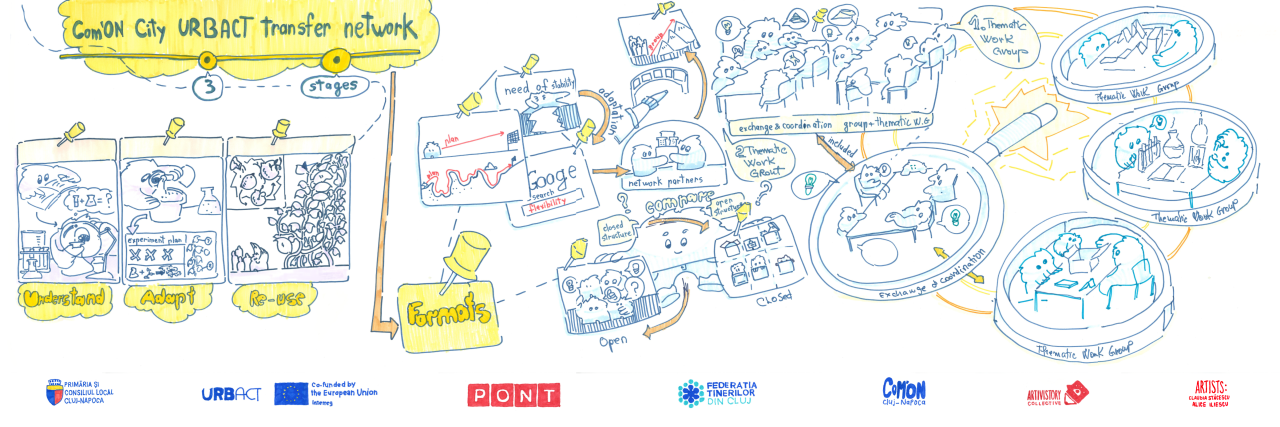
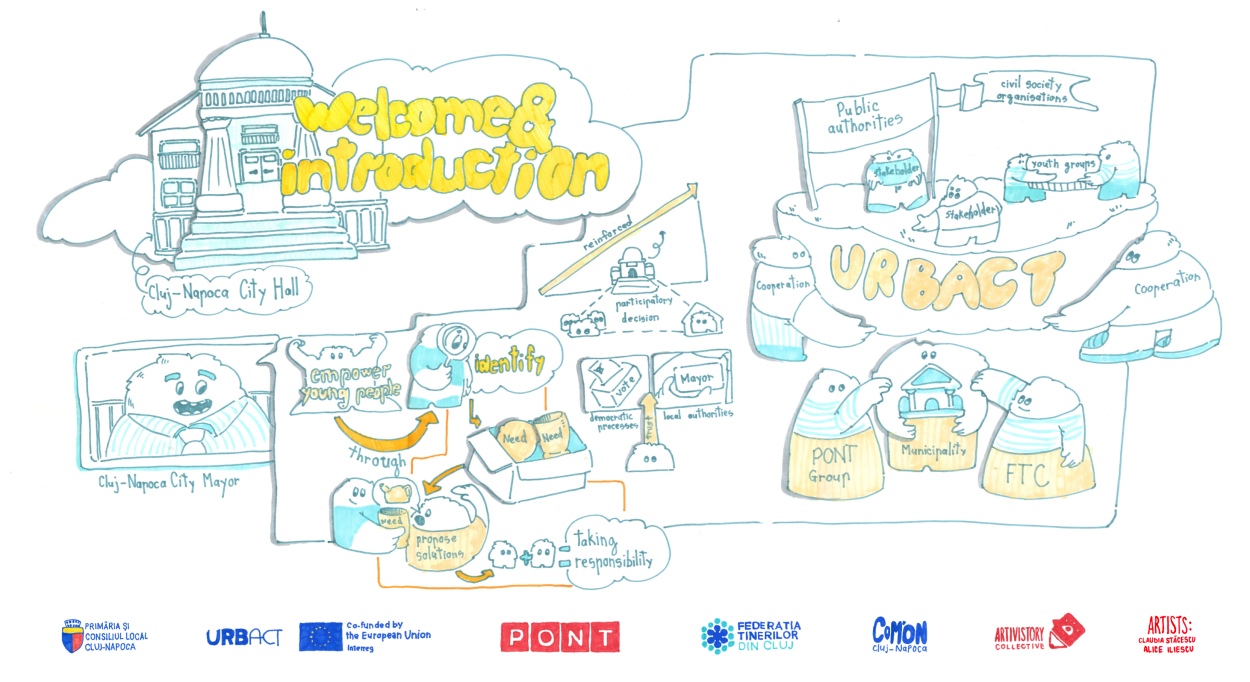
In November 2025 the five cities have started their joint Com’ON City journey to transfer and improve the good practice Com’ON [LINK] from Cluj-Napoca, a successful YPB model. They focused on familiarising with the good practice to understand it in its details. By doing so, they are laying the foundation for a – hopefully – successful transfer and adaptation of Com’ON to their local needs and circumstances. Three encounters shaped these first months: a kick-off meeting in Cluj-Napoca on 4–5 February 2026, where partners met one another and the Com’ON model face to face; an online webinar on 28 May 2026 dedicated to discuss and share ideas who and how to involving in the transfer process in each city; and a network meeting hosted by Valongo in early July 2026 to dig deeper into YPB models and how Valongo’s YPB could be improved.
Alongside these exchanges, Lead Expert Nils Scheffler produced a comprehensive Transferability Study, a proposal for the Network Roadmap and a Transfer & Improvement Plan template, laying the foundations for the work ahead of the network.
Transferability Study (view here). The study documents the Com’ON Cluj model – its five-stage annual cycle (Preparation, Ideation, Decision, Implementation, Closure), its multi-stakeholder governance, and the resources it takes to run the model. In addition, it assesses the transferability of Com’ON Cluj to the other partner cities, outlining the adaptation requirements. Its central message is that transferability rests not on replicating Cluj’s model, but on translating Com’ON’s core principles (low bureaucracy, trust-based micro-funding, demand-driven mentoring and inclusive outreach) into locally owned systems. It also candids about where Com’ON Cluj itself can improve: reaching marginalised youth, voting fairness, financial sustainability, impact communication and alumni engagement; framing the network as a two-way learning from which Cluj-Napoca can learn as well.
Network Roadmap. Building on the study with its draft network roadmap, partners agreed on a common working programme and three transfer topics to structure their collaboration: (1) inclusive and youth-friendly YPB models across all five Com’ON stages; (2) a multi-stakeholder governance structure that lets municipalities, youth organisations, schools, civil society and young people share direction on an equal footing; and (3) funding, human and technical resources to make a YPB model genuinely viable. The roadmap is backed by a toolbox of transfer-support activities – a rolling series of in-person and online network meetings running to a final gathering in Cluj in March 2028, plus on-demand deep-dive webinars, one-to-one coaching on specific questions and bilateral partner visits for hands-on observation of another city's YPB practice. This is complemented by quarterly transfer and improvement diaries for self-reflection to document real challenges and inspiring ideas as input for network exchange activities. The in-person network meetings will follow recurring exchange session formats: thematic input, partner updates, host spotlights and peer coaching and host ULG peer review. All partners are encouraged to bring ULG members and young people into the room wherever possible.
Transfer & Improvement Plan template. Agreed at Valongo, this is the core working document each city will produce to turn Com’ON into its own local model. It covers local challenges that demand greater involvement of young people; objectives for the YPB, its added value and the opportunities it creates; target groups the YPB targets at; the description of YPB model and its stages and the governance, funding and monitoring system behind, summarizing all with an implementation roadmap. The transfer plan is to be understood as a living document: partners are encouraged to have test runs of their models, build in feedback loops and develop the model further over the years. First drafts of the transfer and improvement plans will be discussed in a peer learning exchange in March 2027. The final versions are expected by February 2028.
City Dispatches
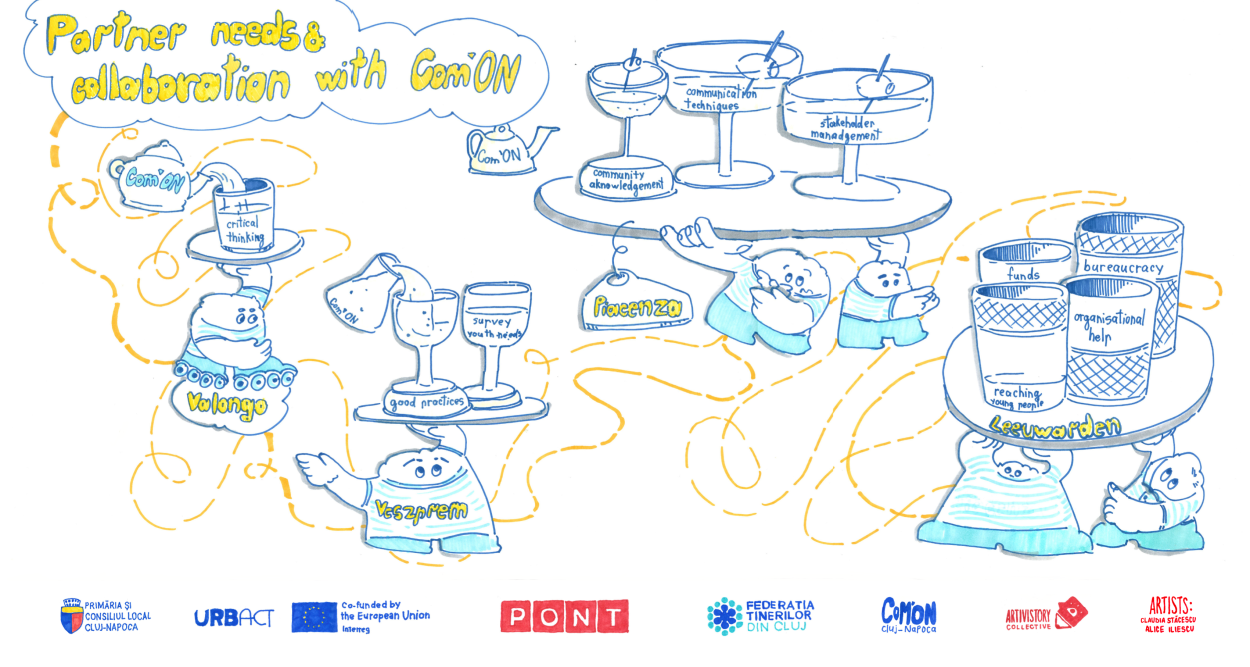
The partners are not starting from scratch: All partners already run youth or citizen budgeting of some kind, and each arrives with something to contribute.
Cluj-Napoca (RO) is using the network to interrogate its own model: how to reach Roma youth, LGBTQIA+ young people and young people with disabilities; how to move beyond a single city-wide edition to neighbourhood and school formats; and how to turn first-time participants into future mentors.
Leeuwarden (NL) brings project500, a small-scale youth participatory budgeting-style initiative providing €500 to approved youth project ideas. What makes it special is that grants are approved by a youth commission within two weeks after project application – a living example of low-bureaucracy funding.
Piacenza (IT) contributes its experience with Piacenza 2030 – Giovane Città Futura, a funding initiative aimed at supporting youth-led projects that promote sustainable urban development aligned with the UN's Agenda 2030 goals.
Valongo (PT) brings in its Valongo Youth Participatory budgeting (Valongo Orçamento Participativo Jovem) focusing on four categories school, community, intergenerational and green.
Veszprém (HU) has launched its first residents’ participatory budget only in 2025 and has no dedicated youth format yet — making Com’ON City a chance to build one from the ground up.
Lessons from the Field
One key understanding of the first months is: YPB is a means, not an end – and getting it right is not only about “mechanics”, but also about mindsets. Other lessons from the study and the first exchanges are:
Transfer is translation, not cloning. What travels is the DNA – trust, simplicity, mentoring, inclusion – while the formats, budgets and tools must be redesigned locally, ideally with young people in the room.
There is no single “right” YPB. In Valongo the network mapped a spectrum of models – city-wide, neighbourhood-based, institution-based, open and target-group oriented, community and thematic-focused, plus hybrids – each with trade-offs. To choose well the model, partners need a set of criteria to be able to “judge”. Relevant criteria could be: the objectives they want to achieve with the YPB, the target groups they want to reach, the skills they want young people to gain and the resources they can realistically commit.
It takes a whole ecosystem of stakeholders. At the Cluj meeting, partners mapped out the key groups that need to be brought on board for the transfer process: young people first and foremost, alongside municipal administrations, education institutions, youth NGOs and associations, cultural, social and community organisations and youth centres, elected representatives, and the private sector and financiers. Identifying who belongs at the table — and with how much power and interest – gives each city a clearer starting point for building its URBACT Local Group (ULG) and, ultimately, shared ownership of its YPB.
Engagement is never automatic. Brainstorming at Valongo made clear that every stakeholder group has its own reason and motivation to take part – and those reasons differ sharply. The network partners see young people value the chance to experience other cultures and partner cities and to build new collaborations. Youth NGOs, cultural organisations and youth centres are drawn by networking, influencing topics they work on and deeper involvement in ideation and implementation; education institutions by access to data, research opportunities and classroom inspiration. Municipal administrations might want a hand in improving the process of YPB to make the YPB cycle easier to handle; elected representatives might want oversight on the process and a channel for residents’ ideas; and the private sector might seek visibility, recruitment of young talents and CSR value. A sustained engagement is not a given, it needs targeted, group-specific incentives and activities to ensure a continuous engagement of the stakeholders.
Young people need youth-friendly ways in. Getting them in starts with low-barrier open calls, recruitment through trusted youth centres and schools, social-media outreach, and youth-friendly formats such as mobile “listening labs” and design sprints — plus clear pathways from participant to future mentor. But the more ambitious aim is to hand young people a real say in the model itself, inviting them to help translate the Com’ON cycle into their own local context through a simple arc: listen, co-design, test, refine, communicate.
In practice, that means listening to the questions that decide whether a model feels fair – which ideas should be funded, how much money and what for, what support young people need, which voting method feels just, and what the participation pathway looks like; co-designing the rules, eligibility criteria, communication channels and pathways together; testing the process, or parts of it, through small-scale pilots; refining the rules, components and transfer plan against how young people actually respond and the barriers that surface; and letting them help communicate the result to their peers. Done this way, the YPB model becomes more credible and young people are far more likely to see Com’ON as something they own, not something imposed on them.
These shifts show up most vividly in the partners’ own reflections. For Veszprém, the biggest change was in mindset:
“We should view YPB not as a goal to reach, but as a tool that brings us closer to our youth goals — helping young people become active citizens, building democracy, strengthening the ecosystem that supports local youth. We also learned there are several models, and we need to design one that fits our local goals and can be scaled and shaped flexibly over the years. And most people — especially young people — may not understand the term ‘YPB’, so we need youth-friendly language.”
— Anna Kauer, project coordinator of the Strategic department of Veszprém
For Leeuwarden, the phase was as much about people and simplicity as it was about models:
“During the past months in this URBACT Transfer Network, I learned about different models of youth participatory budgeting (YPB), their benefits and challenges, and the importance of keeping communication about YPB simple and accessible to young people. I was also inspired in Valongo by great youth-led initiatives and learned how important it is to give young people the space to share their ideas, while meeting some great new people along the way.”
— Else Hofstra, Project Manager for ‘Own Your Spot’, Leeuwarden City Council
Piacenza, meanwhile, used the phase to sharpen both its local group and its plan for adaptation:
“In the first phase of the Com’ON project we focused on two main aspects: the operation of the Local URBACT Group (ULG), engaging both organized entities active in youth policy and individual young people from diverse social backgrounds and neighbourhoods; and the analysis of Cluj’s good practice in comparison with the experience gained from the ‘Piacenza 2030’ call for proposals. This dual focus enabled us to capture key insights and lessons learned across both dimensions:
Working within the network taught us how to turn the URBACT Local Group (ULG) into an active, two-way bridge between youth and local governance, leveraging an external coordinator’s perspective to break away from top-down clichés and empower young people to take direct ownership of city transformation. And from Cluj’s YPB good practice, we learned the value of lowering participation barriers through micro-grants and popular voting, gaining key insights on how to adapt these mechanisms to Piacenza by integrating youth centre facilitation, school outreach, and existing digital voting platforms.”
— Lorena Cattivelli, Municipality of Piacenza
Coming Up
With the basic model understood and the roadmap agreed, the network now shifts from understanding to doing. From 25 to 27 August 2026, all five partners travel to the URBACT University in Cork, Ireland, to work together on stakeholder engagement. On 13–14 October, an online network meeting turns to the first two stages of the Com’ON cycle – Preparation and Ideation – with partners sharing how they intend to transfer and adapt each at home. And a month before that, every city writes its first Transfer & Improvement Diary: an honest stock-take of where they stand in the improvement, transfer and adaptation process, the inspiring activities or approaches worth passing on to the other partners, and the challenges still standing in the way of transfer – hopefully good input for the online network meeting.
From there, the network works methodically through the rest of the Com’ON cycle in the seasons ahead, all the way to a final gathering in Cluj-Napoca in March 2028. The first months proved that a decade of trust in Cluj cannot simply be photocopied — but they also proved that the other cities are ready to develop and earn that trust.
New to the story? For the bigger picture — how Com’ON began in Cluj-Napoca and why it’s now going European — read our feature “Com’ON! How a Romanian city empowered young people…” on our URBACT website, which tells the Com’ON good practice and the network in a nutshell.