From Understanding to Action: Building Social Cohesion One Neighbourhood at a Time

Edited on 27/08/2026

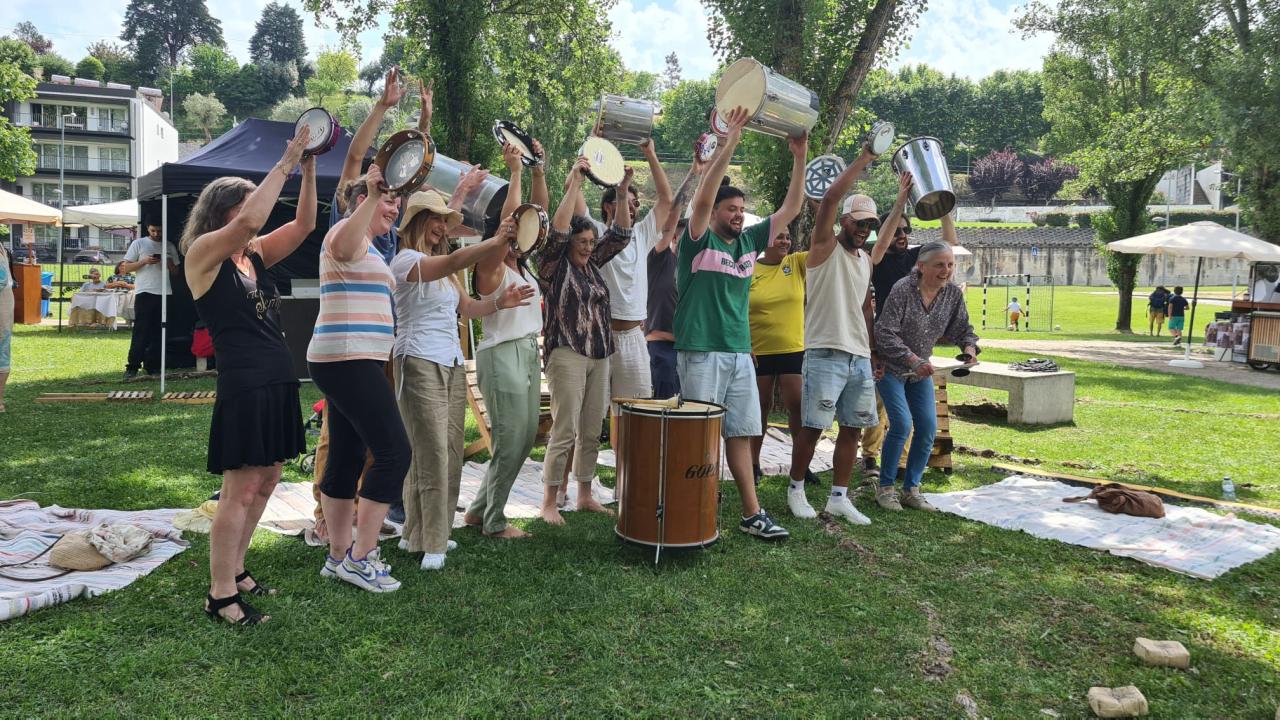
Group of people holding musical instruments in the air

Across Europe, cities are looking for new ways to strengthen social cohesion in increasingly diverse neighbourhoods. The question is not only how to support newcomers, but how to create places where everyone – long-term residents and new arrivals alike – can learn, connect, develop and contribute. 

In this context, the URBACT Plan Einstein Academy network has been exploring how Utrecht’s innovative social transformation model ‘Plan Einstein’ (Netherlands) can be transferred to five European cities of different sizes and characteristics.

Innovation transfer involves sharing and adapting approaches across cities. But as URBACT’s model anticipates, in Plan Einstein Academy, the partners found that this process went beyond simply reproducing an existing model. The network’s journey has been a story of understanding, experimentation and adaptation.
 

Understanding an innovation takes time


One key observation that shaped much of the project is that it takes more than a few presentations and a site visit to truly understand a social innovation. It was important to revisit the core ideas more than once, each time adding layers of understanding and challenging existing ways of thinking.

Throughout our network journey, the image of a wedding cake served as a helpful visual metaphor for our processWhen the project partners first experienced the Plan Einstein model – during the ‘Deep Dive’ visit to Utrecht in November 2024 – they could see and experience the Plan Einstein model, much like being presented with a beautiful cake. But seeing how it looks and tastes does not mean knowing how to make it—or how to recreate it in a different local and cultural context. 

Even a list of ingredients is not enough. Partners initially saw Utrecht’s welcoming community spaces, inclusive and educational activities, and local partnerships. But as the exchanges progressed, it became clearer that these visible elements were only part of the story. Plan Einstein is not a collection of projects to be replicated, but a different way of thinking about social cohesion.
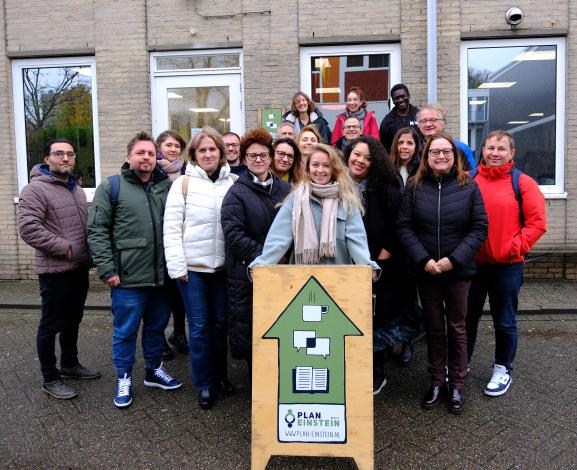
Group of people in front of Plan Einstein Space for Meaningful Encounterss

Partners first experienced Plan Einstein during the Deep Dive visit to Utrecht in November 2024.

The real innovation lies in an approach built around a set of principles: treating newcomers and long-term residents equally, responding to shared neighbourhood needs, creating opportunities for meaningful encounters and building strong local partnerships. It is an approach for all members and residents of the local community – not targeted sub-groups – and it is about facilitating personal development and a natural process of social transformation. 

Understanding these principles, why they matter and how to tell the difference between a few inclusive activities and a meaningful Plan Einstein approach was an ongoing process of discussion, reflection and exchange.


The importance of refining the local partnership


For several partners, their evolving understanding of Plan Einstein had important implications for the whole approach being undertaken and the local partners with whom they wanted to work. Many partners had undertaken their initial stakeholder mapping and URBACT Local Group (ULG) creation from the perspective of a more ‘traditional’ migrant integration project. 

Zagreb (Croatia) was initially looking at the possibility of basing its ULG around an existing multi-stakeholder ‘Coordination Group for Integration’ set up under the city’s Migrant Integration Plan. Warsaw (Poland) took the Plan Einstein concept to its twice-yearly networking sessions for organisations active in the sector of migrant support and human rights to generate interest. Meanwhile, Thessaloniki (Greece) mapped and started working with a range of NGOs working at the front line of migrant reception and integration in the city.

However, it became increasingly clear over the first year of the project that this approach was encountering difficulties and obstacles for supporting the transfer of Plan Einstein. Firstly, the focus on migrant-specific organisations did not fully match the philosophy of engaging and working for the local community as a whole. Secondly, many of these organisations had specific priorities or needs which the network was not equipped to meet. Thirdly, it was relatively hard to talk in concrete and meaningful terms about addressing community needs and enabling meaningful encounters at city level.

For more than one partner then, a shift of focus from thinking about migrant integration at city level to thinking about social cohesion at neighbourhood level brought about a rethinking of who the key ULG members should be. Suddenly, instead of difficult conversations with organisations looking for funding or high-level political solutions, city partners found themselves having fruitful conversations with libraries, schools, cultural centres and others keen to play their role at the heart of their local community.

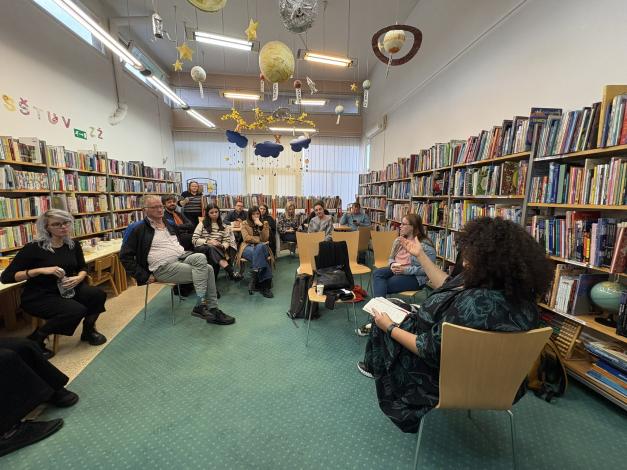
Group of people sitting in a library and talking

Zagreb found a willing partner in the local library of its targeted neighbourhood.

The benefits of small-scale actions

Hand-in-hand with the shift of focus from city-wide to neighbourhood-based approaches and a rethinking of the ULG composition, came the benefits of the small-scale testing actions enabled by URBACT. 

Zagreb worked with the cultural centre in its target neighbourhood of Travno to test the introduction of a more welcoming approach to newcomers within the ‘Days of the Neighbourhood’ celebrations. It also organised a choir to bring locals and newcomers together as equals in a shared activity based around songs from different cultures. These actions helped test different types of inclusive activity building on existing community activities and resources. 

Similarly, Suceava (Romania) tested a sewing activity bringing together Romanian and Ukrainian ladies structured around the shared culture of traditional embroidered blouses. This aimed to use culture as a way to create connections and build new relationships across differences in nationality. Coimbra (Portugal) tested a multi-cultural community orchestra as a means of celebrating diversity and creating meaningful connections between individuals with a shared passion for music. 

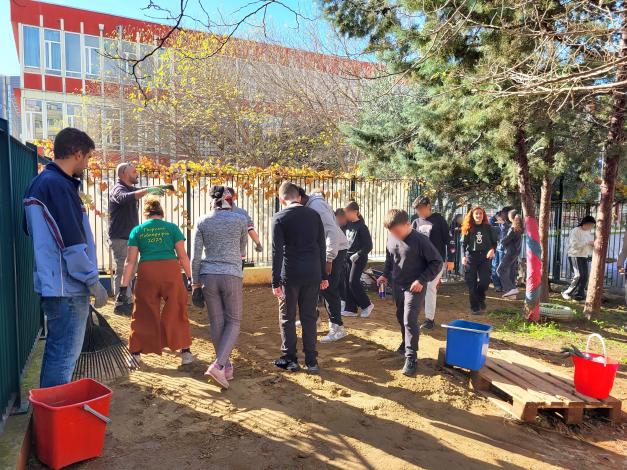
For Thessaloniki in particular, the testing action was seen not only as a means to test an inclusive activity but as a key tool to generate local engagement with the ideas of Plan Einstein. A school in the target neighbourhood of Giannitson was identified as the location for the creation of a community garden, which served to bring together a diverse multi-generational group in which older residents are able to teach younger ones about how to grow different vegetables and herbs. The intention is to use the school as a local anchor for different community initiatives in the neighbourhood selected for its dense residential fabric and social mix.

Group of people working on plot of land in front of a school building

A new community garden brought neighbourhood members together in Giannitson, Thessaloniki.

Conclusions: the value of a collaborative neighbourhood-based approach
 

While Plan Einstein has become policy for the whole City of Utrecht, it is important to remember that it started off as a pilot project in a target neighbourhood of the city and that implementation of the city-wide policy has still meant implementation at neighbourhood level in various locations across the city.

The reality for several partners has been that trying to think immediately in terms of city-wide responses to the needs of all new arrivals and how to ensure inclusive approaches across the city was overwhelming. The needs are too great and the resources too few. However, adopting targeted approaches focused on selected neighbourhoods can make it easier to build an engaged stakeholder coalition, plan meaningful actions and promote tangible and sustainable change that can act as an example to other neighbourhoods, and hopefully impact city-wide policy in the future.

In this context, another lesson connects every partner experience: the importance of collaboration. Creating more welcoming and cohesive neighbourhoods requires far more than municipal action alone. Schools, libraries, NGOs, cultural organisations, community centres, sports clubs and residents all have a role to play. One of the strengths of the Plan Einstein journey has been helping cities recognise that many of these actors are already working towards similar goals, but often in isolation and in ways that can be helpfully reinforced. 

Plan Einstein Academy has demonstrated that transferring innovation is not about finding a blueprint or planning a pre-defined set of actions. It is about creating the conditions in which every city and every neighbourhood can develop its own response while remaining faithful to the principles that made the original innovation successful.

Interested to know more? Continue to follow our network journey, results and outputs through our project webpage and via our LinkedIn page.


Submitted by on 27/08/2026