Networks and cities' news

Catch up on the latest updates from cities working together in URBACT Networks. The articles and news that are showcased below are published directly by URBACT’s beneficiaries and do not necessarily reflect the programme’s position.

Want to learn more about the projects that are featured here? Discover the URBACT Networks.


  • getafe deep dive cover

    Harnessing Innovation in Getafe: A Strategic Deep Dive into the Future of Urban Energy

    Written by Vanya Vandova


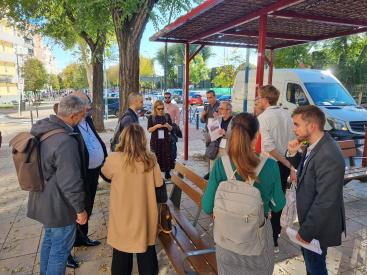
    As the Leading Partner of the EmPowerIngUs network under the URBACT IV Programme, the Municipality of Getafe (EMSV) has established itself as a pioneer in tackling modern urban challenges. By spearheading this international collaboration, Getafe provides the strategic framework and proven expertise necessary to guide partner cities toward sustainable energy solutions. A primary objective of the network is to identify "hidden" energy poverty that standard statistics might miss, allowing for more targeted local administration measures. The city’s proactive leadership was recently on full display during a high-intensity "Deep Dive" into urban resilience held from November 5th to 8th, 2024. During this Transnational meeting, a delegation from Pomorie Municipality, led by the Mayor Ivan Aleksiev, joined partners from Portugal, Belgium, and Greece to transition from theoretical discussions to concrete, data-driven social planning.


    Chiara.Lucchini

    See more
  • Composition image: bird´s view of Getafe´s urban centre and the Healthy Homes Office

    Energy Poverty Intelligence Unit: an innovative energy poverty reduction solution designed and implemented in the city of Getafe

    In 2018, it was estimated that around 15% of Getafe’s households – approximately 30,000 residents – could not keep their homes warm in winter. Additionally, rising climate change impacts and increasingly frequent heatwaves made summer conditions more extreme. Yet, fewer than 1,000 residents (234 households) in Getafe sought assistance – revealing a significant gap between those in need and those receiving help.


    “This was a clear sign we have to act,” says Fernando González Ferreira, one of the key developers of the Energy Poverty Intelligence Unit. “But the more we searched for the solution, the more we realized that there was none suitable for our situation. So, we knew we had to get innovative and do it ourselves in close collaboration with our community.”


    And they did it! Since 2022, when it became operational, the Energy Poverty Intelligence Unit assisted over 2,750 households (more than 6,850 citizens) and, on average, reduced their energy bills by 20%, improved the internal coordination between municipal services, and established fruitful cooperation with a diverse array of external partners like universities, NGO’s, consultancies, etc.

    Klemen Strmsnik

    See more