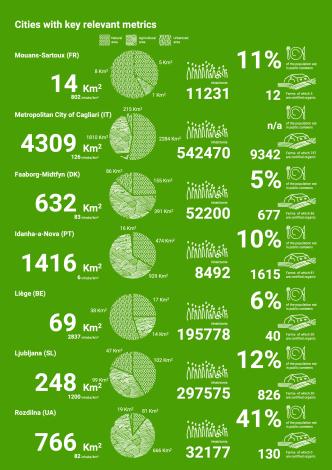
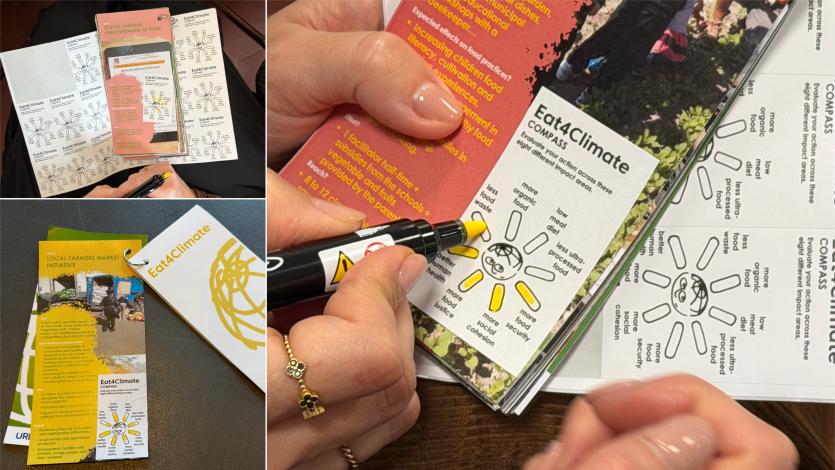
Now six very different European territories are asking whether the model can work for them too.The partners of Eat4Climate stretch from the Mediterranean to Scandinavia, from post-industrial Belgium to rural Portugal and wartime Ukraine. Each arrives with different political powers, food cultures and economic realities. Yet all face the same dilemma: climate neutrality will remain impossible without changing diets.
In the Metropolitan City of Cagliari, Sardinia’s expanding metropolitan authority sees food policy as a way to reconnect fragmented territories. The region retains strong Mediterranean traditions, but processed foods and supermarket dependency are rising fast, while obesity rates are increasing among children and adults alike.
Cagliari’s answer is ambitious. Five former markets are being transformed into multifunctional food hubs under the “Cittadella del Cibo” project, blending food education, social access and community activity. Metropolitan authorities hope these hubs can become living laboratories for climate-friendly eating.
The challenge is political as much as cultural. Cagliari does not directly control school catering, which is outsourced and fragmented across municipalities. Yet officials believe food can become a unifying issue linking public health, agriculture and social cohesion across the South Island territory.
Further north, Denmark’s Faaborg-Midtfyn municipality confronts a different reality. Here, meat-heavy diets remain deeply embedded in rural culture, shaped by generations of pig farming and agricultural identity.
The municipality has no formal food strategy. Children typically bring sandwiches to school rather than eat hot meals, and climate-friendly diets are often perceived as urban or elitist concerns.
Yet beneath the surface, small openings are appearing. Across the municipality, 65 volunteer-led community dinners already gather residents around shared meals. Regenerative farmers are experimenting with low-impact production. And a former industrial site – the Butchery Building – is being converted into a future food hub combining businesses, public services and citizen initiatives.
For local organisers, the project offers a way to reconnect climate policy with everyday pleasures rather than sacrifice.
“Eat4Climate inspired us,” say community organisers Rikke Dyrgaard Kapersen and Karin Lykkegaard. “We could create recipes people actually want to cook at home.”
In Portugal’s Idanha-a-Nova, the paradox is almost the opposite. The municipality has become internationally recognised as a bio-region and boasts more than 17,000 hectares of certified organic farmland. Yet much of that production is exported or sold into premium markets, while local food habits remain relatively unchanged.
Officials describe a lingering cultural contradiction. Traditional plant-based diets once associated with poverty were abandoned during decades of modernisation. Meat-heavy consumption became associated with prosperity. Eat4Climate offers the municipality an opportunity to rebuild what local actors call “food literacy”: reconnecting citizens with local organic production through schools, cooking education and community events. The city plans to create a Sustainable Food Education Centre inspired by Mouans-Sartoux’s MEAD model, while expanding organic public canteens already serving schools and elderly care facilities.
Liège, meanwhile, may be the network’s most politically complex partner. The Belgian city already possesses one of Europe’s most vibrant food-transition ecosystems, built over more than a decade through citizen movements such as the Ceinture Aliment-Terre Liégeoise, or Food Belt and the recently launched Food Policy Strategy.
Organic school meals, food cooperatives, anti-waste programmes and urban food festivals already exist. Yet officials acknowledge that these initiatives remain fragmented and struggle to compete against the city’s overwhelming fast-food environment.
“If in Mouans-Sartoux people are surrounded by sustainable food, here in Liège we are surrounded by junk food,” says Émile Farcy, one of the city’s food policy coordinators.
The city strongly counts on Eat4Climate to help connect its many scattered initiatives into something more systemic – not isolated projects, but a visible ecosystem capable of influencing daily habits across the wider population.
Ljubljana may be the partner closest to Mouans-Sartoux in spirit. Slovenia’s capital combines a strong food heritage with an extensive network of school food programmes, farmers’ markets and local producers.
Yet, as elsewhere in Europe, meat-heavy diets remain the norm and many sustainable food initiatives operate in isolation. City leaders see Eat4Climate as an opportunity to connect these efforts into a more coherent system that reaches beyond public institutions and influences everyday household choices.
By linking food education, local sourcing, urban agriculture and community engagement, Ljubljana hopes to reach 45% food self-sufficiency and to create an environment where sustainable eating becomes a natural part of daily life.
For Rozdilna, in southern Ukraine, sustainable food is closely linked to resilience. Despite the challenges created by the war, the municipality remains committed to improving food security, public health and climate action.
The city already serves thousands of meals daily through schools and social services, giving it a valuable starting point for change.
While home cooking and local food traditions remain strong, organic production is limited and processed foods are becoming more common. Through Eat4Climate, Rozdilna aims to develop its first comprehensive food strategy, using schools, local producers and community initiatives to encourage healthier and more sustainable eating habits.