
Among all the debates during the three days of the URBACT Cork summer university on identifying and engaging stakeholders, one question raised within the Eat4Climate transfer network deserves closer attention: do men participate equally with women in the food transition? Is the food transition gendered? What are the implications for Eat4Climate's strategies to shift food practices in favour of the climate?
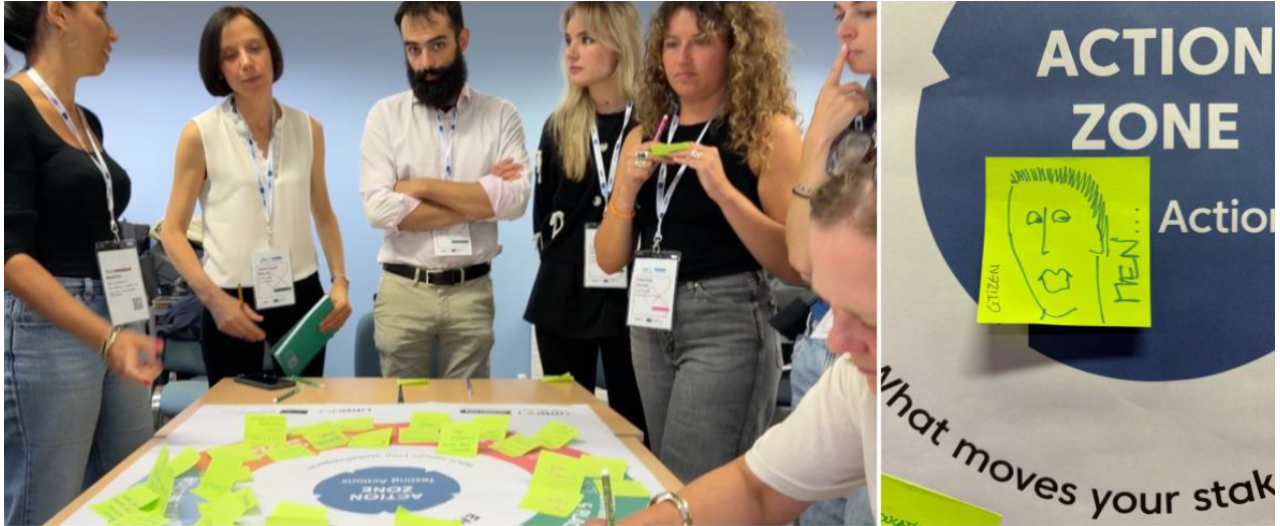
"28 participants at our last workshop on sustainable food in Faaborg-Midtfyn, not a single man!" "It's the same in Mouans-Sartoux - almost only women come to our sustainable food workshops."
What emerges from a quick look at available sources on gender and changing food practices?
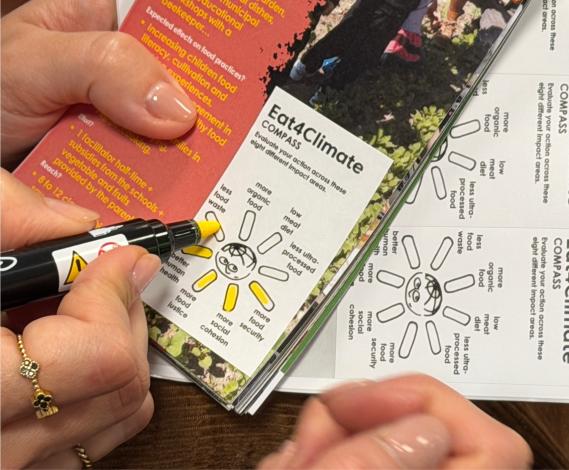
Looking at the question through the four critical entry points of the Sustainable Food Policy Compass (see picture above) developed by Eat4Climate (Less food waste, more organic food, low meat diet, less ultra-processed food), women generally appear more engaged than men in sustainable food practices - though this isn't uniform across all behaviours. The gap seems especially robust for reducing meat consumption, and to a lesser extent for organic products and food waste. For ultra-processed foods, the data show no systematic gender difference.
Above all, these findings raise an important paradox for the strategies to be implemented in Eat4Climate partner cities: women appear to drive the food transition more, but they already carry a disproportionate share of the domestic work that transition requires. Public policies that ask "households" to buy, cook, plan, avoid waste and prepare more raw ingredients risk placing an extra burden on women if they don't simultaneously seek to redistribute food-related work between women and men.
Do women participate more in the food transition?
A 2023 review of consumer attitudes and behaviours toward sustainable diets1 concludes that women are generally more engaged with concerns about food sustainability and are more likely than men to translate those concerns into behaviour. They also more often link meat consumption to environmental and animal-welfare issues and are more receptive to information about the benefits and impacts of reducing meat intake.
The same review notes, however, that gender doesn't act in isolation: education level, income, age, cultural context and food environment also shape behaviour. These differences shouldn't be read as "natural" traits of women or men. Gendered food preferences are closely tied to social and cultural norms, and their effects vary by context.

Meat reduction: the gender gap is particularly robust
This is probably the area where gender differences are best established. Men eat more meat on average, are underrepresented among vegetarians and vegans, and less often express intent to cut back. A 2024 study specifically examining the links between masculinity, meat and vegetarianism2 finds that meat consumption is strongly tied to certain traditional norms of masculinity.
The authors show that meat can function as a symbolic marker of masculinity: eating meat can be associated with being strong, virile, or fitting a certain idea of being a "real man." This norm can act as a barrier to dietary change. But the association isn't fixed - some forms of contemporary masculinity instead value vegetarianism, self-discipline, health, environmental responsibility or cooking skills.
An Italian study, also from 20243, surveying 400 consumers, looked specifically at what drives intention to reduce meat by gender. It found the underlying mechanisms differ: for men, time pressure and awareness of environmental and health consequences play a notable role; for women, the availability of protein alternatives and certain economic factors matter more.
This is a particularly useful finding for refining Eat4Climate partner cities' approaches: the same strategies can't simply be applied to everyone, since the barriers to change can differ by gender.
Organic products: slightly greater involvement among women
In the NutriNet-Santé cohort, which included 28,245 French adults, a 2014 survey4 found that women consumed on average a slightly higher share of organic products than men - 20% of their diet versus 18% for men. For vegetables, the share from organic farming was 31% for women versus 28% for men.
This doesn't mean all women eat more organic food than all men - this average difference, which has likely shifted since then, points for Eat4Climate to differences in health, environmental, family or food-responsibility concerns within the household.
Food waste: a much more ambiguous result
The picture is different for food waste. A 2018 systematic review of household food-waste practices5, drawing on around forty empirical studies, finds contradictory results regarding gender. Some studies find less waste among women; others find no gender effect at all; some even find more waste when women are responsible for shopping.
From Eat4Climate's perspective, it's worth noting that women are often more responsible for day-to-day household food management - and so are also more exposed to the problem of waste and to managing it. This points to an important distinction: producing less waste versus being responsible for the work needed to avoid it. That distinction is essential for a gender-equality analysis.
Ultra-processed foods: no systematic gender difference
This finding shades our initial hypothesis. A systematic review covering 55 studies across 32 countries, based on nationally representative samples, concludes that gender is generally not associated with ultra-processed food consumption.
Across the 22 European countries analysed, the gender difference was generally not significant. Where it existed, it was relatively small - in some countries men consumed more, in others women did. This is therefore an area where gender does not appear to be a major determinant of food practices for Eat4Climate to consider.
The food "gender gap" is also a "foodwork gap"
This is probably the most important dimension for guiding the design of food-transition policies in Eat4Climate partner cities.
The term "foodwork" covers all the work needed to feed a household: planning meals, deciding what to buy, shopping, preparing food, cooking, managing family members' preferences, storing food, dealing with leftovers, and so on.
The sociology of food shows this work remains heavily feminized. Priya Fielding-Singh, a sociologist at Stanford University, emphasizes that food decisions cannot be separated from the physical, cognitive and emotional labour that makes them possible.
A particularly important international study published in 2025 analyses cooking practices across 135 countries, based on 638,192 people surveyed in the Gallup World Poll. It finds that women cook at home 214% more often than men. The gender gaps persist across the different food systems studied. The authors themselves conclude that transforming food systems should include promoting gender equality in home meal preparation.
The foodwork literature thus cautions against treating dietary change as a simple matter of shifting individual preferences. Food behaviour is made possible by a domestic infrastructure of labour that is itself gendered.
What impact on gender equality?
For public policies within Eat4Climate, this points to a more nuanced question than simply how to get people to adopt more sustainable food practices. It also needs to ask: who does the work that makes these practices possible?
For example, a food-transition policy that encourages more fresh produce, more organic products, fewer ready meals, more legumes, less meat, more home cooking, better leftover management, more local and seasonal shopping, and so on, can indeed reduce the environmental impact of food. But it can also increase domestic food-related work when these tasks remain mainly carried out by women.
This is precisely why Fielding-Singh calls for moving beyond an approach centred solely on food choices, to also account for the labour that enables those choices, who performs it, and why it is distributed unequally.
An important implication for Eat4Climate
The literature supports a hypothesis particularly relevant to the network: the food transition is currently gendered. Women appear more engaged in several sustainable food behaviours, while men show notably stronger resistance to reducing meat. But this asymmetry is inseparable from a gendered division of domestic food labour. Women are both more likely to drive certain dietary changes and more responsible for the work needed to implement them.
This means that prioritizing women because they are already more engaged may be effective in the short term, but risks reinforcing existing inequalities.
A more transformative approach would seek simultaneously to shift food behaviours, increase men's participation in the transition, and redistribute the foodwork this transition requires between women and men.
A policy can succeed in its food transition while failing on gender equality if it shifts more food-related work onto women. Conversely, an intervention that leads men to reduce their meat consumption while increasing their involvement in planning, shopping and cooking could produce a double benefit: environmental and equality related.
-
E4C_260921_Who is cooking the transition_article.pdf(PDF, 666Ko)