Have you heard that URBACT has a brand-new type of call for networks? Open until 17 June 2026, the call for Action Networks (ANs) invites cities across Europe to partner together and turn existing strategies into concrete local results.
Want to know more? Let us brief you on this new opportunity and answer some questions you may have before submitting your application.
Turning strategies into real action
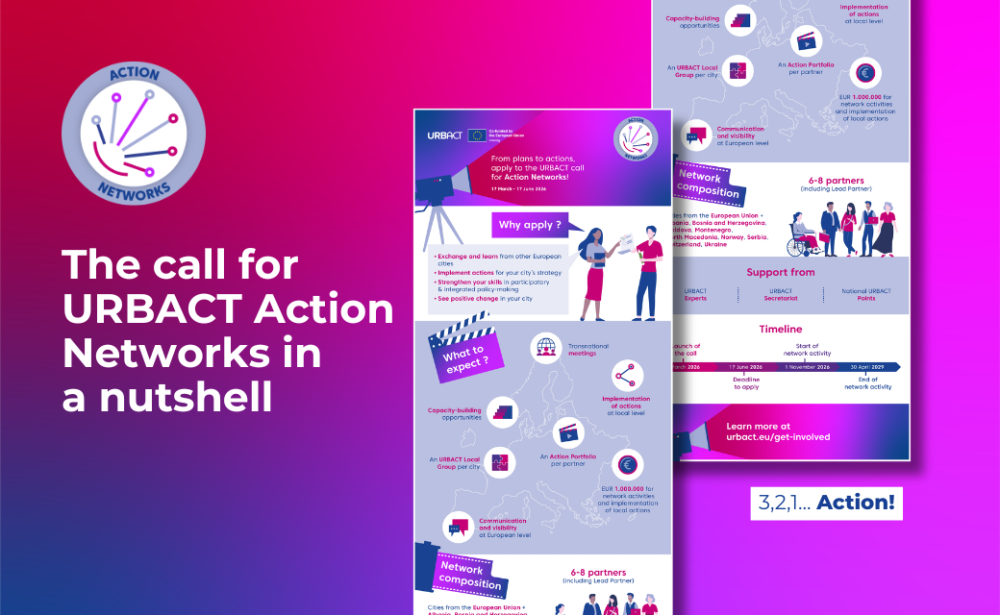
For cities that already have strategies or projects, URBACT Action Networks will help you ‘act’ on these existing plans between 1 November 2026 and 30 April 2029.
As part of a network, each city commits to refining, implementing and monitoring concrete actions, addressing clearly identified local challenges, through transnational collaboration and learning exchanges. With a dedicated budget in hand, each partner city can roll out targeted local actions, test solutions on the ground and fine-tune them in real time—bridging the gap between vision and tangible change.
What can partner cities expect at each phase of the URBACT Action Network journey?
The journey ‘in action’
The URBACT Action Network journey is split into three distinct phases, starting with a crucial ignition phase—where partnerships are fine-tuned, ambitions aligned and a clear Network Roadmap is set. This is also when cities come together for the first time at the ‘Ready for Action’ meeting, setting the tone for the journey ahead.
What follows is the heart of the programme: a hands-on phase driven by transnational exchange, peer learning and on-the-ground experimentation. Cities host practical local workshops, known in URBACT as Action Labs, to test and implement actions on the ground. In parallel, municipalities work with local stakeholders through URBACT Local Groups, dedicated local groups that help co-shape and support delivery. Together, these activities lead to concrete results, captured in an Action Portfolio for each partner and in a network-level ‘Actions Playbook’. The playbook brings together the main lessons, tested approaches and practical takeaways from the partnership.
The journey closes with a forward-looking finale. In its last stretch, each network showcases its achievements, sharing results and lessons learned—turning experimentation into lasting impact and setting the stage for what comes next.
By now, you may already be wondering what this means for your city. Who can apply? What kind of actions fit? And what would joining an Action Network actually involve? Let’s take those questions one by one.
Who can apply?
Each network brings together six partners from EU Member States and Partner States (Norway, Switzerland, Albania, Bosnia and Herzegovina, Montenegro, North Macedonia, Serbia, Ukraine or Moldova), with at least half coming from EU Member States.
The core partners are cities and public bodies, with the possibility of also including non-city partners. There is no minimum population size, so smaller cities are very much part of the picture too.
How extensive should a project proposal be?
Action Networks are meant for cities that already have a strategy, policy framework or action plan in place. Strong applications will have a clear starting point, even if some details are missing. From there, the focus is on choosing a number of realistic actions, implementing them during the network journey and learning from the process together with local stakeholders and partner cities.
What kind of actions can be implemented in the frame of the Action Networks?
Here are some examples, to be complemented with yours:
- Cities may pilot services or operational tools designed to address a specific urban challenge, like a digital platform for citizen reporting or neighbourhood problem-solving.
- Actions may focus on improving how institutions and stakeholders work together to deliver urban policies, like creating a cross-departmental task force within the municipality to coordinate climate adaptation measures.
- Cities may test temporary urban interventions that allow them to observe behavioural change or test spatial solutions before longer-term decisions are made, for example piloting temporary pedestrianisation or traffic calming measures in selected streets.
- Cities may implement actions designed to strengthen citizen participation and stakeholder engagement in policy delivery, like piloting new participatory budgeting mechanisms for small local projects.
- Some actions may focus on developing new capacities, tools or practices within the local administration or stakeholder ecosystem; for example, piloting new procurement approaches that support social or environmental objectives.
- Actions may also focus on adapting and testing solutions identified within the network, like piloting a community energy initiative inspired by another network partner.
What about funding?
Each network will have up to EUR 1.000.000 for network activities (the highest budget per network in URBACT history!), of which 50% should go to the implementation of local actions. On top of this, each approved network is slated to receive a dedicated expertise budget of EUR 127 500, which can support expert input on methodology, learning activities, stakeholder involvement and delivery.
What other types of support will network partners receive?
Action Networks are not only about getting resources to test actions on the ground. Cities also benefit from support throughout the journey. This support will come at programme level (from the URBACT Secretariat) but also from National URBACT Points, coupled with capacity-building and expert guidance and peer learning across the wider URBACT community.
A key moment will come at URBACT’s 2027 Summer University, where the entire Action Networks community will gather to jointly learn about participation to be able to fortify the co-creation process with the URBACT Local Groups.
Support will also come in the form of enhanced communication and visibility at European level. The network journey itself is remarkable, and the impact can only be amplified if it is properly communicated. All URBACT networks benefit from a dedicated webpage to communicate about good practices, case studies, recommendations or reports to an audience external to the beneficiary cities. In this sense, a network webpage acts as a ‘business card’.
URBACT is a regular and significant participant at European and worldwide events on integrated urban development (e.g. EU Week of Regions and Cities, EU Green Week, etc.). These events will provide platforms to promote the networks’ activities and outputs.
3, 2,1…are you ready to apply?
In a nutshell, URBACT Action Networks enable cities to turn ambition into action using the well-tested URBACT Method. This participatory co-creation and integrated approach also ensures the sustainability of results, all while building a community of like-minded peers across Europe.
We look forward to seeing your city take action! Submit your project proposal and find your partners by 17 June 2026 (by 15.00 CEST) using the Partner Search Tool. Get tips on finding partners and creating a great partnership in the applications guide.
Watch our online info session recording about the call for more information and stay tuned for more upcoming info sessions (general and national level). Here are some sessions you should keep an eye on:
12 May 2026, 10.00-11.00 CEST: Exchange and learning during the network journey
27 May 2026, 10.00-11.00 CEST: Time to submit your application: tech & troubleshooting (for candidate Lead Partners)
29 May 2026, 10.00-11.30 CEST: How to write good applications using storytelling techniques
9 June 2026, 10.00-11.00 CEST: Final troubleshooting (for candidate Lead Partners)