
European cities are not short on data. Today, sensors track air quality in real time. Administrative systems record who applies for housing, who claims benefits, who uses which services. Citizens fill in surveys, flag problems, and show up to consultations.
When it comes to the social policies, many cities still cannot answer basic questions: who is this policy actually reaching? Is the situation improving, and for whom? The gap is not about how much data exists. It is about connection: data that sits siloed across departments or disconnected from the decisions it should inform.
URBACT is expanding its knowledge platform to address the challenges surrounding effective social data management. Want an idea of the type of expert insights and partner city inputs from the new section of the URBACT Knowledge Hub? Read the article for information on what social data is, how it can be collected and managed, and, ultimately, how its impact can be measured.
Starting with the problem, not the data
Social data is never only just about people or their surroundings. It's about both: the individuals who live in a city, and the physical, spatial conditions around them, from housing to green space to mobility. Most social policies act on both at once, which is exactly what makes this data so valuable, but this potential is still too often overlooked.
Looking at the wider European agenda, evidence-based methodologies are a cornerstone of future urban policies. The Cities of Equality Partnership explores how better data can expose inequalities and unequal access to services, while the New Leipzig Charter calls for integrated, evidence-based urban development.
This capacity to use data gathered from different digital and social platforms can be explored further through the ‘Social Data Policy Cycle’. Its four stages are intended to mirror how evidence-based public policy in cities actually evolves:
- Diagnosis
- Analysis,
- Decision
Evaluation
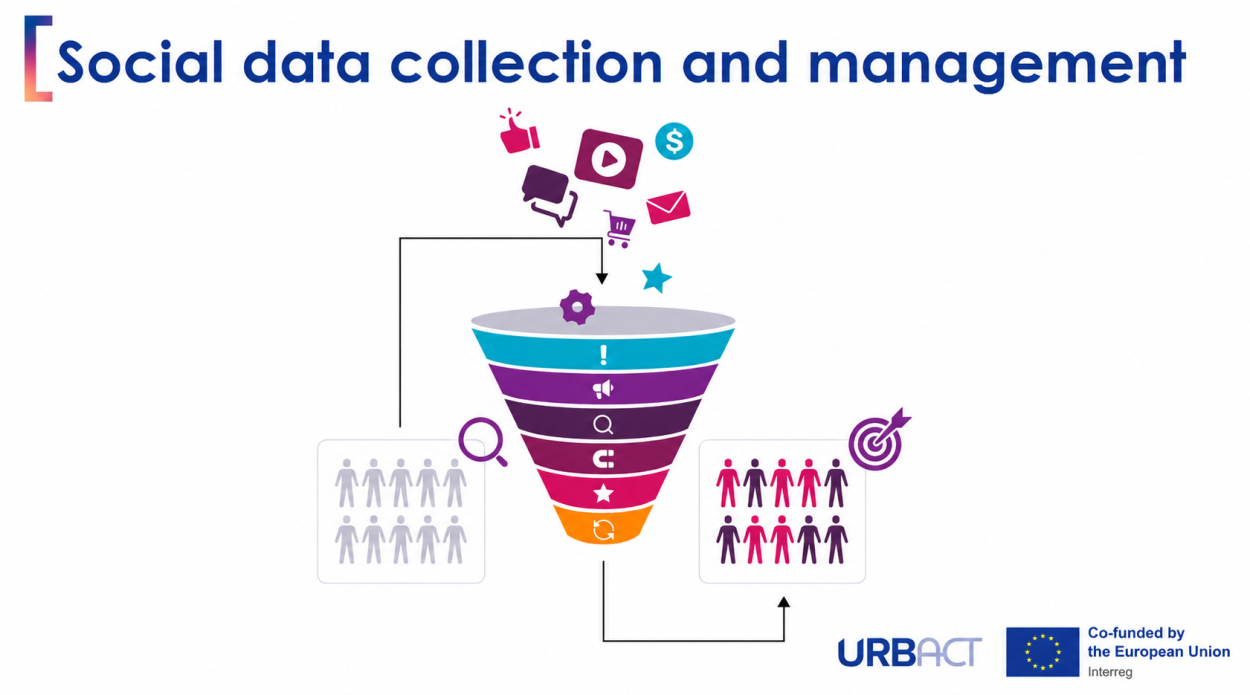
Having a clear starting point
The cycle begins with diagnosis: clarifying what problem a city is actually trying to solve, before deciding what to collect, from where, and how. The temptation is always to start the other way around (building dashboards or installing sensors simply because the technology is available), which only produces data sitting there without informing anything.
In practice, this might begin with a city reviewing the information held by different departments and discovering that, while it has detailed figures on service use, it knows much less about why certain residents do not use those services in the first place. A conventional survey may not solve that gap if the people most affected are also the least likely to respond. The city may instead need to collect information through schools, community organisations, local events or frontline services, using shorter and more accessible formats.
Diagnosis is, therefore, not only about identifying missing data, but also understanding whose experiences are absent and adapting the way evidence is gathered.
Turning numbers into something you can act on
Once the right data is flowing in, the next challenge is analysis: turning raw counts and records into indicators a city can actually understand. A single number rarely tells that story, and not every indicator is a direct count; some, like a satisfaction score or a vegetation index used as a proxy for green space quality, only work if you understand what they're standing in for.
Getting this right also means knowing when to act: defining the thresholds that turn a passive record into a signal worth watching. For example, a city can build indicators, combining health, lifestyle, and living-environment data into a single multidimensional picture instead of tracking any one metric alone. Viewed separately, each measure offers only a partial picture. They need to be analysed together. None of this matters, though, if the insight stays locked inside a spreadsheet. Some cities are making data visualisations (e.g. maps, charts) that residents, not just officials, can read and explore for themselves via public observatories or dashboards.
From insight to decisions that reach the right people
Having the evidence is not the same as using it well to make informed decisions. Cities that do this best treat policies as something to keep adjusting, not a fixed programme designed once and left to run. They use data to see what's working and change course, rather than just to justify choices already made. In practice, that means two things: targeting action at exactly where and for whom it's needed most, instead of running the same programme city-wide, and increasingly, trying to anticipate problems before they escalate rather than only reacting once they do.
To improve decision-making, some cities are using AI tools or developing social digital twin models of different issues (e.g. isolation, health). The AI can provide guidance, but the decision always stays with the human, frontline professionals who know their neighbourhoods.
Closing the loop: feeding back into the cycle
Impact is the part that actually matters: a stronger sense of belonging, safer public spaces, healthier communities, a neighbourhood that's genuinely improving rather than just delivering services. But it's also the hardest thing to measure because it asks not just what was delivered, but what changed, for whom, and whether it would have happened anyway. That takes both quantitative and qualitative approaches and it takes patience, since social change is slow to show up in the data.
Since social change rarely appears immediately, consistent measurement is often more useful than a single assessment at the end of a project. Evaluation, therefore, needs to be considered from the start, with a clear baseline, meaningful indicators and an understanding of what success should look like. Its purpose is not simply to prove that an intervention worked, but to identify what should be continued, changed or stopped. Those findings then feed into the next diagnosis, closing the cycle and improving the policies that follow.
Outstanding questions about effective data work
None of this works without answering a harder set of questions first: who is responsible for data, who can use it, and who is protected by it. Cities often run into the same four fault lines.
- Infrastructure (whether systems are open or proprietary, hosted locally or in the cloud) determines whether data can flow where it's needed at all, or gets locked into a system a city can't later escape.
- Capacity is not just about training analysts; it's about whether public officers have the competence to procure and oversee data systems themselves, rather than outsourcing the knowledge along with the technical work.
- Quality and ethics raise a deeper risk: data can reproduce the very inequalities it's meant to address, or reduce people to data points and none of it works without trust, since communities that don't understand how their data is used simply won't engage with it.
- Governance ties all three together: without a clear answer to who decides what gets collected, how it's used, who can access it, and who is accountable, infrastructure, skills, and good data end up scattered and unused. None of this is a technical problem that can be delegated. It's a political one, and it has to be treated as such from the start.
Getting it right also means getting the right people in the room. Effective data work brings together policy departments who define the problem, data teams who ensure technical quality, and frontline staff who know what's actually happening on the ground plus, just as importantly, the residents whose lives the data describes. Involving them isn't a courtesy; participation shapes which realities get counted in the first place, and communities that understand why data is being collected are the ones that engage with it honestly.
(Data) work in progress
Making social data work is not primarily a question of special resources or technology. It requires a shift in how cities treat data: not as a reporting obligation, but as a tool for understanding people's lives, deciding better, and learning from what happens next. That shift carries risk: data can flatten people into data points, reproduce the inequalities it is meant to expose, or erode trust if handled carelessly. Used with the right governance and care, data does something rarer: it lets a city argue with evidence instead of assumption, and be honest about what is and isn't working.
The new URBACT Knowledge Hub on Social Data Management is your go-to knowledge resource for understanding these concepts through the full cycle. There, you can also find ‘From social data to better cities’, URBACT’s public webinar series for an indepth view of the "Social Data Policy Cycle” and supporting materials. This is just a start…more materials and tools are coming soon.
Want to hear from URBACT cities working on social data management? Check out the URBACT Action Planning Networks (2022-2025), and related resources, including One Health 4 Cities, U.R. Impact, NextGen YouthWork and Cities@Heart.