"Without data, you're just another person with an opinion."
The famous quote by statistician W. Edwards Deming has been repeated countless times in policy circles. Yet anyone working in a city knows that data alone is rarely enough.
Cities have never had access to so much information as they do today. They can measure traffic flows, monitor air quality, map vacant buildings, analyse health trends, collect feedback from citizens, and rely on digital platforms that generate data every day. Yet many local authorities still face various questions: Are our policies actually improving people's lives? Which communities are being left behind? Are we investing where the needs are greatest?
The challenge, therefore, is no longer only collecting data; it is making sense of it.
This was the common ground discovered by four very different URBACT Action Planning Networks. Cities@Heart, U.R. Impact, One Health 4 Cities and NextGen YouthWork started from distinct policy priorities: city centre management, urban regeneration, health, and youth work. But as their projects evolved, one point became central: helping cities use social data to make better policy decisions.
Between 2023 and 2025, the partner cities explored how social data brings together perceptions, experiences, participation, trust, well-being and quality of life, dimensions that are often the hardest to measure, yet the most important for shaping better places.
How to collect the right data: The process begins with understanding what information is actually needed. It continues through collecting and managing data responsibly, analysing it together with local stakeholders, translating evidence into decisions, and finally evaluating whether those decisions have made a difference.
The four networks explored different parts of this cycle. Some cities questioned whether the available data truly reflected reality. Others developed new ways of combining health and well-being indicators. Some experimented with digital participation to better understand young people, while others worked with communities to define what successful urban regeneration should actually look like. Although they approached urban development from different angles, the four URBACT Action Planning Networks gradually converged around a common question: how can cities make better use of social data?
Cities@Heart: understanding the people behind the place
Bringing together 10 network partners, Cities@Heart set out to create more balanced, attractive and inclusive city centres. Early in the network's journey, partners realised that this required looking beyond economic indicators. Footfall, vacancies or commercial activity only tell part of the story. Cities also need to understand how people experience the city centre, who uses it, who feels excluded and why.
Across the network, cities experimented with combining quantitative information with local knowledge and stakeholder engagement. In Sligo (IE), for example, official vacancy data was complemented by local observation and collaboration with businesses to build a much richer understanding of how the town centre functions in practice. Rather than collecting more data, the network demonstrated the importance of collecting the right data.
For cities wondering where to begin, the Cities@Heart Playbook: A Policy Guide to Transform Your City Centre turns the network’s experience into a hands-on guide, structured around five strategic levers and filled with practical tools, indicators and examples from all ten partner cities.
Cities@Heart included Métropole du Grand Paris (FR) (Lead Partner), Kraków Metropolis Association (PL), Granada (ES), Osijek (HR), Associação de Municípios de Fins Específicos Quadrilátero Urbano (PT), JZ Socio Celje (SI), Sligo (IE), Cesena (IT), Fleurus (BE) and Lamia (EL).
U.R. Impact: from measuring projects to measuring change
For U.R. Impact, which brought together 10 network partners, social data became the foundation for a new way of approaching urban regeneration. While still asking whether projects had been delivered on time and within budget, the network encouraged cities to also ask a more ambitious question: what difference are these projects making in people's lives?
Working together, partners explored how social impact could be planned from the beginning of an intervention through Theory of Change, co-created indicators and participatory evaluation. Cinisello Balsamo (IT) illustrates this approach well. Rather than defining indicators internally, the municipality involved different municipal departments and local stakeholders in identifying what success should look like, from stronger social cohesion and civic participation to improved well-being. The result was not only a framework for evaluation but also a shared language across the local administration.
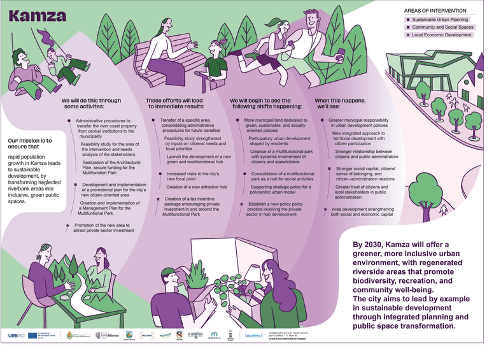
What does this approach look like in practice? The U.R. Impact Exhibition Catalogue answers through expert reflections, stories from the partner cities and nine visual Theory of Change posters that trace the path from local challenges to meaningful social impact.
U.R. Impact included Cinisello Balsamo (IT) (Lead Partner), Bielsko-Biala (PL), Bovec (SI), Broumov (CZ), Hannut (BE), Kamëz (AL), Longford (IE), Mértola (PT), Murcia (ES) and Târgu Frumos (RO).
One Health 4 Cities: connecting health data and urban policy
The nine network partners in One Health 4 Cities brought together municipalities working at the intersection of health, environment and urban planning. The network highlighted that health data is no longer relevant only to public health departments; it is becoming a strategic resource for shaping urban policies. Cities explored how existing datasets, digital tools and cross-sector collaboration can support decisions on wellbeing, prevention and quality of life.
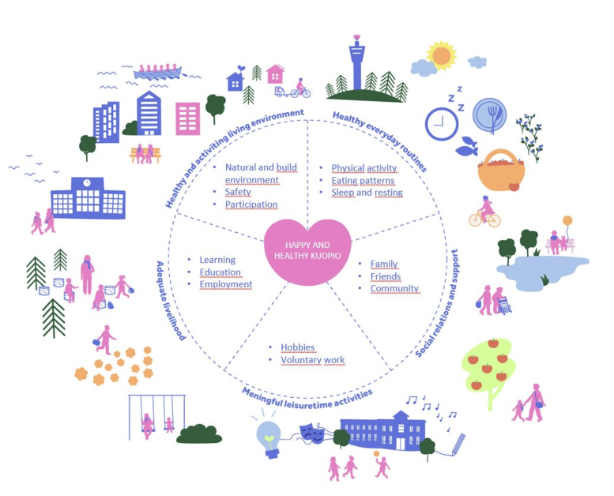
Kuopio (FI) offers a compelling example. By combining national datasets with interactive dashboards, the city monitors well-being indicators that directly inform strategic priorities. Data is not treated as a reporting exercise but as an everyday management tool that helps guide investments and long-term planning.
The numbers alone make One Health for Cities: The Essential Guidebook for City Makers worth exploring: 142 practical tips, 15 urban case studies and an index of 19 tools show how cities can move One Health from an ambitious idea into everyday policy-making.
One Health 4 Cities included Lyon (FR) (Lead Partner), Suceava (RO), Eurometropolis Strasbourg (FR), Kuopio (FI), Loulé (PT), Lahti (FI), Benissa (ES), Elefsina (EL) and Munich (DE).
NextGen YouthWork: making young people's voices visible through data
Across the 10 network partners of NextGen YouthWork, the question was again different: how can cities understand the realities of young people in an increasingly digital world?
The network explored how digital youth work generates valuable forms of social data, meaning not only statistics but continuous feedback, participation and dialogue.
Cities such as Oulu (FI) and Klaipėda (LT) demonstrated how information collected through youth services and digital engagement can help adapt programmes more quickly to changing needs. Rather than evaluating policies years later, practitioners use data as an ongoing learning process that strengthens both participation and service design.
Looking for a way into the fast-changing world of youth work? The NextGen YouthWork Final Network Product mixes city profiles and policy recommendations with practical lessons, tested approaches and short videos covering digital, hybrid and offline youth work.
NextGen YouthWork included Eindhoven (NL) (Lead Partner), Aarhus (DK), Cartagena (ES), Iași (RO), Klaipėda (LT), Oulu (FI), Perugia (IT), Tetovo (MK), Veszprém (HU) and Viladecans (ES).
Social data: four lessons for European cities
Looking across all four networks, several common lessons emerge.
- First, start with the policy question, not with the available data. Data only becomes meaningful when it helps answer a real and specific challenge.
- Second, build a culture of data, not simply a database. Technology matters, but collaboration, trust and shared understanding matter even more.
- Third, combine numbers with lived experience. Social data is strongest when quantitative indicators are enriched by qualitative insights.
- Finally, measure impact to learn, not simply to report. Evaluation should support better decisions, encourage adaptation and strengthen public trust.
From data to better cities
No single city has all the answers, but in URBACT networks cities share methods, challenge assumptions and learn from one another. In this case, through exchange and learning data becomes something much more powerful than information. It turns into a catalyst for better conversations, better decisions and, ultimately, better cities.
Want to find out more? Read our article For the love of data and consult the new URBACT Knowledge Hub on Social data management. The resources gathered there, including the webinar series, and city examples, can support municipalities across Europe that wish to strengthen evidence-informed policy making and make social data work for their communities.