
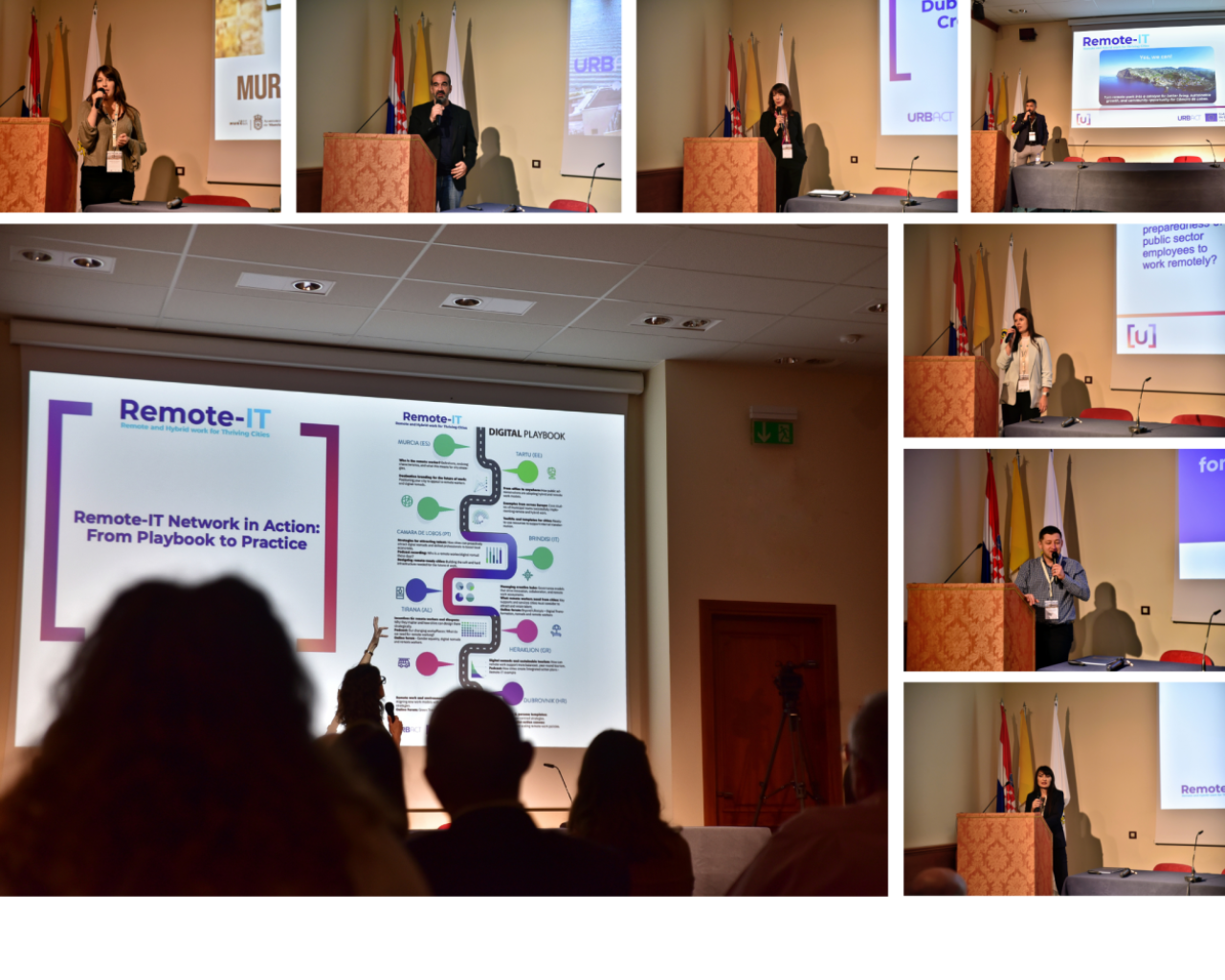
Insights from two and a half years of experimentation, collaboration and learning across eight European cities
The Remote-IT URBACT network brought together cities that were different in size, geography and administrative culture, yet united by a common challenge: understanding how remote work is reshaping urban life and how local governments can respond in a strategic, and future-oriented way. Over 2.5 years, partners tested policies, rethought internal systems, supported local ecosystems, and exchanged knowledge through URBACT’s participatory methods.
The following 10 Recommendations reflect what the cities learned collectively. They are practical, repeatable insights that can guide any municipality aiming to integrate remote work into its development, inclusion and sustainability strategies.
1. Understand who you are designing for – personas matter
Cities repeatedly confirmed that remote workers, hybrid municipal employees, SMEs, digital nomads and returning diaspora are not uniform groups. Without clear personas and mapped user journeys, policies quickly become generic and ineffective. Remote-IT showed that grounding decisions in real needs through interviews, surveys and co-creation, results in targeted, inclusive and feasible solutions.
2. Build integrated, cross-sectoral strategies – no siloed solutions
Remote work is not only a labour-market issue. It affects mobility, housing, digitalisation, tourism, public administration, sustainability and social inclusion. Cities that approached remote work through isolated departments struggled to move beyond small actions. Those that integrated HR, IT, planning, economic development, tourism and environmental teams progressed faster and delivered more coherent outcomes.
3. Pilot, learn and iterate - small tests lead to scalable change
Remote-IT’s strongest operational lesson is that prototyping works. Whether testing hybrid-work rules in one department, trialling a remote-work welcome service, or experimenting with hub governance models, small and controlled pilots revealed challenges early and prevented costly failures.
4. Invest in both soft and hard infrastructure – both are essential
Digital infrastructure, coworking spaces, public Wi-Fi and ergonomic setups matter, but they are insufficient without “soft” infrastructure such as community networks, digital skills, HR reform, support services and incentives. Remote-IT cities learned to design for both: spaces that function and ecosystems that sustain them.
5. Foster collaboration between public and private sectors – ecosystems thrive together
Remote-work ecosystems rely on many actors: local SMEs, real-estate providers, coworking operators, universities, tourism organisations, digital-skills providers and civil society. In every Remote-IT partner city, progress accelerated when the municipality acted not only as regulator but as coordinator and facilitator. Ecosystems flourish when responsibilities are shared and value is co-created.
6. Address inclusion and equality from the start – access must be universal
Remote work can widen opportunities, but it can also deepen disparities. Cities must consider gender, disability, income, housing stability, age and digital access when designing policies. Remote-IT partners found that inclusive approaches such as accessible digital onboarding, affordable workspaces, clear procedures, and multilingual communication- strengthen legitimacy and social cohesion.
7. Link remote-work strategies with sustainability goals
Reduced commuting, smarter use of buildings and more balanced tourism patterns can support climate goals. But sustainability benefits are not automatic. Cities must coordinate remote-work strategies with mobility planning, energy-efficiency policies, tourism management and environmental goals.
8. Use digital transformation as a tool for social innovation – not an end in itself
Digital tools can make hybrid work possible, but Remote-IT partners consistently learned that technology alone does not transform organisations. True impact comes from digital practices that enable collaboration, transparency, inclusive communication and new service models. Digital transformation worked best when it supported human-centred organisational change, not when it was pursued for its own sake.
9. Engage local communities and stakeholders continuously – co-create solutions
Community engagement is essential in all phases: diagnosing needs, designing pilots, testing policies and evaluating outcomes. URBACT Local Groups helped Remote-IT cities involve residents, businesses, remote workers and civil-society groups meaningfully. Solutions developed with communities are proven to be more realistic, better supported and easier to scale.
10. Keep learning – policies must evolve as work does
Remote work continues to change shaped by technology, global labour markets, worker expectations, geopolitical shifts and economic trends. Remote-IT reinforced that cities need adaptive policies: regularly reviewed, data-informed and open to iteration. Continuous learning, supported by peer networks like URBACT, is a long-term governance capacity, not a one-off task.
Remote-IT leaves behind not only tools and pilot actions, but a mindset:
start small, stay user-centred, work across sectors, and keep learning.