Welcome to the CSG final network product
When the Cities for Sustainability Governance started its journey in 2023, a few “CSG principles” were set to guide our work and collaboration. These were:
- A roundtable and co-exploration approach
- Pioneering work
- Non-linear, iterative co-creation
- No “one-size-fits-all”
- Embracing different starting points
- Taking active roles
Now, 2.5 years later, those principles continue to reflect the sense-making process we have been engaged in since the start.
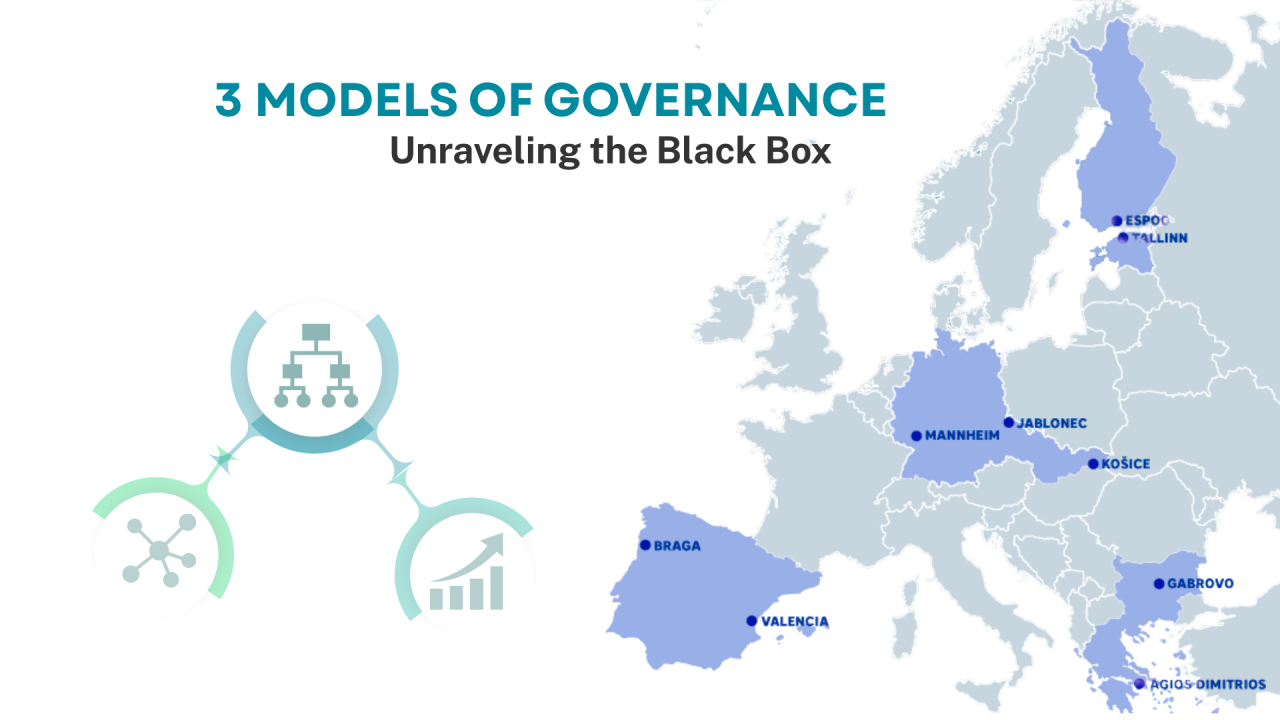
The CSG tool is based on three governance “models”, that stem from - in addition to the experiences coming from the CSG partners - three main theoretical sources: 1) Prof. Meuleman’s governance styles, 2) the duality of hierarchical and network governance presented by Espoo´s SDG report: ”Stories of European Cities”-book (published Dec 11th 2025), and 3) the work of Dr. Barbara Karanian on Storytelling, Stanford University, USA.
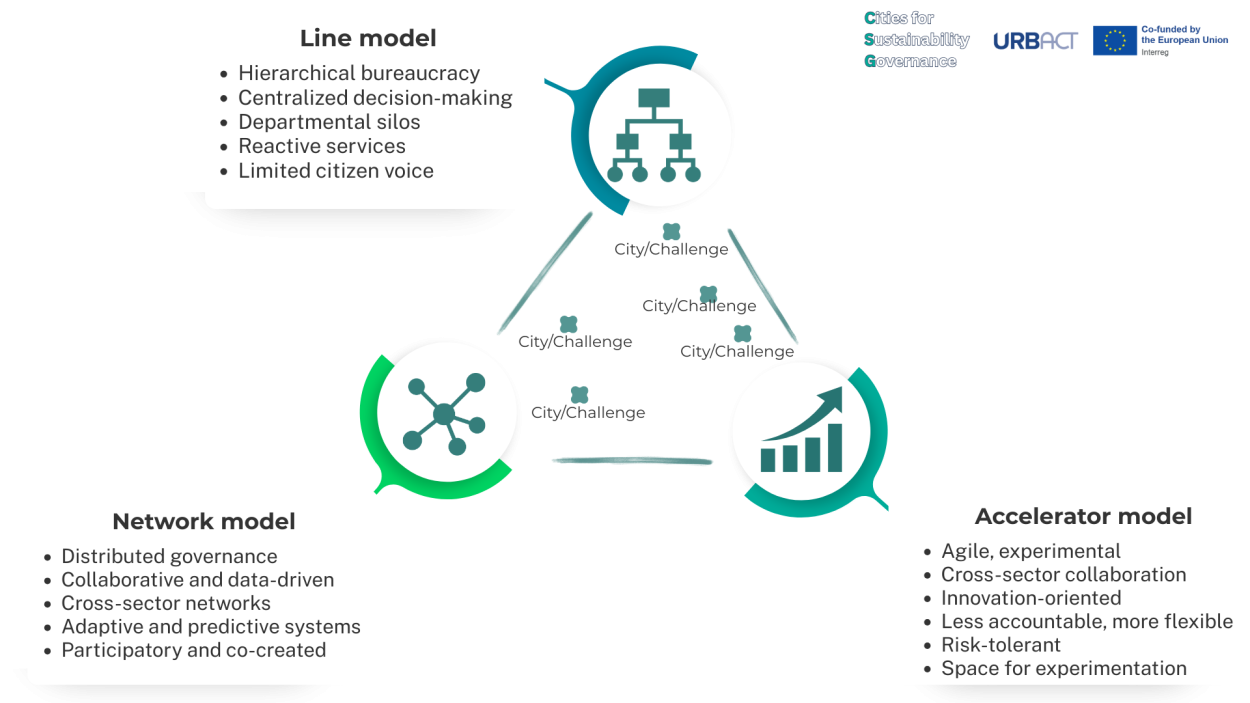
The Line model - which represents more traditional, top-down governance is used to steer the city organisation towards systematic and structured change. The Network model - based on decentralised governance and collaboration. Accelerator model - provides freedom to experiment and innovate.
None of these models is likely to be found in a “pure” form in a city, since urban governance comes from a mix of contexts and approaches. Yet, having three complementary, even contrasting models allows for reflection, analysis and discussion. Understanding how things are currently in a chosen context, a city can deliver better outcomes.
We invite you to explore the three models, then look at some examples from the CSG partner cities.
The CSG tool - reflecting on governance contexts
The model of effective governance varies based on:
- Governance culture,
- Phenomenon in question, and
- City management focus
…We have to first understand where we are in this 3 models frame as a community. Which governance model is most prominent in the current context? Then design how to make change happen.
How to use the CSG tool
- Explore the three models of urban governance
- Consider your specific urban context / challenge / project
- Reflect on where in the triangle you think it would fit currently and why
- Discuss / reflect on how the less prominent models may add value to how you make change happen
- Choose the “ideal” position in the triangle
Line model
Despite the advantages offered by network and accelerator models, traditional line-model municipal organizations remain highly effective in many contexts, particularly in implementation of day-to-day services of cities.
Line organizations operate through clearly defined processes, hierarchical structures, and focused planning frameworks. Roles and responsibilities are well established, supported by regular budgetary cycles. This model is designed to maintain and deliver the core services that define city operations, such as education, infrastructure, and social services.
While not inherently future-oriented, line organizations excel at executing day-to-day services efficiently. They fulfill the implementation role within a dual municipal system, where elected decision-makers set policy and the city organization ensures administration and governance. Traditional city governments are structured to provide essential services reliably—water, waste management, transportation, housing, and public safety. Their bureaucratic form is optimized for repeatable, regulated, and accountable execution.
Examples from the CSG network where the line model is most prominent:
- Agios Dimitrios' Data-driven Sustainability Governance
- Braga's Strategic Model for Sustainable Development
- Braga's Sustainability Reporting
- Creating Impact through Integration in Espoo
- Gabrovo’s new Governance Model for Strategic Alignment
- Jablonec nad Nisou’s new sustainability management
- Tallinn’s Sustainability Governance Model
Network model
A network-based organizational model is inherently future-oriented, agile, and innovative. By leveraging networks, developers gain access to extensive information flows, shared resources, and diverse expertise. This connectivity fosters innovation and enables flexible stakeholder participation around specific themes.
Unlike traditional municipal structures that centralize control, a network-driven approach functions as an interconnected ecosystem. It brings together government agencies, private enterprises, community organizations, nonprofits, and citizen groups. The goal is to co-create city services and initiatives through public–private–civic partnerships, ensuring optimal quality and relevance.
Digital infrastructure, such as IoT systems, data platforms, and sensor networks, provides a robust foundation for collaborative development. Each actor contributes and shares resources, information, and decision-making through digital and social networks. This creates a city environment that is adaptive, participatory, and efficient.
Examples from the CSG network where the Network model is most prominent:
- Agios Dimitrios’ Youth Advocates programme
- Espoo's Participatory Approach to Sustainability Communication
- Gabrovo's SDG engagement
- Jablonec nad Nisou’s Climate Mainstreaming and Continuous Learning Approach
- Košice’s new Sustainable Development Education
- Mannheim’s city-to-city exchange
- Mannheim’s Urban Thinkers Campus
- Tallinn's Sustainability Governance Hub
- The Sustainable València Framework and Green Book
Accelerator model
The accelerator model enables cities, in collaboration with key partners, to establish independent foundations or intermediary entities (e.g. development agencies) to coordinate large-scale, cross-sector projects. This approach creates a safe space for experimentation by:
A) Testing innovative solutions without disrupting the existing bureaucratic or line-model organization prematurely.
B) Avoiding entanglement in political discourse during the early stages of experimentation.
C) Facilitating collaboration among government, businesses, and citizens, with the city acting as an orchestrator.
When granted an adequate mandate, these semi-independent entities operating in a networked mode can transform policy ambitions—such as climate neutrality—into actionable programs. They connect with universities, startups, community organizations, and NGOs, forming flexible structures tailored to specific challenges. Citizen engagement is fostered through open innovation platforms and Living Labs, enabling participatory projects.
Partners collaborate with the foundation to co-design strategies, ensuring alignment and shared ownership of outcomes.