The industrial dilemma Europe is struggling with
Across Europe, thousands of towns have grown around industry. Steel plants, textile factories, manufacturing workshops and logistics hubs have shaped not only local economies, but landscapes, identities and ways of life.
Today, these same cities sit at the centre of one of Europe’s most complex transitions. They are expected to decarbonise, become more resource-efficient and embrace new technologies—while continuing to provide jobs, attract investment and remain competitive. For small and medium-sized industrial cities, this balancing act is particularly delicate. They often depend on a limited number of sectors, operate with constrained local capacities, and host ageing industrial areas that are difficult to transform.
In many places, the risk is clear: if the green transition is poorly managed, it can deepen industrial decline, social vulnerability and territorial inequalities. Yet the opposite is also true. When approached strategically, industrial transition can unlock innovation, improve quality of life and reposition cities within emerging green value chains.
This tension—between decline and renewal—is where In4Green is rooted.
Ten cities, ten industrial realities – why In4Green was needed
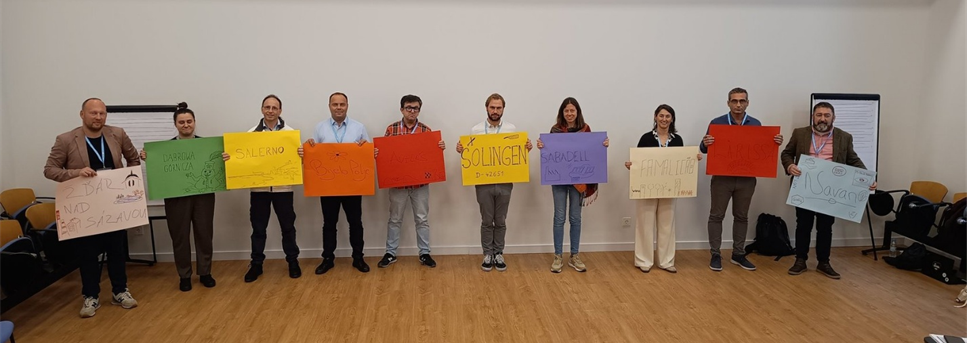
In4Green brought together ten European cities with very different industrial profiles, but a shared question: how can industry become an ally of the green transition rather than its main obstacle?
Some partners are dealing with heavy industrial legacies, and vast post-industrial sites close to their city centres, as in Dąbrowa Górnicza. Others, like Avilés or Solingen, are working to modernise established manufacturing bases while supporting SMEs under increasing environmental pressure. Textile-driven innovation ecosystems shape cities such as Vila Nova de Famalicão, while places like Navan or Žďár nad Sázavou focus on skills, energy and community-level transformation to sustain their local economies.
The contexts differ, but the challenges overlap: high emissions, inefficient energy systems, fragmented industrial areas, skills mismatches, limited cooperation between municipalities and businesses, and difficulties translating European climate objectives into concrete local action.
Rather than treating these issues separately, the In4Green cities approached them as interconnected parts of a broader industrial transition. From renewable-based district heating in Bijelo Polje to energy communities in Sabadell, from business collaboration offices in Larissa to reuse and repair hubs in Navan, the network became a space to explore how green transition plays out in real industrial settings, with real constraints and trade-offs.
What united these experiences was not a single model, but a shared determination to ensure that green transition strengthens—rather than replaces—the industrial foundations of their cities.
Where change is happening on the ground
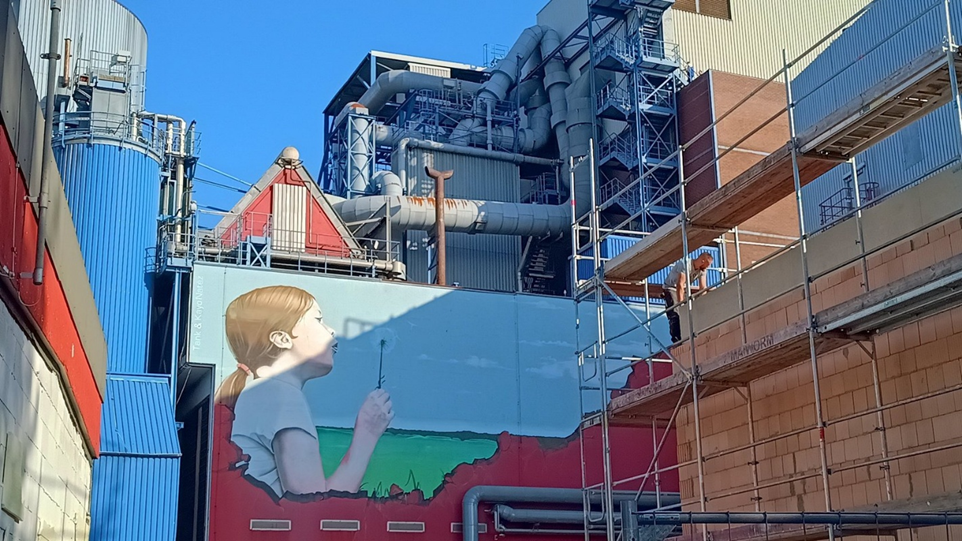
Across the In4Green network, green transition stopped being an abstract objective and took shape through very concrete interventions, rooted in local industrial realities. While approaches differ, together they illustrate how small and medium-sized cities are acting where the transition really happens: in industrial areas, energy systems, skills pipelines and everyday economic practices.
In Avilés, the focus is on rethinking industrial land and innovation together. The city’s Integrated Action Plan builds on the regeneration of obsolete industrial areas and the development of the Isla de la Innovación, a science and technology park designed to attract R&D-intensive and green economic activities. Brownfields are no longer seen as a liability, but as strategic assets for diversifying the local economy and reconnecting industry with the urban waterfront.
In Bijelo Polje, green transition starts with air quality. Facing severe winter pollution caused by individual coal- and wood-based heating systems, the city is preparing a renewable-based district heating network powered mainly by biomass. This long-term investment aims to cut emissions, improve public health and reduce energy costs, showing how industrial and energy infrastructure can directly improve quality of life.
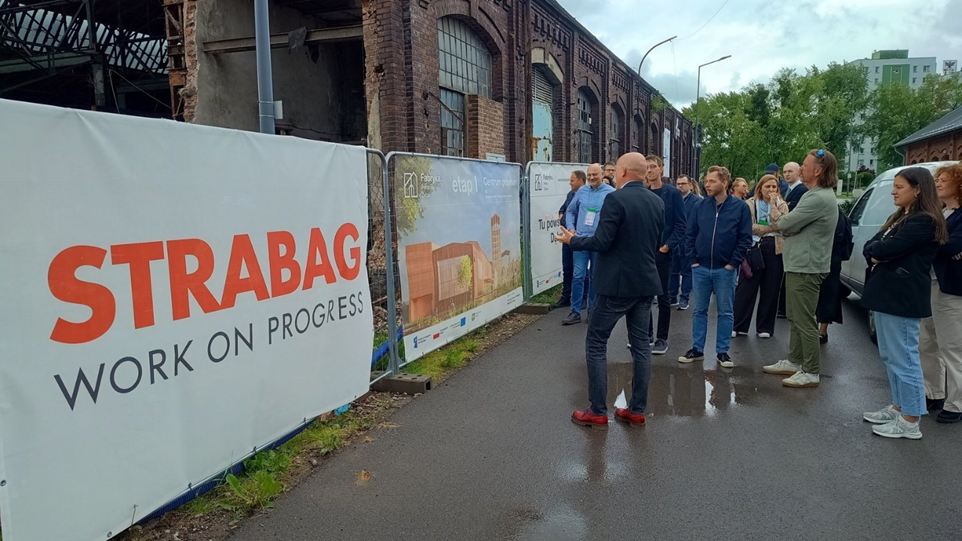
In Dąbrowa Górnicza, the challenge is how to give new life to a declining industrial core. The Full of Life Factory project focuses on transforming a large post-industrial site near the city centre into a multifunctional area combining economic, cultural and social activities. Here, green transition is inseparable from urban regeneration, public space and local identity.
In Larissa, the emphasis is on governance and coordination. The city is establishing a Business Collaboration Office inside the municipality to act as a permanent interface between public administration, companies and knowledge institutions. Rather than a one-off project, it creates a structured mechanism to co-design green investments, improve logistics and align industrial needs with municipal policies.
In Navan, circular economy is made tangible through people’s daily practices. The planned Community Reuse & Repair Hub aims to centralise repair, reuse and upcycling activities, offering citizens a visible space to learn skills, reduce waste and support social economy initiatives. Green transition here is about behaviour change as much as infrastructure.
In Sabadell, decarbonisation is tackled collectively. The city is assessing the feasibility of creating an industrial energy community, enabling SMEs to jointly produce and share renewable energy. By reducing costs and emissions simultaneously, the initiative responds to regulatory pressure while strengthening cooperation among businesses.
In Salerno, green transition intersects with social inclusion. Urban regeneration actions focus on reactivating abandoned or underused buildings as multifunctional spaces hosting cultural, educational and community services. These projects link environmental sustainability with social cohesion and opportunities for young people.
In Solingen, industrial transformation centres on circularity. The planned Circular Economy Competence Centre is designed to support manufacturing SMEs with advisory services, innovation tools and access to expertise, helping them adopt resource-efficient and circular production models within a traditional manufacturing context.
In Vila Nova de Famalicão, innovation infrastructure plays a central role. The redevelopment of INHUB as an Innovation Campus aims to bring together companies, startups, research centres and training organisations, reinforcing the city’s position within green and digital industrial value chains.
In Žďár nad Sázavou, skills are the entry point. The expansion of a Fablab-based technical education programme focuses on equipping young people with practical competencies in engineering, digital fabrication and innovation, helping local companies address skills shortages while improving the city’s long-term attractiveness.
Together, these examples show that greening industry is not a single path, but a set of locally grounded responses—each shaped by history, scale and economic structure.
What cities learned from each other (and why it mattered)
What made In4Green distinctive was not only the diversity of actions, but the way cities actively borrowed, adapted and reinterpreted ideas from one another.
Cities working on SME decarbonisation and industrial cooperation drew inspiration from Avilés’ structured approach to engaging companies and linking climate objectives with competitiveness. Experiences from Vila Nova de Famalicão’s innovation ecosystem and textile R&D influenced partners looking to strengthen links between industry, research and skills development. Navan’s community-driven energy transition provided a concrete reference for cities exploring participatory models in energy and circular economy.
Post-industrial regeneration in Dąbrowa Górnicza informed discussions in cities facing similar spatial challenges, such as Salerno and Bijelo Polje. Meanwhile, exchanges between Sabadell and Solingen helped refine approaches to circular economy support for manufacturing SMEs.
These inspirations did not result in replicas. Instead, they helped cities ask better questions: Who needs to be involved? Where should public intervention focus? What can realistically be implemented next? In this sense, cooperation accelerated decision-making and reduced the risk of investing in untested or misaligned solutions.
From local actions to transferable pathways: the In4Green Playbook
The diversity of actions across the network raised an obvious question: how can such different experiences be useful beyond their local contexts?
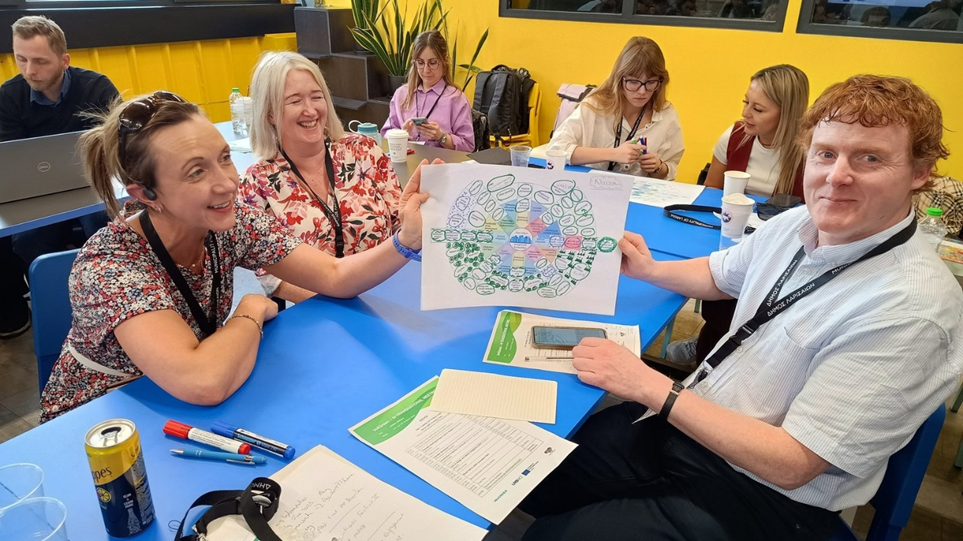
The In4Green Playbook was created precisely to answer this. Rather than cataloguing projects city by city, it distils the network’s experience into clear pathways for action, based on recurring patterns observed across the ten cities. These pathways reflect how industrial transition actually unfolds on the ground: through governance choices, investment priorities, skills development, spatial transformation and cooperation with businesses.
Drawing on the Baseline Study, the testing activities and the Integrated Action Plans, the Playbook translates complex experiences into practical guidance. It shows, for example, how cities can approach industrial decarbonisation without losing competitiveness, how circular economy initiatives can be anchored in SME realities, or how innovation infrastructures can connect education, research and production.
Importantly, the Playbook does not propose a fixed model. It recognises that industrial cities start from very different positions—economically, socially and territorially. Its value lies in helping cities identify where to start, what to combine, and which pitfalls to avoid, based on lessons already learned by peers facing similar constraints.
For cities beginning their green transition, it offers structure and orientation. For those already advanced, it provides benchmarks, inspiration and concrete ideas to refine their strategies.
What this means for other industrial cities in Europe
The experience of In4Green shows that greening industry is neither a technocratic exercise nor a distant policy goal. It is a place-based process that touches energy systems, industrial land, skills, governance and everyday economic practices.
For other small and medium-sized industrial cities, the message is clear: transition does not mean abandoning industry. It means reshaping it—step by step—so that environmental ambition, economic resilience and quality of life reinforce each other rather than compete.
In4Green does not offer shortcuts. What it offers is reassurance grounded in practice: that industrial transition is possible even with limited local capacities, that cooperation can accelerate learning, and that concrete actions—whether an energy community, a competence centre, a regeneration project or a skills programme—can open new trajectories for cities that have long depended on industry.
As Europe advances its green and industrial agendas, these experiences matter. They show how high-level objectives translate into local decisions, and how cities that once powered Europe’s industrial past can actively shape its sustainable future.