• PROJECT "VITAL CITIES" COMES TO THE END BUT LOULÉ WANTS TO KEEP INTERNATIONAL PARTNERSHIPS TO PROMOTE PHYSICAL ACTIVITY

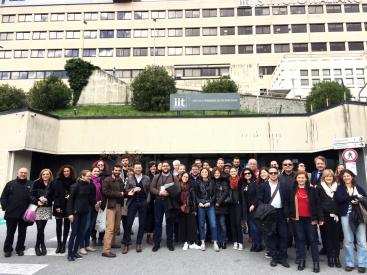
    The ten cities that form the European network "Vital Cities" gathered on March 19 and 20 in Loulé, for the final meeting of this project to promote physical activity. As a leading partner, Loulé was the host of this review event where the partners had a clear positive balance, especially in the exchange of experiences and good practices.

    Combating sedentariness in all age groups, creating solutions in the public space to encourage the population to practice sports, breaking social barriers through sport, promoting actions in poor areas, are some of the commitments assumed by the network that, in addition to Loulé, has also joined Burgas (Bulgaria), Krakow (Poland), Budapest (Hungary), Birmingham (England), Vestfold County / Horten (Norway), Rieti (Italy), Usti Nad Labem (Czech Republic), Liepaja and Sibenik (Croatia).

    jguerreiro

    See more
  • Freight TAILS lead partner Cross River Partnership shares urban freight experiences

    As we approach the final few weeks of the Freight TAILS project, lead partner Cross River Partnership (acting on behalf of City of Westminster) publishes a series of case studies highlighting their work related to urban freight transport.  

    charlotteknell

    See more
  • More Freight TAILS Focus....

    The Freight TAILS network is pleased to publish the final three 'Focus on...' reports summarising the views and experiences of our 10 partner cities on our themes of Urban Freight Transport and Regulation & Enforcement, Voluntary Behaviour Change, and Procurement.

    charlotteknell

    See more
  • Cities in migration - A conversation with Anne Bathily on integration

    I have first met Anne Bathily, expert on integration policies former policy officer at European Council on Refugees and Exiles (ECRE) and now at UNHCR for Northern Europe, in the early meetings of the EU Urban Agenda Inclusion of migrants and refugees.

    Since then, we entered in never ending and always enriching informal conversations about  the role of cities in integration of migrants and refugees.

    This article is a recollection of our conversations. It looks forward at ways to capitalise on the work that URBACT network Arrival cities has achieved in the last 2 years.

    Laura Colini

    See more
  • Murcia - Integrated Action Plan

    How can cities develop long-term strategies that integrate the goals of more sustainable resource use, reduced carbon emissions and more equitable social development? Learn more through this video! This video is part of the URBACT II Capitalisation Workstreams.

    fvirgilio

    See more
  • CLLD Lisbon - Integrated Action Plan

    The CLLD Lisbon Network - Community-Led Local Development aims to develop effective models of local co-governance of the city that favour the implementation of actions articulated between the social, educational, cultural and economic sectors to promote inclusion and social cohesion, employment and education in disadvantaged areas in the urban context of the Municipality of Lisbon. Those urban areas are called BIP/ZIP – Priority Intervention neighborhoods. The Local Strategy of Development (LSD) general objective is to contribute to the reduction of the socio-urban fracture identified in the city of Lisbon, through three strands: 1) Increase in employment levels and stimulation of local economy; 2) Higher levels of school qualification; 3) Reduction of generational poverty

    fvirgilio

    See more
  • The Arrival Cities Partners present their Action Plans at local level

    In order to present the Integrated Action Plan the project partners organized local events to promote the approval of the Action Plan and disseminated the results of the project.

    cvestrini

    See more
  • Implementation Networks: Peer Review Session

    Roma-NeT II’ offers an opportunity for partners to build on previous experience to find new and innovative ways to develop a deeper understanding of and create capacity and know-how for cities in tackling Roma integration.

    Massimiliano Rumignani

    See more
  • Creating temporary space for experimentation about future activities

    The case study on Hamburg (Germany) is one of the concrete results of the URBACT workstream ‘Sustainable regeneration in urban areas’, after collection of data, a study visit, and interviews with local stakeholders. It explores environmental measures for regenerating urban areas the city put in place, achievements and challenges, success factors, and conditions for transfer to other cities. The first part of the case study summarises the key points of the practice, while the second part (analytical template) provides more details for those interested in transferring the practice to their local context.

    Ivan Tosics

    See more
  • Varna - Integrated Action Plan

    The case study on Amersfoort (The Netherlands) is one of the concrete results of the URBACT workstream ‘Social innovation in cities’, after collection of data, a study visit, and interviews with local stakeholders. It explores the practice the city put in place to engage with citizens and optimise public services, actions implemented, achievements and challenges, success factors, and conditions for transfer to other cities. The first part of the case study summarises the key points of the practice, while the second part (analytical template) provides more details for those interested in transferring the practice to their local context.

    fvirgilio

    See more
Subscribe to