


Photo by Pamela Heckel on Unsplash
Talent doesn’t disappear. It hesitates. It waits for opportunities — and for a city to be ready. In C4TALENT, ten cities decided to open the door.
1. What if the story had never happened?
At the start of the C4TALENT journey, we told the story of two brothers who returned to their hometown and opened a small pasta bar. It was a hopeful story — about coming back, taking a risk, and building something local.
But what if they hadn’t returned? What if, like so many others, they had decided that the timing wasn’t right, the support unclear, or the door simply felt closed?
Across Europe, countless young people consider returning home, starting a business, or building a life in small and medium-sized cities. Many never do. Not because they lack skills or motivation, but because cities are often not ready to receive them — with fragmented support, unclear signals, or no visible pathway from idea to action.
Over the past 2.5 years, this question — how open is the door, really? — moved to the centre of the agenda for C4TALENT partner cities. And crucially, the network did not stop at recognising the problem. Cities began to learn how to open that door wider — and, most importantly, started to act.
2. From concern to commitment: when urgency changed shape
At the beginning of the network, many partner cities shared the same uncertainty. They knew brain drain was real but were unsure how much influence cities could truly have over decisions shaped by global labour markets, housing pressures, and lifestyle choices.
What changed over time was not the urgency — but its meaning. Through exchanges, peer review, and a series of thematic masterclasses, cities began to move from intuition to structure. The masterclasses helped unpack how entrepreneurial ecosystems function, how talent journeys unfold over time, and why place branding is about lived experience rather than slogans. Just as importantly, they gave cities a shared language to question assumptions and compare themselves honestly.
A key moment came when cities started reviewing each other’s draft Integrated Action Plans. Seeing another city’s priorities laid out on paper — and exposing one’s own unfinished ideas to peer feedback — made the challenge suddenly more concrete. Comments were rarely about copying actions. Instead, they focused on challenges, ambition, and coherence: What problem are you really trying to solve? Why this action? Why now?
By the final phase of the network’s journey, the risk was no longer not knowing what to do. The real risk had become waiting too long to act. Across the network, Integrated Action Plans reflect this shift — from fragmented initiatives to clearer pathways, from cautious experimentation to deliberate commitment. The door did not open all at once — but it began to open.
The city stories that follow can be read in many ways. Some focus on spaces, others on people or governance. Together, they reflect three recurring reference points that shaped local decisions: entrepreneurial ecosystems, the talent journey, and place branding grounded in reality. Cities did not start from these pillars — they arrived at them through practice.
3. Opening the door: ten cities, ten ways of acting
Cities did not open the same door — nor did they start from the same place. Some focused on people who had already left, others on talent that was already present but overlooked. In some cases, the shift began with space, in others, with mindset, leadership, or coordination. What follows are ten moments where cities moved from intention to action.
Nyíregyháza – Reopening the path back home
For years, Nyíregyháza watched young people leave to study elsewhere, knowing that many would never return. Graduates faded from view, and local employers struggled to reconnect with talent that once had strong ties to the city.
Through C4TALENT, the city began to treat this as a structural issue rather than an inevitable trend. The focus shifted towards understanding the full journey of young people — from education to employment to long-term settlement — and identifying where connections were lost. As a result, Nyíregyháza’s Integrated Action Plan places strong emphasis on reconnecting with former students, aligning education with local opportunities, and making return a realistic option rather than a coincidence.
What changed was the city’s stance: instead of hoping that young people might come back, Nyíregyháza started building reasons — and pathways — for them to do so.
Rzeszów – Treating students as future city-makers
Rzeszów is a strong academic centre, yet many students still see the city as a temporary stop rather than a place to build a future. Entrepreneurial support, cultural life, and business opportunities were often experienced as disconnected worlds.
Through C4TALENT, the city began to reposition students at the heart of its talent strategy. Mentoring programmes, networking events, and initiatives linking student life with entrepreneurship and culture were brought together under a shared vision.
Rzeszów’s Integrated Action Plan reflects this shift in perspective: students are no longer only learners, but potential founders, employees, and long-term residents. Keeping the door open starts with recognising who is already standing in front of it.
Roeselare – Seeing talent that was already there
In Roeselare, labour shortages existed alongside underused potential. Migrants, people with disabilities, and other groups were present in the city — but often disconnected from local employers and entrepreneurial opportunities.
Participation in C4TALENT helped reframe the challenge. Rather than focusing exclusively on attracting new talent from outside, the city began to look inward, recognising that talent attraction also means removing barriers for those already part of the local community. This shift led to an Integrated Action Plan that embeds inclusion into employer support, workplace coaching, and recruitment practices.
Opening the door here did not mean bringing people in — it meant finally letting people through.
Vilanova i la Geltrú – Making the door visible
Vilanova i la Geltrú was not lacking initiatives. With Neàpolis as a local innovation hub, many services already existed to support entrepreneurs and digital talent. Yet for potential users, the ecosystem often felt fragmented and difficult to navigate.
C4TALENT exchanges highlighted a simple insight: a door that is hard to find might as well be closed. In response, the city focused on coordination — redesigning the entrepreneur’s journey, clarifying roles, and repositioning Neàpolis as a clear entry point into the local ecosystem.
Rather than adding new programmes, Vilanova focused on coherence. The result is a system where talent knows where to knock — and what to expect when the door opens.
Alytus – From concept to commitment
Alytus did not start from zero. Having already taken part in a previous URBACT network, the city entered C4TALENT with a clear awareness of its challenges — but also with unfinished business.
The idea of an innovation hub existed, yet it still lacked the content and momentum needed to become a real driver of change. Learning from peers, and backed by strong political engagement and leadership, Alytus chose to turn the hub into a concrete local ecosystem. Mentoring, acceleration, STEAM education, and support for first-time entrepreneurs were brought together into a coherent pathway, now firmly embedded in the Integrated Action Plan.
What changed was not just the list of actions, but the level of confidence: Alytus moved from experimenting with ideas to committing to a long-term direction.
Varberg – Thinking beyond the campus
In Varberg, early efforts to support entrepreneurship were closely linked to the local campus. While this provided a solid starting point, it also limited the scale and visibility of talent-related actions within the wider city.
Through exchanges within the C4TALENT network, Varberg began to reframe the challenge. Talent attraction was no longer seen only as an educational issue, but as an urban one — connected to space, identity, and long-term development.
This shift opened the door to a more ambitious vision: moving from a campus-based approach towards the idea of an entire innovation district, linking education, businesses, and urban development into a single spatial strategy.
Alghero – Reconnecting people, spaces, and opportunities
In Alghero, youth outmigration was closely tied to everyday realities: rising housing costs driven by tourism, limited shared spaces, and weak connections between skills, jobs, and local businesses.
Rather than treating talent attraction as a single policy area, the city focused on reconnecting what had become fragmented. Underused spaces were mapped and activated, small community hubs tested, and training aligned more closely with local economic needs.
The Integrated Action Plan reflects this approach, prioritising visible, accessible entry points — places where young people can meet, work, learn, and imagine a future in the city.
Pula – Turning a closed place into an open future
Pula’s economy has long been shaped by tourism, bringing growth but also rising housing costs, seasonal jobs, and limited prospects for young professionals.
At the heart of the city’s new direction lies Vallelunga — a former military base once closed and inaccessible, now reimagined as a space for innovation and diversification. Through C4TALENT, Pula connected entrepreneurship support, new industries, housing, and spatial development around this site.
Vallelunga is set to become an innovation district, hosting incubation, training, and collaborative spaces. Opening the door to talent here also meant opening up a place — and turning a symbol of the past into an opportunity for the future.
Piraeus – Making support tangible
In Piraeus, young entrepreneurs often struggled with first steps: affordable space, mentoring, and practical guidance were hard to access, despite the presence of a major university and a strong economic base.
Instead of waiting for large-scale reform, the city used C4TALENT to test immediate, low-threshold solutions. A small business hub, mentoring schemes, and closer university–business cooperation were piloted to respond directly to real needs.
These experiences shaped an Integrated Action Plan focused on usability and speed. In Piraeus, opening the door to talent meant making support something people could step into right away.
Centar Sarajevo – Making staying a viable choice
Centar Sarajevo operates in a context marked by high youth unemployment, outward migration on a dramatic scale, and structural inequality. For many young people, entrepreneurship feels risky and disconnected from everyday support.
Through C4TALENT, the municipality focused on building enabling conditions rather than quick fixes. Emphasis was placed on entrepreneurship infrastructure, inclusive access to support, and opportunities linked to the green transition.
Opening the door here is about resilience: creating conditions where staying, building, and contributing locally becomes a realistic option.
4. What made this shift possible: learning together — and daring to act
Midway through the network, many cities reached a similar point. They had analysed the problem, explored options, and started sketching solutions. Yet a quiet doubt lingered: are we really addressing the core issue — or just rearranging familiar tools?
That question became especially tangible during peer review sessions, when cities shared early drafts of their Integrated Action Plans with one another. These were not finished strategies, but working documents — full of ambition, uncertainty, and unresolved choices. Reading another city’s draft, partners often recognised their own challenges on the page: fragmented ecosystems, limited capacity, political trade-offs, and the difficulty of prioritising in the face of complexity.
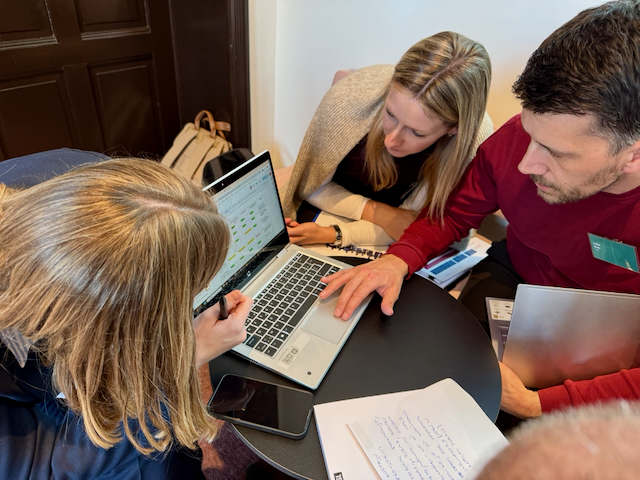
Photo by Béla Kézy
What made these exchanges powerful was not consensus, but honesty. Feedback rarely pushed cities toward the same actions. Instead, it helped sharpen focus and raise ambition. A question from a peer clarified what really mattered. A comment from another city exposed where intentions were still vague. Confidence grew not from copying ideas, but from having them challenged.
This process was reinforced by the shared language that developed through exchanges and masterclasses. Cities became more precise in how they described their challenges — not simply as brain drain, but as broken journeys, invisible opportunities, or disconnected actors. This precision mattered locally. It made conversations with stakeholders easier, and decisions built on stronger foundations.
Perhaps most importantly, learning together reduced the fear of acting at all. Taking a decision felt less risky when cities knew others were doing the same — experimenting, adjusting, and moving forward despite uncertainty. C4TALENT did not remove local responsibility. It strengthened it.
In the end, the network did not give cities answers. It gave them something more useful: the confidence and ability to find their own.
5. Our C4TALENT legacy: keys other cities can use

Photo by Filip Szalbot on Unsplash
C4TALENT does not end with ten Integrated Action Plans. What remains is something more transferable: a set of shared learnings shaped by real city decisions, tested through action rather than theory.
Throughout the network, cities realised that opening the door to talent is rarely about a single bold move. More often, it depends on having the right key or keys — an understanding of how ecosystems function, how talent journeys break or connect, and how place identity is experienced on the ground. This is what the Final Network Product offers.
Built around three interconnected pillars — entrepreneurial ecosystems, talent attraction management, and place branding grounded in reality — it brings together concrete guidance, examples, and tools that cities can adapt to their own context. It does not unlock the door automatically. But it helps cities understand which door to focus on, and which key might fit.
Still, the most important outcome of C4TALENT is not the key itself — but the decision to use it.
Talent decisions are personal, fragile, and often made quietly. Cities cannot force people to stay, return, or take a risk. But they can choose whether opportunities are visible or hidden, whether first steps are supported or discouraged.
Across C4TALENT, cities stopped waiting for perfect conditions. They began trying keys — reconnecting actors, rethinking spaces, clarifying pathways, and making support tangible. None of these actions alone will solve brain drain. Together, though, they change what is possible. For cities across Europe facing similar questions, the invitation is simple: the door is already there. C4TALENT offers a key.
But remember: a key is only useful when someone decides to turn it.
Linkedin Teaser
Talent doesn’t disappear. It hesitates.
Across Europe, countless talented people consider returning home, starting a business, or building a future in smaller and medium-sized cities. Many never do — not because they don’t want to, but because the door doesn’t feel open.
Over the past 2.5 years, the URBACT C4TALENT network brought together ten cities to face this challenge head-on. Not with slogans, but with decisions. Not with one solution, but with many ways of acting.
Our final network article is now out: Opening the Door to Talent: What Ten Cities Decided to Do Differently
It’s a story about confidence, cooperation — and the keys cities can use to open doors to talent.