
Why remote work belongs in the climate conversation
For many cities, remote work first appeared as a crisis response to Covid-19. Five years later, it has become a structural feature of labour markets. Across Europe, large shares of knowledge-intensive jobs can now be done at least partly remotely, and both employers and workers expect hybrid arrangements to remain common.
In parallel, European cities are under increasing pressure to deliver on climate targets: cutting greenhouse gas emissions by at least 55 percent by 2030, moving towards climate neutrality by 2050, and adapting to more frequent heatwaves, floods and other climate impacts. Transport and buildings- the two sectors most directly affected by where and how we work still account for a large share of urban emissions. Remote work sits exactly at this intersection. It changes commuting patterns, the use of office and residential buildings, and even the structure of cities and regions. The question is not whether remote work is “good” or “bad” for the environment, but how cities can shape new work models so that they support, rather than undermine, their climate strategies.
A system view of remote work and the environment
To align remote work with climate goals, cities need to look beyond commuting (only) and consider the full chain of effects across transport, buildings, ICT and land use.
Transport and mobility patterns
Hybrid and remote work can reduce the number of daily trips to central offices, lower congestion during peak hours, and potentially support modal shift if fewer long commutes make walking and cycling more attractive. The European Environment Agency’s foresight work on “From the daily office commute to flexible working patterns”[1] highlights that reduced commuting can decrease car-related emissions and noise, and free up space in cities for more sustainable and people-friendly uses.
However, lets be cautious:
- some remote workers may move further away from city centres, increasing distances when they do commute
- saved commuting time may be partly “reinvested” in other trips (for leisure, shopping, visiting friends), some of which may be by car
- if public transport loses peak-hour passengers without service adjustments, financial viability can be affected, potentially leading to reduced frequency and a less attractive service.
For Remote-IT cities, many of which are already grappling with congestion and air quality issues, remote work is an opportunity to rethink mobility more holistically: adjusting public transport schedules, expanding cycling infrastructure, and reallocating road space as part of a broader green mobility strategy.
Buildings: office consolidation and home energy use
Remote work changes how we use buildings. If fewer people are in the office every day, there is scope to reduce office space, consolidate functions, and repurpose buildings for other uses. At the same time, working from home increases residential energy use, particularly for heating, cooling, lighting and ICT equipment. Studies comparing office and home energy use show that net effects depend heavily on:
- the energy performance of homes versus offices
- heating and cooling practices (for example, heating the whole house rather than a single room)
- the carbon intensity of the local electricity and heat mix.
The message for cities is that remote work and building policy must be coordinated. Municipalities that own large building portfolios- city halls, administrative offices, schools, cultural institutions, are in a strong position to pilot office consolidation, deep renovation and adaptive reuse, while also supporting residents to improve the energy performance of their homes and adopt efficient home-office practices.
How cities can align remote work with climate strategies
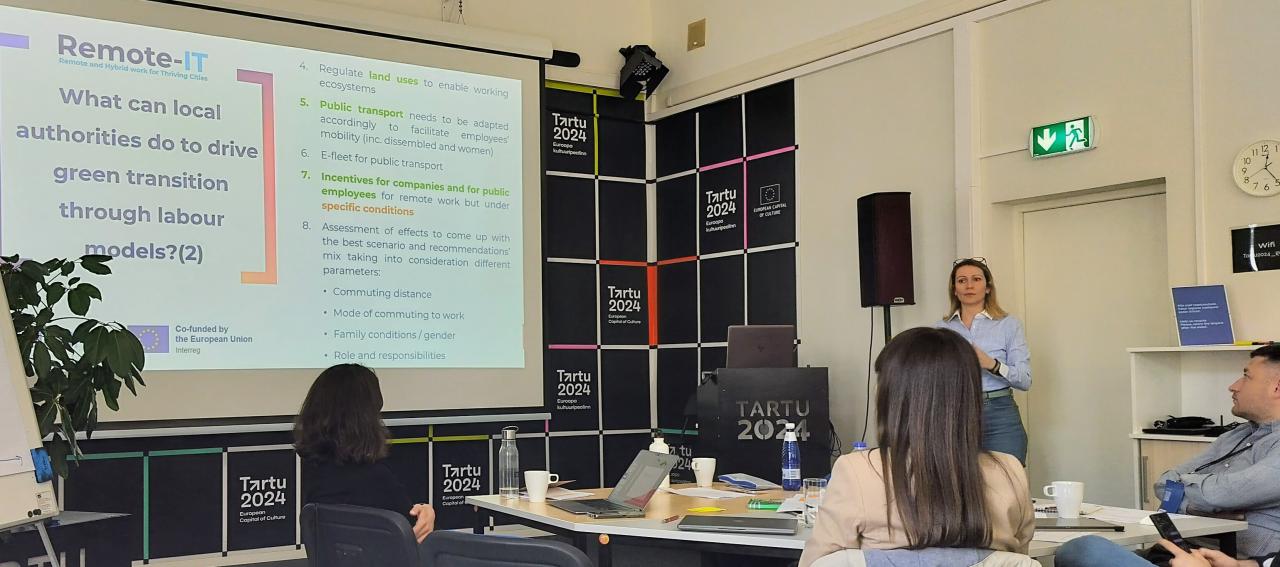
Given this complexity, what can cities practically do? While local contexts differ, several design principles emerge from the evidence and from the Remote-IT experience.
- Embed remote work in climate and mobility plans, not only HR policies. Hybrid-work strategies for municipal staff, and support for local employers, should be co-designed with transport planners and climate teams. Remote work scenarios can be included in SUMPs and climate-neutrality roadmaps, with explicit assumptions about modal shift, peak-hour demand and building use.
- Link hybrid work to building renovation and space optimisation. Municipalities should use remote work to justify and accelerate the consolidation of office space, deep renovation of retained buildings and adaptive reuse of freed-up sites. Impact assessments should consider not only energy savings but also social uses- for example, turning former offices into community hubs, co-working spaces or housing.
- Plan for resilient, low-carbon mobility in a hybrid world. Reduced commuting is an opportunity to reallocate road space, expand cycling and walking infrastructure, and strengthen public transport outside peak hours. Cities can pilot mobility packages for remote workers that incentivise low-carbon travel on days when they do commute.
- Support efficient and equitable home working. Local programmes on energy efficiency, building retrofits and digital inclusion can explicitly address the needs of home-based workers, including those in apartments or older buildings. Guidance on healthy and sustainable home-office practices can be integrated into public information campaigns.
- Coordinate with regional and national policies on telework and digitalisation. Many legal and fiscal aspects of telework sit beyond municipal control. Cities should engage with national authorities where possible- for example, by contributing to telework guidelines, advocating for green digital infrastructure, and aligning local initiatives with national climate and digital strategies.
- Monitor, evaluate and adjust. Cities should establish indicators to track the environmental impacts of remote work- including changes in commuting patterns, building energy use and ICT emissions – and be ready to adjust policies as evidence accumulates.