
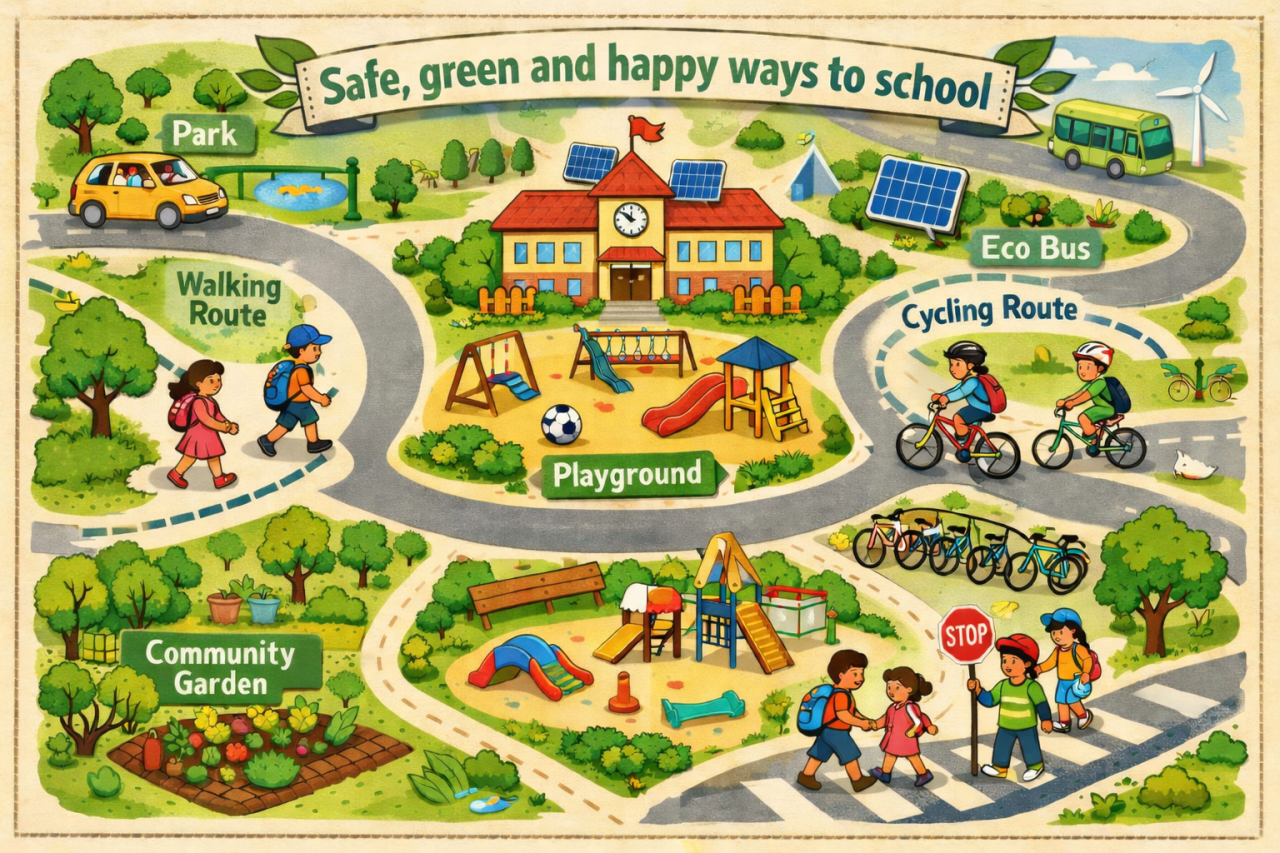
We are happy to present you with our lessons learnt. Below you find dedicated messages to our main target groups – local authorities, politicians, teachers and of course: parents. And you’ll find the snapshots of our network story – SCHOOLHOODs in a nutshell: where we started, what we did and what we recommend others to do.
We wish you a good time with watching, hearing and reading on us!
So, let’s start. Here is our message to our main target groups:
SCHOOLHOODs for local authorities
Cities can reduce traffic congestion and promote sustainability by prioritizing pupils’ active mobility and implementing infrastructure and policies that encourage children to walk, cycle, or scooter to school rather than being driven by car.
🚗 School schedules add to traffic congestion in urban areas as pupils arrive and leave to school for their lessons during traffic peaks.
🚗 The increased car use for school commutes contributes to city traffic problems and creates a vicious cycle, where more cars lead to perceived safety concerns, discouraging walking, cycling, or scooting to school. With even more pupils arriving to school by car.
🚸 Children prefer though not to be driven to school by car, and reducing car transportation can ease traffic, lower emissions, and increase road safety.
🚴♀️ Cities should prioritize students' active mobility over general private car use by transforming school areas into attractive shared public spaces.
👧 The Urban 95 method helps people see the world from a child's perspective for designing it to their needs.
🚦 Like safer infrastructure with slower speeds, separated bike lanes, and good pathways to promote sustainable mobility. And implementing traffic measures like school streets or walking buses to encourage walking, cycling, and scooting to school.
🚗 Local authorities can implement simple traffic education campaigns, such as gamification and interactive stories, to motivate parents and children to avoid car trips to school and promote alternative transportation methods.
▶️🎧Play audio
SCHOOLHOODs for political decision makers
Politicians and schools should prioritize and invest in promoting sustainable and active transportation to school, such as walking or cycling, to improve children's health, academic performance, and overall well-being, while also benefiting the community.
🤝 Politicians' commitment is crucial for municipal investments in school mobility, and understanding their motivations for investing in it is essential.
🌎 Teaching sustainable mobility practices to children is crucial while they grow up, and politicians need to support schools and parents to encourage children to walk or bike to school to reduce traffic jams and pollution.
🚶♀️ Educating children on active transportation to school improves their physical and mental health, and enhances their academic performance, while also benefiting schools and parents.
🌳 School neighborhoods need to prioritise people-friendly public spaces over traffic flow, promoting road safety, happy and independent mobility for children, and benefiting local residents, businesses, and commuters.
👥 Politicians must regain public trust by collaborating with local communities, parents, and schools to develop sustainable mobility solutions.
▶️🎧 Play audio
SCHOOLHOODs for teachers
Children can benefit from walking, scooting, or cycling to school, but face obstacles such as safety concerns and lack of infrastructure, which can be addressed through measures like mobility education, infrastructure changes, and parental trust.
 Children who walk, scoot, or cycle to school are more attentive, have improved cognitive functions, and develop essential life skills, making physical activity to school beneficial for their overall development.
🚶 Many pupils want to walk to school independently but often lack parental trust to do so.
🚗 Schools struggle with students being driven to school due to safety concerns, traffic, and lack of infrastructure for active transportation modes.
🚴♀️ Teachers can empower pupils to safely navigate traffic by incorporating mobility education, games, and cycling skills into lessons.
🚪 School gates should be managed for a safe and welcoming environment.
🚶 Simple measures like school streets, redesigned roads, and walking bus pilots can make children more visible and safer in public spaces around schools.
▶️🎧 Play audio
SCHOOLHOODs for parents
Parents should give their children more independence by allowing them to walk or cycle to school, rather than driving them, in order to help them develop essential skills and navigate cities safely.
🚶 Parents play a significant role in deciding how their children commute to school, often choosing the mode of transportation, such as driving or walking.
🚗 Parents choose the transport mode for children’s school commutes putting priority on road safety and activity levels mixed with their own convenience.
🚶 Most children want to walk, cycle, or scoot to school independently, without their parents, if given the choice.
🚗 Children need to learn to navigate cities independently, as relying on parents for transportation can be impractical and hinders their ability to develop essential skills.
🚶Parents can help kids develop this independence and abilities to cope with traffic by letting them walk or cycle to school, starting with short trips accompanied by adults and gradually increasing responsibility.
🚗 School Streets that close access street to schools for 30 minutes at start time support safe and inviting conditions for children coming to school on their own.
👨🏫 Longer tests, lasting a month or more, allow people to adjust and produce better results.
▶️🎧 Play audio
Let’s continue with our own story. The SCHOOLHOODs story. Where and why it all started, what we worked on and how plus our key recommendations for other cities to engage in sustainable and happy school commutes for our children.
The SCHOOLHOODs story - joint challenges, their causes and effects
What are the SCHOOLHOODs challenges?
Seven cities worked together in the SCHOOLHOODs project to address problems related to school mobility. A major challenge is that less and less children walk or cycle to school. Instead, more and more are driven by car, which causes heavy traffic congestion during peak hours, especially near school entrances.
What causes these challenges?
Many parents choose to drive their children to school because it feels more convenient and safer. They often worry about letting children walk or cycle for safety reasons and low trust in children’s abilities to cope with traffic. There are misunderstandings about traffic conditions around schools and about what children would prefer. At the same time, schools start lessons at the same time creating traffic peaks that reduce road safety and worsen air quality.
What are the visible effects?
Children’s daily travel to school is increasingly automatic and car-dependent. Busy family schedules, convenience, and high traffic volumes at school gates around lessons’ start contribute to this growing reliance on cars. These conditions discourage active travel and make it harder for children to learn safe traffic behaviour.
What can be done to address these problems?
To encourage children to walk or cycle to school, it is essential to create safe and comfortable environments for active travel. This includes improving walking and cycling infrastructure, raising awareness among parents, and promoting sustainable school mobility. Cities must work together to support behaviour change, reduce traffic congestion, improve safety, and lower environmental pollution around schools.
▶️🎧 Play audio!
The SCHOOLHOODs story - the value of cooperation
Collaboration and knowledge-sharing among cities and stakeholders are key elements for effective solutions that improve school mobility and safety, transforming streets into high-quality public spaces for children. The SCHOOLHOODs team learnt on:
Child-centered planning
Design streets and neighborhoods around children’s needs, using approaches like Urban 95.
Safe school environments
Implement traffic calming measures and safer street designs around schools.
Active involvement of schools and communities
Engage schools, parents, and local stakeholders through cooperation and public consultation.
Pilot actions and experimentation
Test solutions such as a Pedibus and school streets through real-life pilot projects.
Data-driven planning and clear strategy
Collect data to understand mobility patterns and develop a shared, long-term action plan.
▶️🎧 Play audio!
The SCHOOLHOODs story - our recommendations to other cities
Cities can create safe, green, and happy school trips by engaging with local stakeholders, prioritizing children's perspectives, and collaborating with citizens, schools, and policymakers to develop and implement sustainable transportation plans. The essential are to
gathering concrete data that informs sustainable plans and actions.
gain full support from schools and policymakers.
challenge common myths about school transportation and prioritize children's perspectives to effectively implement solutions.
involve local communities, especially parents and children, from the start, and use creative actions and piloting to gain support for school-friendly mobility initiatives.
▶️🎧 Play audio!