
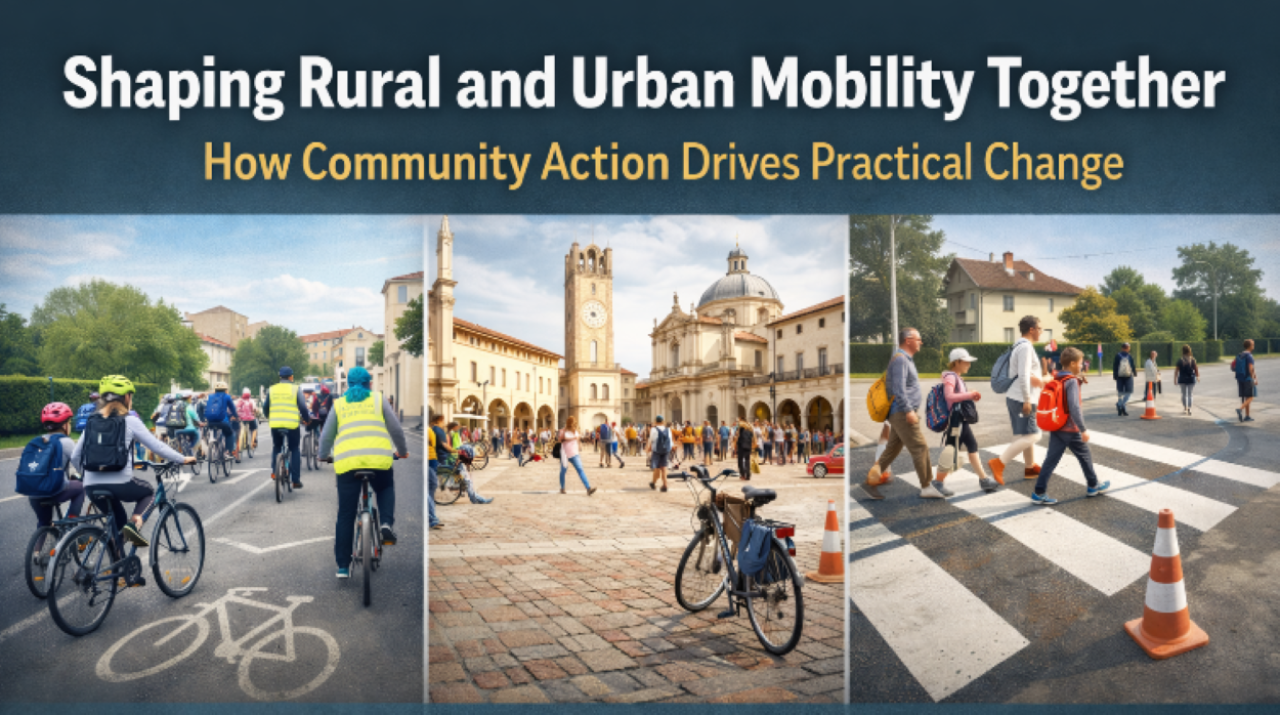
Beyond the Urban is an URBACT network, an EU initiative which helps cities and municipalities to develop an integrated set of actions for sustainable change in the urban and rural mobility. The Beyond the Urban Baseline Report highlighted the difficulties faced by many rural residents. Destinations were close by but hard to reach on foot. Cycling was rare outside a few areas with strong traditions. Public transport was inconsistent, and regional connectivity was often weak.
Co-creation rooted in local life
Partners discovered that participation works best when it aligns with existing community habits rather than formal meetings.
Across the network, partners met people where everyday life already happens. Treviso worked through neighbourhood events and schools. Feira relied on parish halls and trusted local associations. Bram co-created solutions with parents and volunteers. Kocani and Szabolcs 05 used schools and youth groups to map real walking routes. Osona coordinated across more than thirty municipalities while keeping discussions grounded in local priorities. Tartu engaged students directly through mobility games that revealed behaviour patterns.
In all territories, participation grew strongest where engagement happened in familiar places among familiar people.
Pilots that build confidence and evidence
Pilots allowed partners to test ideas quickly, observe real behaviour, and adapt before committing to larger investments. Some focused on public space and everyday movement. Treviso tested a car-free Piazza Duomo to see how people used the space, while Bram organised community rides to demonstrate that cycling could be part of daily family routines. Others addressed safety and accessibility. Kocani trialled safer school routes based on children’s actual paths, and Szabolcs 05 introduced small fixes near schools and village centres that improved perceived and real safety.
Several pilots explored system coordination and behaviour change. Machico tested improvements to walking routes in steep areas to understand what made short trips easier. Tartu used mobility games in schools to explore behaviour patterns. Osona validated regional cycling corridors through joint workshops across municipalities. Larger-scale trials, such as the intermodal hub in Hradec Králové or electric buses and coordinated ticketing in Bucharest Ilfov, showed how pilot learning could inform wider network and fleet decisions. Feira tested clearer bus-stop information through the Mob.Feira app to improve everyday usability.
These pilots built momentum because residents could see, experience, and discuss change as it happened.
Using data to shape decisions
Data supported more accurate decision-making across the network.
Tartu used a mobility dashboard to monitor behaviour patterns. Feira analysed Mob.Feira app usage to understand how residents accessed transport information. Treviso used footfall counts and on-site surveys during its pedestrianisation trial. Osona monitored proposed cycling routes through shared counts. Bucharest Ilfov measured the performance of cleaner fleets and upgraded stations. Szabolcs 05 and Kocani gathered detailed feedback from schools and community workshops.
This combination of quantitative and qualitative insight helped partners choose which interventions to scale.
Turning pilots into long-term strategies
Several territories transformed pilot results into strategic decisions.
Bucharest Ilfov integrated its early electric bus trials into a long-term regional fleet transition and a unified ticketing plan. Osona turned its collaboratively mapped cycling corridors into a shared regional strategy. Szabolcs 05 used findings from youth-led pilots to update local mobility planning. Treviso incorporated evidence from its car-free trial into its broader mobility vision. Hradec Králové strengthened the role of its intermodal hub as a core element of regional mobility.
Across the network, pilots became the foundation for future plans.
Overcoming roadblocks
The partners also encountered obstacles. Budgets and staffing were limited. Steep terrain, dispersed villages, and narrow historic streets created physical challenges. Car dependency was culturally ingrained in many places. Digital access varied widely. Coordinating across cities could be difficult. Residents sometimes hesitated to support changes that affected parking or traffic.
Pilots helped address these challenges. They provided quick lessons, reduced uncertainty, and encouraged communities to try new possibilities without long-term commitment.
The path ahead
From the first baseline findings to the final Integrated Action Plans, the ten territories underwent a clear shift. Mobility planning became more connected, more community-led, and more evidence-driven. The network demonstrated that progress does not always start with large infrastructure projects. It often begins with small actions that are easy to test, easy to explain, and easy to adapt elsewhere.
For cities and regions facing similar challenges, the lesson is practical rather than abstract. Start small, involve communities early, and use pilots to build confidence before scaling. Sometimes change begins with something as simple as a child cycling behind the Vélobus in Bram, discovering a new way to move through their town.