

 Tech
TechWhy diversity-first makes cities not only smarter, but mostly more human
The digital transition fails when it assumes everyone shares the same language, devices, skills, and trust in institutions. It succeeds when products and policies are co-created with communities, accessible in multiple languages and formats, and governed transparently. TechDiversity helps cities adopt this diversity-first stance and translate it into practical instruments - procurement criteria, innovation lab briefs, skill compacts with employers, and data-governance guardrails. The payoff is twofold: better services today and a more resilient & diverse innovation pipeline tomorrow.
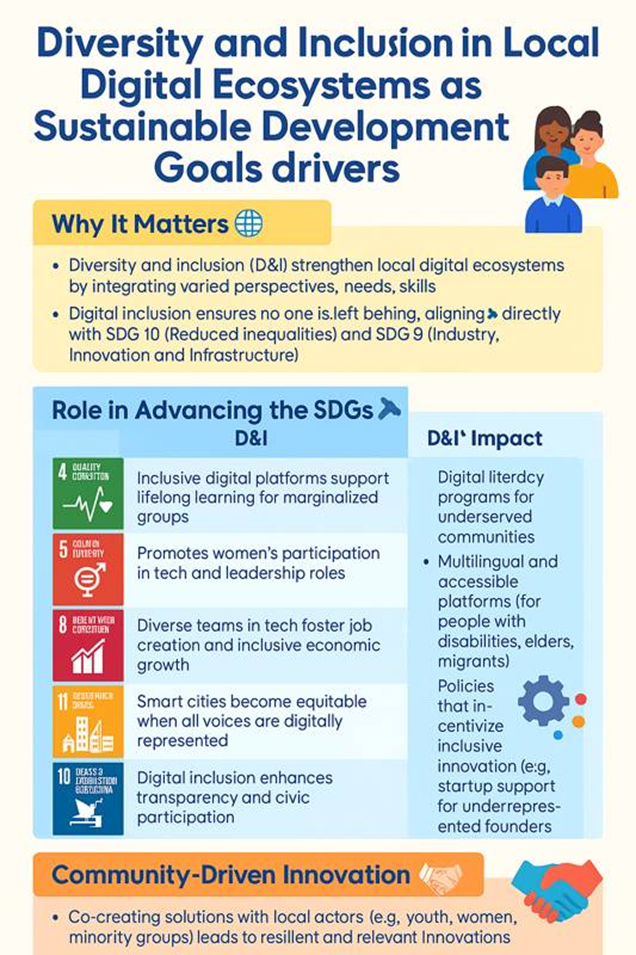
How TechDiversity advances the Sustainable Development Goals
SDG 4: Quality Education. We widen on-ramps into the tech & digital economy with inclusive STE(A)M pathways, beginner-friendly coding, and AI literacy. Urban labs turn residents into makers, not just end-users, and connect learning directly to local challenges.
SDG 5: Gender Equality. From mentorship networks to gender-sensitive product design and targeted incubation, we raise women’s participation in both tech learning and leadership. The principle is simple: build for the full range of human experience.
SDG 8: Decent Work & Economic Growth. By plugging under-represented talent into SME and startup pipelines, cities generate quality jobs and broaden the local skills base. Publicly supported digital services commit to diversity-by-design hiring, proving inclusion and growth can—and should—advance together.
SDG 9: Industry, Innovation & Infrastructure. Accessible innovation ecosystems are productive ecosystems. Co-designed civic-tech pilots, diversity-aware testing, and common accessibility baselines make tools that people actually use and trust.
SDG 10: Reduced Inequalities. We tackle structural barriers - connectivity, device access, biases in recruitment and procurement. Local Diversity Charters make equity commitments visible and verifiable, so progress isn’t just promised; it’s tracked.
SDG 11: Sustainable Cities & Communities. Inclusive smart-city policies are co-authored with residents. Urban Living Labs invite communities to shape e-governance tools, mobility apps, and “diversity tech” focused on everyday urban needs.
SDG 16: Peace, Justice & Strong Institutions. Transparent data governance and multilingual participation platforms broaden civic voice, reduce capture, and build legitimacy for digital reforms.
SDG 17: Partnerships for the Goals. The networked method - city-to-city peer learning, shared toolkits, and multi-level collaboration - is SDG 17 in motion, accelerating what works across contexts.
From small scale actions to policy: what cities can implement now
Bake D&I into procurement. Update tender templates so accessibility, inclusive research, and community co-creation earn points. This shifts market behavior quickly and transparently.
Fund SDG innovation sprints. Inside your Urban Living Lab, set annual challenges tied to SDGs 4/8/10. Recruit diverse teams, publish open briefs, and measure outcomes with shared indicators.
Create skills compacts with employers. Align training cohorts with real vacancies; guarantee interviews and apprenticeships for programme graduates. This turns learning into livelihoods.
Adopt civic data guardrails. Publish data charters, accessibility standards, and algorithmic transparency notes for city tech. Better governance (SDG 16) improves adoption across services.
Build partnership pipelines. Formalize cross-city exchanges to scale proven ideas—template policies, replicable pilots, and common UX patterns. Partnerships (SDG 17) lower costs and raise quality.
What success looks like
When diversity becomes a tool or even “an infrastructure”, cities see faster uptake of tech & digital services, stronger local talent pools, and higher trust in public innovation. Residents become co-designers; startups and SMEs find new markets and mentors; and city teams make better decisions because more voices inform the process. The result is a more diverse & smarter city that is also fairer - and demonstrably aligned with the SDGs.
TechDiversity’s message is clear: diverse teams build better cities. By treating accessibility, representation, and co-creation as non-negotiables, we convert values into systems - and systems into results. If your city is ready to go beyond small-scale actions and embed diversity & inclusion in the machinery of tech and digital transformation, the playbook is here: start with procurement, labs, skills, governance, and partnerships. Everything else - innovation, adoption, and impact - follows.

Kostas Karamarkos
Strategic Planner, TechDiversity Network Expert