
Why retention matters more than branding
Remote and hybrid work are now a structural feature of European labour markets rather than a temporary adjustment. Data shows that even after the pandemic, a large share of workers continue to prefer hybrid arrangements over a full return to office-based work, while at the same time, there are indications that while capital regions adapted fastest, smaller cities and intermediate regions with adequate infrastructure are increasingly able to retain remote workers once they arrive.
For cities, this shifts the policy question. Attracting remote workers through marketing or short-term incentives may create visibility, but retention depends on whether everyday life works. Remote workers are not just temporary visitors; they are residents, parents, service users and contributors to local economies. Recent reports show that the cost of living, connectivity, safety, healthcare access and a sense of community outweigh lifestyle imagery when deciding whether to stay.
The Remote-IT URBACT network, bringing together Dubrovnik, Brindisi, Bucharest District 6, Câmara de Lobos, Heraklion, Murcia, Tartu and Tirana- has embraced this shift. Rather than focusing on branding alone, partners explored how local services, governance and ecosystems shape long-term retention. This entry captures some of those insights and complements other Playbook entries on attraction, infrastructure, incentives and governance.
Remote workers as residents, not a special category
The Playbook’s earlier entries argued that there is no single “remote worker” profile. Remote workers include mid-career professionals with families, freelancers, public-sector employees on hybrid contracts, seasonal workation visitors and long-term digital nomads. What they share is not lifestyle but reliance on digital infrastructure and a degree of choice over location.
Research from the Horizon Europe R-MAP project confirms that retention is strongly influenced by place-based conditions: broadband quality, housing, access to services and environmental quality. Similarly, the OECD’s assessment for Trentino[1] uses indicators such as rooms per capita, access to physicians and digital skills to evaluate teleworking readiness.
For cities, the implication is clear: remote workers should be treated as part of the resident population. In Remote-IT, this translated into the use of personas and customer journeys to understand how different remote workers interact with housing systems, schools, healthcare, mobility and public administration.
Digital basics and workspace- necessary but not sufficient
Reliable connectivity is a baseline expectation. R-MAP notes that lagging broadband speeds can limit retention despite overall labour-market potential. However, retention depends on a complete digital work ecosystem, not connectivity alone. Evidence from coworking and workation studies shows that remote workers value choice and predictability: the ability to alternate between home, shared spaces and quiet public facilities, and to rely on backup options when home connectivity fails. Data security and privacy in public or shared spaces are also increasingly important.
Investments in high-speed internet and coworking spaces are used not only to attract remote workers, but to encourage longer stays and year-round presence. Remote-IT cities such as Câmara de Lobos and Brindisi followed similar paths, combining public investment with partnerships around hubs and creative spaces. The key lesson for retention is that cities must plan digital infrastructure, workspace provision and licensing frameworks together.

Câmara de Lobos, own photo
Housing, affordability and everyday services
Retention fails quickly when housing and basic services do not work. Surveys consistently rank cost of living as the single most important factor for remote workers’ location choices. OECD readiness assessments underline the importance of space to work from home (measured through rooms per capita) and access to healthcare. These factors matter especially for remote workers with families or long-term health needs.
From a city perspective, retention depends on:
- housing availability and diversity that avoids direct competition with short-term tourism rentals;
- access to everyday services such as healthcare, education and local administration;
- reliable local mobility, even for people who do not commute daily.
Wellbeing, safety and work–life balance
Safety and wellbeing strongly influence whether remote workers remain in a location. While remote work can support autonomy, it is also associated with longer working hours, blurred boundaries and increased work–life conflict, particularly for women and parents.
Cities cannot regulate employers directly, but they can influence retention by shaping environments that support healthy routines - from safe public spaces, accessible parks, opportunities to disconnect, to visibility of mental-health and wellbeing services.
Community, belonging and participation
Social connection is a decisive retention factor. Recent findings point to social isolation as a recurring challenge for remote workers, particularly those without family networks. At the same time, most digital nomads express concern about their impact on local communities, and are taking this into consideration when choosing a destination.
Cities can support retention by ensuring that remote workers have visible entry points into local life. Remote-IT experience shows that coworking spaces, creative hubs, libraries and cultural venues can act as connectors when programming is inclusive and open to residents. Brindisi’s approach explicitly framed hubs as ecosystem connectors rather than closed professional spaces.
Equally important is access to volunteering, cultural associations, sports clubs and participatory processes. Several Remote-IT cities piloted meetups and co-creation events linking remote workers and local residents. These experiences confirm that remote workers are more likely to stay and contribute when they feel recognised as part of the community.
Administrative clarity and local governance
Administrative uncertainty is a major challenge to long-term stay. While national governments define visas, tax rules and social-security frameworks, cities shape the day-to-day experience. Eurofound and national studies, including Croatia’s comparative report on remote and hybrid work, show that fragmented guidance and unclear responsibilities create friction for remote workers, while (e-)Estonia has some of the best case examples of transparency and administrative clarity within local and regional governance.
Cities can support retention by offering clear, multilingual information; one-stop contact points; and predictable local regulations on housing, hubs and home-based work. Remote-IT experience confirms that cities increasingly act as navigators of complex governance systems, helping remote workers move from temporary presence to stable residence.
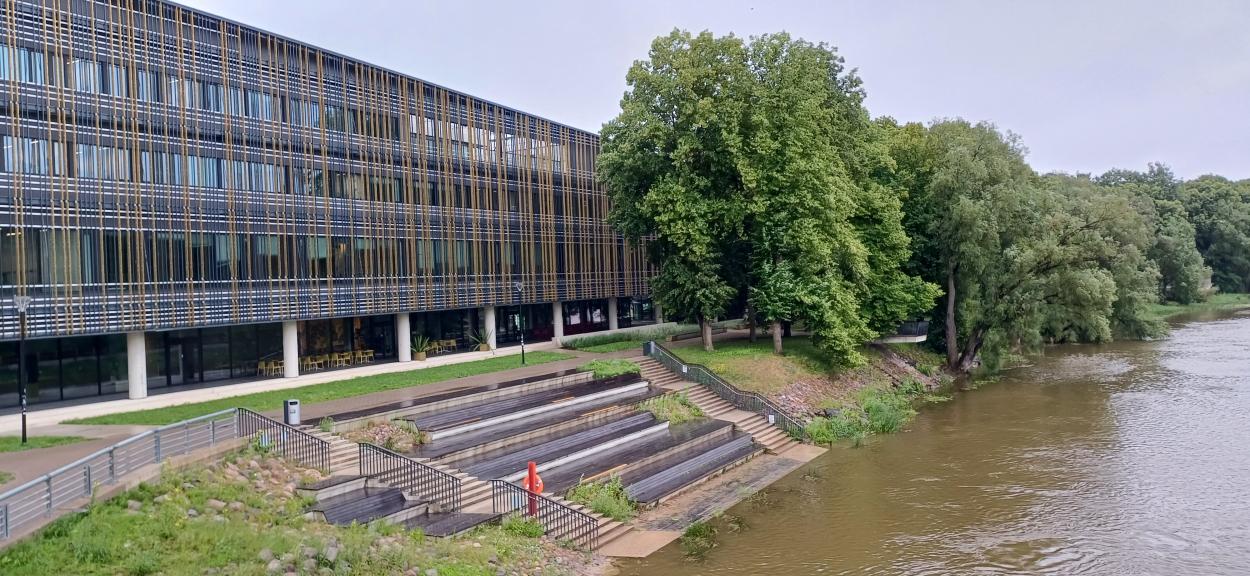
Tartu, own photo
Environmental quality, mobility and green transition
Environmental conditions are increasingly shaping retention decisions. Clean air, access to green and blue spaces, manageable congestion and an overall sense of environmental quality influence whether remote workers choose to stay in a city over the longer term. Less congested and less polluted environments, in particular, can support the retention of professionals who continue to work for employers located in larger metropolitan labour markets.
For cities, this reinforces the link between remote work and green transition strategies. Safe public spaces, low-emission mobility and climate resilience are not only environmental objectives but also factors shaping talent retention.
Retention through everyday city-making
What remote workers need to stay is largely what residents need to thrive- affordable housing, reliable services, safety, opportunities for connection and a healthy environment. What distinguishes remote workers is their greater mobility and sensitivity to local system performance.
For Remote-IT cities and others across Europe, the lesson is to move beyond short-term attraction narratives and treat remote workers as partners in city-making. Retention emerges when cities integrate remote workers into mainstream service planning, governance and community life, and when policies evolve
[1] https://www.oecd.org/en/publications/the-future-of-remote-work_35f78ced-en.html