During the past 2½ years the COPE partners have worked on engaging citizens locally in neighbourhoods in their cities. With the COPE main focus on engaging the citizens in place based green actions the COPE partners experience that a lot of their work is related to and depending on internal change of procedures and habits in their governance structures and administration. On a network level COPE also experiences that the 8 European cities face similar opportunities and challenges, but at very different scales.
This broad insight in different municipality contexts makes it clear how different ways of organizing the political level and how the differences in what mandate the public administrations either have or not have makes a huge difference in a project like this.
The interdependence between the different political levels also plays a role in the cities. The municipalities work in very different settings with different budgets and different responsibilities, and therefore they do not have the same opportunities and mandates. And higher levels of policymakers can influence the state of play, e.g., a national decision and agenda can have great impact or less impact depending on the national governance structures.
In COPE, our aim is to transform the role of the municipality from the decision-making authority to a more facilitating unit. In this new role the municipality brings citizens and stakeholders together to explore their neighborhood and together define and prioritize their local challenges and based on these priorities define and prioritize the possible solutions.
When working with the COPE agenda of engaging citizens in both defining problems and solutions, the interdependencies and structures can have a great impact on the level of political support which again affects the difference between success and failure. If the engagement process loses political support, it can end up hurting local democracy and citizens' trust and the project might bounce in a wrong direction.
Why are we working with deliberative and participatory processes?
When we talk about a just green transition, we often point toward the need for reducing carbon emissions or other very specific or technical needs. But just to make it clear, COPE is about acting on the very specific and local crises of both climate and biodiversity and, with that, all the aspects of our lives that these crises have an impact upon, our everyday life, our economy, and our relations. This is why COPE's overarching topic is the engagement of citizens and local stakeholders.
"As Policymakers, we must strive to make sure the enabling decisions are taken as close to us as citizen as possible. Because the green transition is not a power grab from global elites, rather it is the opposite: A means of empowering communities to make positive and beneficial changes. And from a practical point of view, this is also how change will work best. If people see green policies as an edict from Brussels, these policies will have no chance of succeeding. But when people are included and take ownership of the transition themselves - that is when the change can really happen" - EPV Vestager, Keynote speech
Democratic Sustainability
In COPE our methodology is based on a place-based approach in order to keep a very local perspective and in this way keep the actions as concrete as possible – so we are not talking about sustainability or biodiversity. We speak of community gardens and greening of city centers. We also work with the ABCD approach – the Asset Based Community Development approach, because we want to engage citizens locally looking at their resources instead of defining them as people with problems that the municipality will solve with a service.
But the bigger WHY, if we zoom out and ask ourselves why COPE is working with alternative methods such as ABCD? Why are we doing this? And how can we work more strategically with these kinds of processes? And how can we learn and improve our work?
“We live in a world where the professional point of view is blind toward place. Therefor communities are not seen as a resource but an obstacle for specific thematic agendas developed from above. With COPE, we want to turn this approach on its head. With COPE we create an arena for collaboration, co-creation positive dialogue and thereby construct the unexcepted meeting, where new and innovative ideas can emerge” Øystein Leonardsen, Lead Partner
A good framework can help us address these questions and think about these methodologies in a more structured way. Therefore, I would like to introduce the recent analysis and model taken from a Danish context På sporet af det tavse flertal, translated freely into Identifying the silent majority.
How to understand the model
The analysis builds on the Core-belief model developed and tested in several countries by the agency More in Common. The aim is to better understand how we can balance different interests and motivations and succeed in finding solutions building on compromises that all can recognize and accept. A tool for finding such a balance is an understanding of the core beliefs and values at stake in the society – or locally in the communities. Values and culture are critical in making changes. Figure 1 shows that action is based on values, core beliefs, and norms.
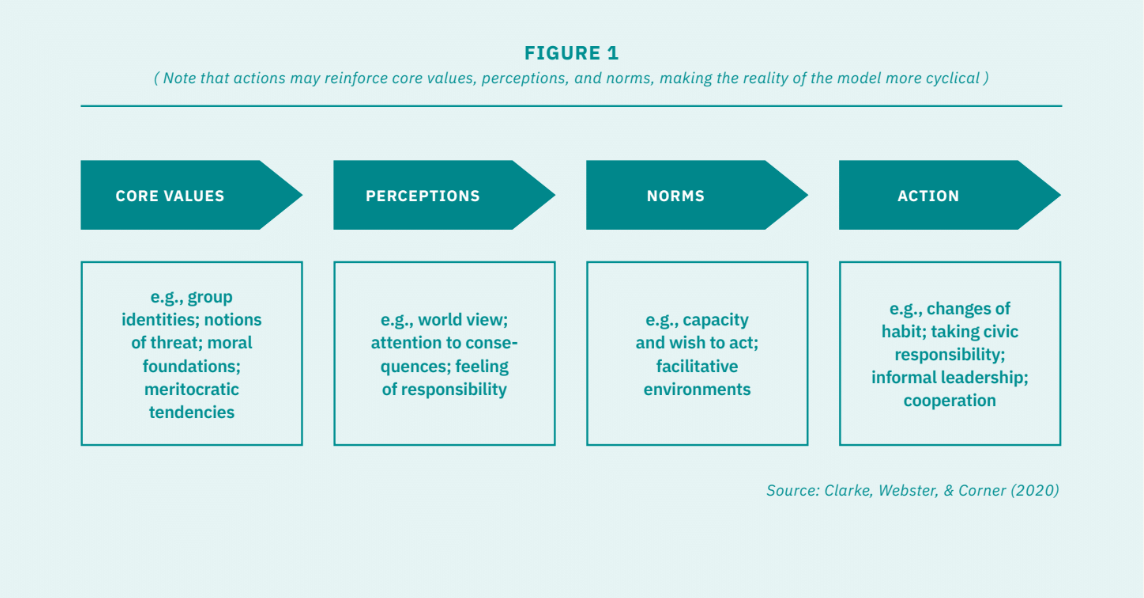
When believing that values, core beliefs and norms are defining our actions we see that we need to engage people through these categories.
Another structure to be aware of is what different factors are needed to support a society in balance. A way to talk about this could be to divide the society on 3 dimensions: The first describing the different types or categories of sustainability we need to keep balance – this could be social, environmental and cultural sustainability. The second could be our experience of the democratic system consisting of our individual democratic self-esteem and how we experience the fairness of our institutions. And the third could be our individual faith in the future and belief in our ability to solve problems and create good results.
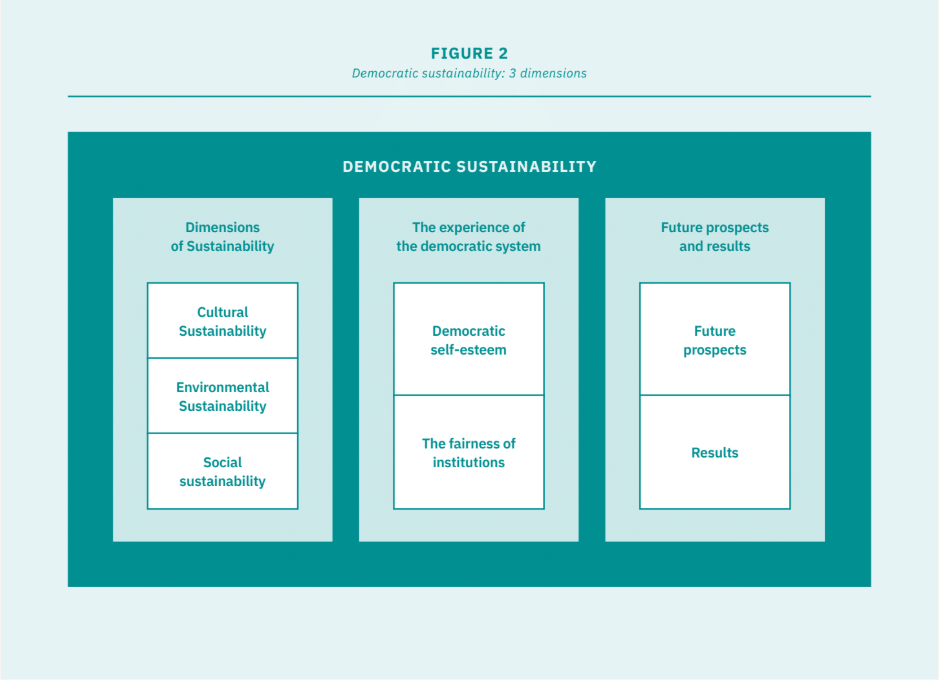
The model indicates that new methods considering e.g., different values can influence the experience of democracy and belief in the future, which can affect the democratic self-esteem. The model can define the purpose of processes and the effects of processes. This also means that we as a municipality can create better products.
How COPE actions fit in a bigger strategy
The municipalities are the closest institutions to the individual citizens, and they therefore have a great impact on the experienced level of democracy. When the COPE partners succeed in being a trustworthy institution making an effort in balancing the different interests and being transparent and accountable and not least if they provide results that make their citizens believe in a good future, then they are on a good path for a sustainable democracy.
In COPE we work with engaging more people in exploring solutions believing that, to some extent, it can increase the level of fairness, the experience of confidence in democracy and in own democratic self-esteem.
When we make this change, it is because we want to influence the middle dimension of figure 2 so that we have a better future in the last dimension.
When Kavala Municipality co-creates a park with the local citizens being a trustworthy, transparent, accountable and inclusive partner then they do not only develop a useless and unsafe spot in the community into a warm and useful parc. They also develop relations and trust, and they give the citizens a positive experience with the local authorities and through the participatory process, where they are heard, involved and taken seriously the municipality help build democratic self-esteem in their citizens. This self-esteem hopefully means that the citizens are more likely to participate again and even to take on a local leadership engaging their neighbours too next time.
The same happens when Copenhagen, Vilnius and Saint-Quentin empower citizens through community gardens and community dinners, Korydallos co-creates brand and storytelling with students, A Coruña include local resources in greening and lifting the local streets and business opportunities and Bistriţa co-creates ideas for promoting soft mobility with local stakeholders.
In this perspective the overarching goal that COPEfeeds into with these local actions is the process of increasing institutional justice through building capacity in both our democratic institutions and the individual democratic self-esteem.
When you, dear reader, participate in democratic processes, you are contributing to the greater purpose. I hope you will dive into the COPE experiences and take on a local leadership to build responsible, engaged local communities in your neighborhood.
Find COPE here: COPE | urbact.eu