
On a foggy autumn morning in the Coimbra region of Portugal, an elderly woman steps into a small rural taxi that forms part of the SIT FLEXI on-demand transport service. Not long ago, she avoided travelling alone — the nearest health centre was far, bus services were unreliable, and moving through the region felt risky and exhausting. Today, she arrives at her appointment safely, with dignity and independence. This seemingly ordinary ride is just one of many quiet transformations achieved by eight European cities working together in the URBACT FEMACT-Cities Action Planning Network.
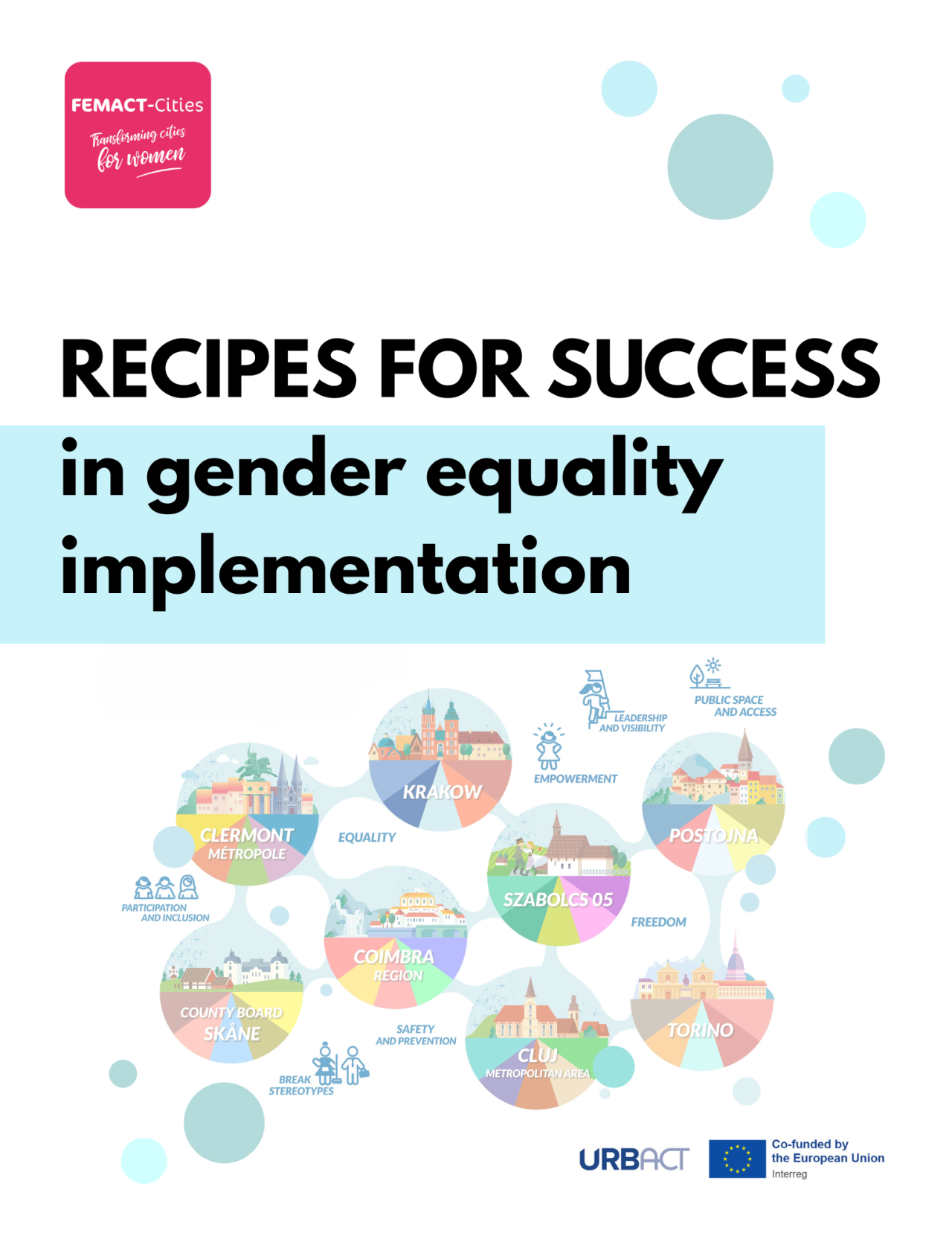
Over the past two years, the FEMACT-Cities Network has helped eight municipalities and regions embed gender equality into everyday governance. Eight partners tackled persistent gaps in safety, mobility, education, inclusion, and access to services. Their work shows that gender equality is not an abstract aspiration — it is a concrete method for designing better cities.
And the range of topics the network addressed — from early childhood education to public transport, from violence prevention to cultural memory, from rural mobility to multi-actor governance — illustrates just how diverse gender equality work must be. It also shows why the field can be so challenging: delivering meaningful change requires working across sectors, policy areas, and professional cultures that rarely intersect. FEMACT-Cities demonstrates that only by bringing these topical actors together can structural transformation take root.
Several FEMACT-Cities partners discovered that governance structures must change before services can. In Skåne (Sweden), the URBACT Local Group evolved into a dynamic knowledge-sharing space: entrepreneurs, public agencies, NGOs, and equality specialists exchanged expertise, challenged assumptions, and co-created solutions. What began as a meeting format became a learning ecosystem.
In Szabolcs 05 (Hungary), collaboration took the form of a deeply interconnected social support network serving some of the country’s most disadvantaged rural communities. Family centres, NGOs, schools, health visitors, and mobile outreach teams worked together to support Roma women and girls, young mothers, and isolated households. Trust-building, culturally sensitive outreach, and continuity of care became the pillars of progress.
Gender equality is impossible without safety, and several FEMACT-Cities partners placed this at the centre of their work. In Cluj Metropolitan Area (Romania), women were frequently harassed or reported feeling unsafe in public transport. The city introduced tailored bystander training for residents, students, vulnerable groups, drivers, and police. Participants learned how to recognise harassment, intervene safely, and support victims — creating a cultural shift from bystander silence to shared responsibility.
Meanwhile, Torino (Italy) addressed a form of violence that had long remained hidden: gender-based violence against women with disabilities. Its Anti-Violence Support Centre — the first of its kind in Italy — provides accessible psychological, legal, and social services and coordinates closely with municipal support structures. The centre has supported more than a hundred individuals in just one year, making visible a phenomenon that had too often been met with disbelief or silence.
Culture and norms shape how safe, respected, and welcome people feel in public space. Clermont Auvergne Métropole (France) confronted everyday sexism through an annual public-space campaign displayed across 21 municipalities. With bold, relatable visuals and messages, the campaign emphasised that women belong everywhere and that harassment is unacceptable – an important step to challenging everyday sexism.
In Kraków (Poland), the Feminist City Tour reframed the city’s historical narrative by mapping women’s contributions onto its streets, squares, and landmarks. Designed for both locals and visitors, the routes invited the public to rediscover the city through a gender-inclusive lens, shifting heritage from a predominantly male narrative to a shared civic memory.
The Coimbra (Portugal) region’s mobility solution — SIT FLEXI — tackled isolation in rural and low-density areas. By offering flexible, on-demand connections to health care, education, and essential services, the model directly addressed inequalities affecting older residents, caregivers, and single-parent households. Mobility became not just transport policy but a tool for social inclusion.
Finally, Postojna (Slovenia) focused on early childhood education, training teachers to recognise and challenge gender stereotypes that often emerge — unintentionally — in classroom routines, play environments, and communication styles. Through reflective exercises and practical tools, educators began integrating gender-sensitive approaches into daily practice, influencing the next generation’s understanding of equality.
Across all eight cities, the same challenges surfaced:
- deeply rooted cultural norms that reinforce bias
- a lack of gender-disaggregated data
- staffing and funding constraints, particularly in rural or low-resource areas
- difficulty reaching isolated or marginalised groups
- persistent institutional silos
- participation fatigue among communities often asked to “show up” without seeing results
Taken together, these challenges reveal the complex landscape cities must navigate when turning equality principles into everyday practice.
In the years ahead, residents of the FEMACT partner cities may take these improvements for granted: safer buses in Cluj, inclusive shelters in Torino, stereotype-challenging public communication in Clermont, feminist heritage routes in Kraków, and mobility solutions in Coimbra that make everyday life possible.
But behind this progress lies a shared insight: gender equality becomes real only when it is integrated into everyday practice. Not a side project, not an add-on, but a guiding principle in governance, planning, education, mobility, and public space.
All this — and many more practical examples, tools, and lessons — are now available in the network’s final product, Recipes for Success in Gender Equality Implementation. We hope they will inspire others to turn ambition into action and make gender equality a lived reality throughout Europe.