
Welcome to the New Wave
The idea is that we can imagine digital transition as a ‘Wave of Digitalisation’ sweeping through society. We can understand that individuals cannot stop the Wave and that what determines their outcomes in relation to the digital transition is their ability to ‘surf’ that Wave - making use of it to support them and add value to their lives, to help them move forward.
The reality for many is that they struggle to keep up as the Wave sweeps along and many can end up being left behind entirely.
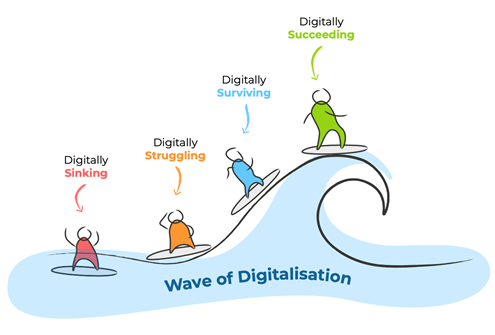
This visual metaphor helps us to understand that digital exclusion is experienced on a spectrum and not only by those who have been totally left behind by the Wave of Digitalisation. It also highlights that some may slide down the back of the Wave, becoming more excluded over time as the wave moves on. Our four different surfers highlight that local digital exclusions manifest differently for different people or profiles, and this was key for the Digi-inclusion network understanding the development of actions to address this.
We used this model extensively throughout the latter parts of the network, to help explore the nuance of digital exclusion, to challenging entrenched ways of thinking, reframing discussions with stakeholders and partners.
It enabled a more nuanced view of digital exclusion locally, including those groups only partly excluded but still with support needs, and helped partners understand better who their local action plan was focussing on.
Ripples of Cause and Effect
Whilst the Wave provides an engaging model for thinking about digital transition and exclusions, it is important to understand the major development the network went through in our understanding of the true nature of local digital exclusion over the course of the Digi-inclusion network. Starting from a general, macro-level understanding of the digital divide at EU level, we worked together to gradually created a much more nuanced and focussed understanding of the topic. Particularly important for partners was the translation of the European-level perspective on the digital divide to a local level understanding of digital exclusions and how to address those locally.
We started addressing digital exclusion as a multidimensional and systemic challenge affecting access to services, social participation, education, employment and democratic engagement. It was important to not focus solely on connectivity or digital skills, so partner cities were encouraged to adopt a more holistic understanding, which acknowledged a wider range of drivers or ‘causes’ of digital exclusion.
In doing this we gradually developed our understanding from the starting point and focus of the original baseline report, which were the traditional “three digital divides” – which describe the differences between regions in:
Access (to the internet)
Use (of the internet)
Outcomes (from using the internet)
Through the transnational exchange process (and some long working sessions for myself and Ed Thorpe, one of the Ad hoc Experts working with us) these three digital divides were developed into a more nuanced view, based more around how cities worked on this topic and how they needed to tackle the causes of digital exclusion at local level.
This work led us to develop our ‘8 Causes Matrix’ for digital exclusion. This model describes the nuance between barriers and causes, providing a new way to analyse digital exclusion locally. It is based around the four main digital barriers that we see individuals experience, namely:
1. ACCESS barriers - difficulties getting connected to digital tools and services
2. USABILITY barriers – difficulties using digital tools and services effectively
3. USEFULNESS barriers – difficulties deriving value from digital tools and services
4. TRUST barriers – difficulties relying on digital tools and services to be safe
Each barrier has both an individual side (what people lack) and a system side (what the digital environment fails to provide). This results in an understanding of the causes of digital exclusion in terms of 8 aspects and we combined these aspects into one causality matrix of the 8 aspects – ‘The 8 Causes Matrix’.
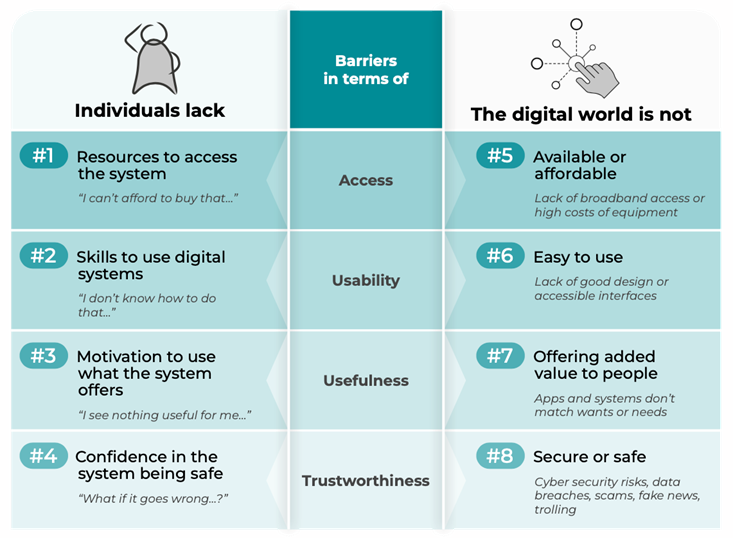
This Matrix became a key tool for driving and shaping new discussion and exchange, both between the partners at network level, but also within the local ULGs. This new way of approaching the network theme was key for translating the thematic knowledge from national or European level, down to local level.
We saw that the narrative about the digital divide is fundamentally different at local level. The focus moves from regions and becomes about individuals and groups, how they experience digital exclusions, and what causes those exclusions for them specifically. It was also important for partners to realise some of those causes are easier to tackle at local level than others. For example, Cause #1 (lack of personal resources) is a macro-economic challenge that is harder to address purely at local level. Whereas, for example Cause #2 (lack of digital skills) is easier for local actors to address directly.
This distinction between individual and system causes is key for prioritising focus and understanding the scale of impact possible from a set of actions, and many partners revised their approach as a result of using the tools we develop associated with this model.

The Wave and Matrix were then further developed into our Digi-inclusion Framework – which sets out a new approach for tackling digital exclusion at local level. This is a cornerstone of our Digi-inclusion Playbook, which you can view and download here: [link].
The Playbook explains this Framework in depth, and offers a set of 17 ‘Plays’ that can be used individually or in combination to use this Framework in a very practical way to improve your local approach to digital exclusion.
These Plays are coupled with 16 Case Examples taken from network partner activities and beyond, which illustrate how the Plays can look in practice and also provide inspiration for new approaches and interventions to try.
Practice makes perfect – and The Playbook!
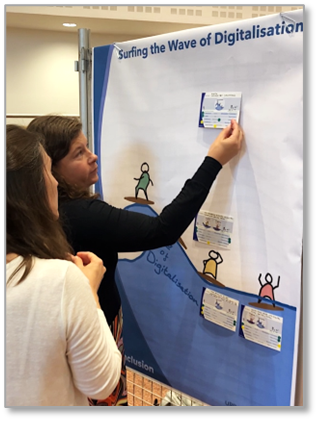
One of the questions was how well these tools would work in practice. To answer this, we tested it out! In the transnational partner meeting in in June 2025, we designed a series of interactive tools using the Wave and Matrix for partners to work through as part of the peer review process.
This saw partners self-assessing their draft plans using ‘Wave cards’ to evaluate each actions in terms of the profiles targeted, and the causes addressed, before aggregating the overall focus and plotting their whole action plan onto a large ‘Wave Canvas’ to provide a visual representation of their draft action plans.
This proved very effective and helped partners to discuss, visualise and understand their actions and the overall plan much better. Several partners repeated the exercise with their local stakeholders upon returning from the meeting, further improving their approach and understanding.
This set of ‘Wave methods’ and all the other insights and examples from the network are captured in The Playbook. This is a practical guide, toolbox, and inspiration source for urban practitioners and city administrations wishing to understand digital exclusion better and improve their approach to tackling it. The Digi-inclusion Framework described above is just a part of it, and the Plays and Case Examples are what bring that theory to life!
A complex, nuanced and evolving future
Tackling the digital divide at local level means addressing the digital exclusion experienced by local citizens. Digital exclusion is complex, nuanced, relative and evolving and tackling it effectively requires a similarly nuanced and dynamic approach.
How digital exclusion manifestations today will not be the same as in a few years’ time; new waves of digitalisation have the potential to create new exclusions; people who can’t keep will gradually become more excluded.
In creating the Framework and Playbook, the Digi-inclusion network has provided a way to work with this complexity more effectively and to help cities become more successful in ensuring that no one is left behind in a digital world.