
Networks and cities' news

Catch up on the latest updates from cities working together in URBACT Networks. The articles and news that are showcased below are published directly by URBACT’s beneficiaries and do not necessarily reflect the programme’s position.

Want to learn more about the projects that are featured here? Discover the URBACT Networks.


  • Agents of CoExistence: final network report

    Across Europe, cities are searching for new ways to strengthen the relationship between public
    institutions and the citizens they serve. Local governments face growing expectations for
    transparency, inclusion, and responsiveness, while at the same time dealing with complex societal
    challenges, increasing polarization, and rapidly changing technologies. Many traditional approaches to
    citizen participation no longer meet the needs of contemporary urban societies.
    The Agents of Co-Existence (AoCE) Network was created in response to this changing democratic
    landscape. Supported by the URBACT IV program, the network brought together nine partner cities
    from across Europe to explore one central question:
    How can local governments organize themselves to work more effectively, creatively, and
    meaningfully with their citizens?

    Yasemin Yilmaz

    See more
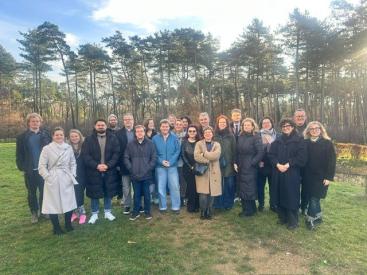
  • fieldtrip Genk

    Rebuilding Democracy from the Inside Out with the Agents of Co-Existence

    Picture this: On a Tuesday evening in Aarhus, a group of residents sit around a table with a
    local politician. There is no raised platform, no official speeches, no formal agenda handed
    down from city hall. The topics have been chosen by the citizens themselves. The discussion
    is guided not by a civil servant, but by a neighbour — trained together with municipal staff
    as a “Democracy Host”.

    Yasemin Yilmaz

    See more
  • Quart de Poblet’s introduction of an Urban Innovation Laboratory

    To work with citizens means creating transparency

    When the Quart de Poblet Town Council joined the Agents of Co-Existence network, one of its main objectives was to include a greater number of citizens in civic participation and to involve municipal officials in different forms of participation.

    Yasemin Yilmaz

    See more
  • Agents of Co-Existence: From Testing to Transformation

    As the Agents of Co-Existence (AoCE) network enters the final stretch of its URBACT journey, partner cities are moving from testing to embedding change. Partners have now entered a decisive phase where ideas have turned into action and new structures for civic participation have begun to take root. Thus, a good moment to share where we are.

    Yasemin Yilmaz

    See more
  • SDG wheel

    Walking a fine line: how civil servants can work with sustainable development amidst political polarisation

    What’s the issue? 

    When asked what sustainable development means to them, the participants of the Agents of Co-existence fifth online academy had lots of ideas: from “working together” and “co-creating a better world” to focusing on “balance between social, economic environmental dimensions” and “ensuring that there is enough for everyone, everywhere and always”, as well as “finishing projects” and “ensuring long-term funding”.

    Stina Heikkila

    See more
  • The Role of Civil Servants in Strengthening Citizen Participation Lessons from the Agents of Co-Existence Network

    Citizen participation is an essential pillar of democracy, yet many municipalities struggle to create effective and inclusive engagement processes. The Agents of Co-Existence (AoCE) Network, a European collaboration of cities working together as a URBACT action planning network, focuses on innovative ways to bridge the gap between governments and citizens. Basically, they look at two ways to improve citizen participation. On the one hand, they search for new ways and methods to include citizens in decision-making processes. On the other, they seek ways to foster meaningful engagement by redefining the role of civil servants. This requires experimenting with new participatory approaches and learning from each other. After 1,5 years of working and exploring together, it is time to share some relevant findings and key insights from the AoCE network and related studies, shedding light on how civil servants can better facilitate citizen participation at the local level

    Yasemin Yilmaz

    See more