URBACT Expert Ed Thorpe builds on the lessons of two studies to share first-hand observations and reflections from cities involved in 30 URBACT Action Planning Networks (2023-2025). Within these networks, each partner city was tasked with co-developing an Integrated Action Plan. The resulting 273 Integrated Action Plans will be featured in Nicosia at the URBACT City Festival from 31 March to 1 April 2026.
In anticipation of the Festival, what lessons can we already draw from these local plans for sustainable change?
A strategy or a roadmap? The URBACT method and integrated action planning
When the 2023-2025 URBACT Action Planning Networks kicked off, most of the partner cities were in the same situation. Each city faced its own urban challenges, but did not have a (fully developed) plan to resolve them. Working together in their thematic networks, they each sought to develop a shared local vision and specific actions for positive change, clustered thematically around participative governance, urban planning, local economy, climate action and social cohesion.
The result of this thematic collaboration was an Integrated Action Plan, produced by each partner city. These plans are an offshoot of the URBACT Method, a set of guiding principles for exchanging knowledge between cities based on integration, participation, and active learning.
Looking at the recently completed Action Planning Networks, how does an Integrated Action Plan really help to support change on the ground? In theory, an action plan sets out the specific steps to turn a strategy into a reality. However, for many cities, the value is not so much in the action planning detail as setting out a new strategic approach or ‘roadmap’ to guide local actions. Part of this is ensuring a coherent and integrated overall approach, managing the complexity of joining up different areas of work into one overall plan.
 |
“It’s not about accumulating individual projects, but about establishing a coherent overall approach to commercial revitalisation, redevelopment of public spaces, support for housing, leveraging cultural heritage...”. – Fleurus, Cities@Heart. |
Typically, the Integrated Action Plan is best understood not as the end of the planning journey, but as a crucial step forward in an ongoing planning journey.
|
“Most valuable of all is the co-created Integrated Action Plan, which now serves as both map and compass for the future… It has become a shared commitment, and it continues to grow, carrying the hope of a greener, more connected future for generations to come”. – Vila Nova de Poiares, GreenPlace. |
A good Integrated Action Plan does not have to look like a good project funding application, nor does it need to be the end of the planning process – committing the city and its local partners to follow a fixed and precise timeframe and budget. However, by setting out some clear strategic choices and defining specific actions to be undertaken across a range of areas, the plan can be an extremely valuable stepping stone towards preparing one or more specific funding applications, as was the case for Löbau (DE).
|
“The Integrated Action Plan forced us to be stricter with our strategic thinking. We are very happy and proud to have used the resulting plan as the basis of a big funding application for the next 4 years. It really helped us to prepare the application.” – Löbau, GreenPlace. |
For some cities, the Integrated Action Plan can feed into an immediate funding application like this. On others, certain planned actions may need to wait for the right funding opportunity. In the U.R.Impact network, Longford (IE) recently reported that they had only just obtained funding to build a museum on the site of the former military barracks – an idea originally set out in their 2018 plan under the MAPS network.
When speaking to cities who had drafted action plans in 2018, a consistent message was that the plans continued to evolve and implementation success was often supported by project applications which built upon, but also further refined the initial plans.
Plans as engagement tools
Some cities found it constructive to think about the Integrated Action Plan as a living document, breathing new life into their communities’ vision of change. In other words, if Integrated Action Plans are only seen as ‘internal’ planning documents, this misses a crucial part of their added value as tools for communicating the newly agreed approach to others. This is relevant for generating engagement amongst local stakeholders and buy-in from local politicians. A clearly outlined plan can also support exchange and learning with other cities, and understanding by national authorities and other potential funders.
A key challenge across the URBACT Action Planning Networks was to to develop clear one-page visualisations of their intervention logic. The visualisation provided by Wrocław (PL) shows clearly how the plan is structured under three strategic objectives to revitalise underused or abandoned spaces (e.g. industrial sites). The aim here is not to set out the individual actions, but to capture the objectives and key areas of intervention through which the city intends to achieve its vision.
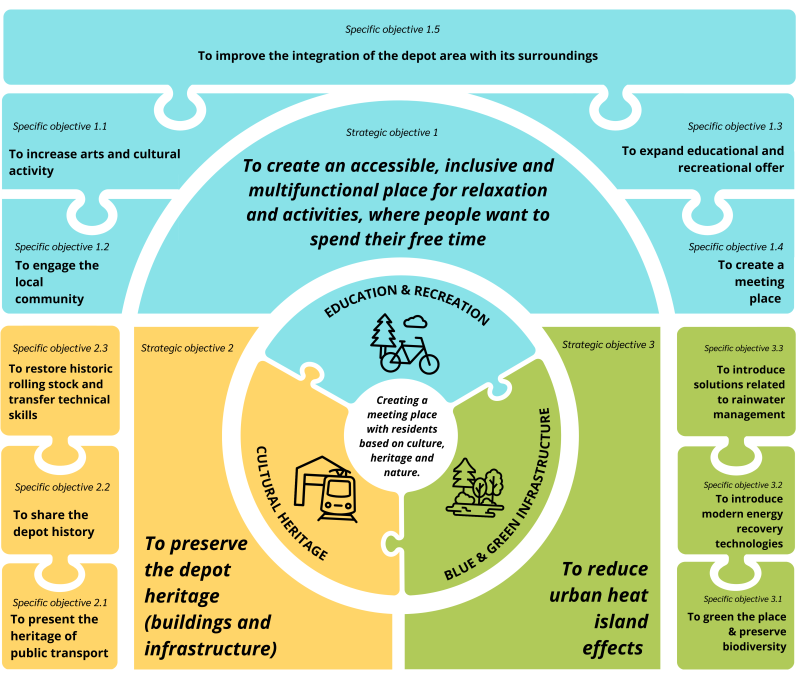
This process can be demanding and requires some complex thinking to get the logic of the plan right. Yet the outcome is often a concise and accessible overview of the city’s strategic approach.
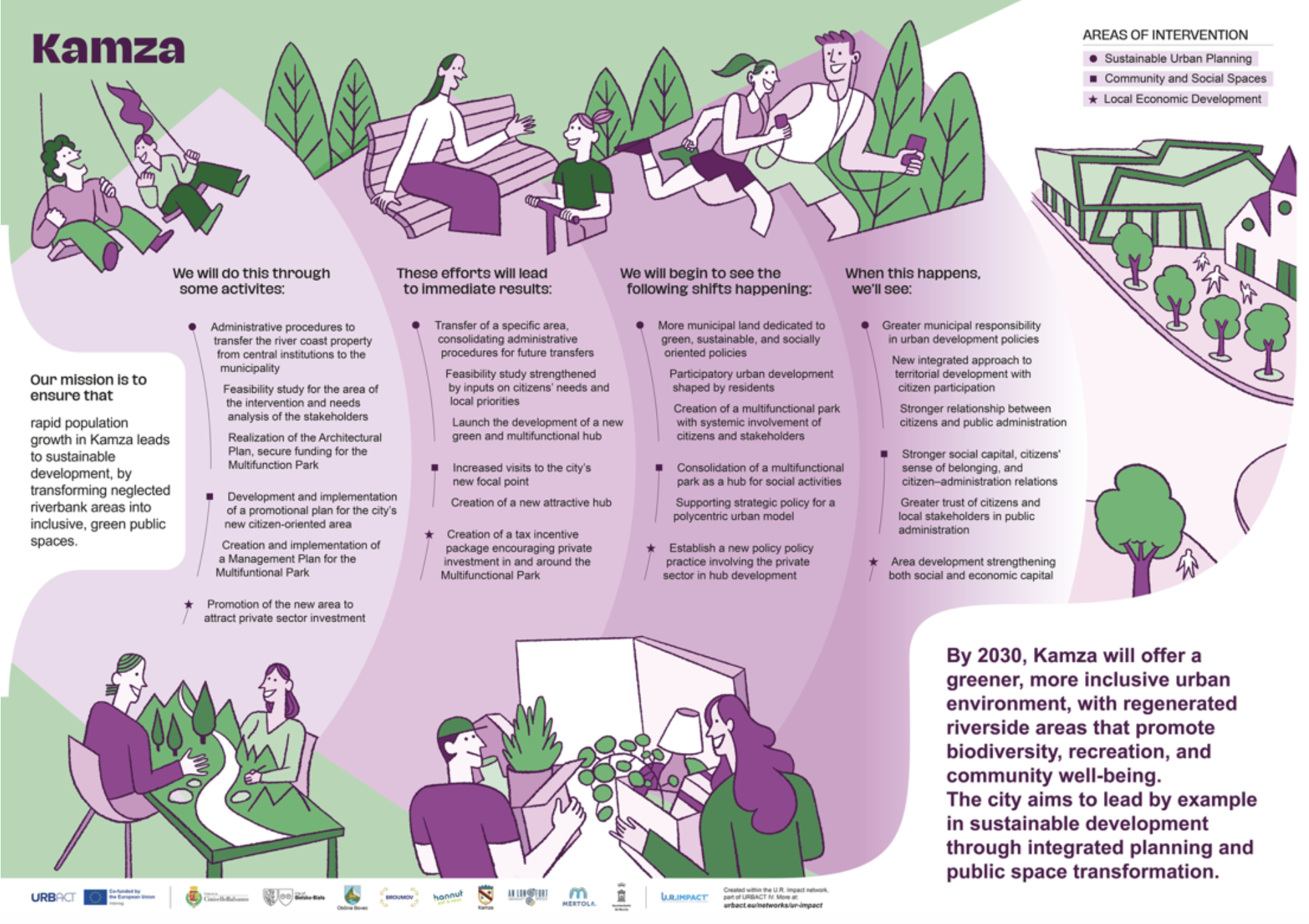
U.R.Impact did some additional interesting work in this context, developing and visualising the ‘Theory of Change’ at the heart of the Integrated Action Plans.
This provides a clear framework for understanding how the planned actions are expected to create local impact and, ultimately, deliver the vision defined for the city’s plan.
Preparing to take action
The previous points have sought to reduce the emphasis of seeing the Integrated Action Plan as merely a planning document. Nevertheless, they do clearly have an important planning component.
Some of the clearest examples of action planning start with a set of summary action planning tables covering all the actions foreseen, followed by more detailed action planning for a sub-set of actions that particularly warrant it. This follows the recommendations of the updated URBACT guidance to encourage cities to set out a broad range of actions, without feeling that they all have to be planned to the same level of detail.
The summary action tables have a double added value. First, they provide an excellent overview of all the planned actions, in a format that is easy to scan and share (thus, supporting engagement with the plan). Second, they confirm basic planning details, including who is responsible for delivery and other optional elements such as foreseen timings, outputs and resource needed – all without overwhelming the reader with detail.
Intervention area 1: Providing support for local SMEs | ||||
Specific objective 1: Increasing the growth rate and competitiveness of local SMEs | ||||
Action title | Timing | Short description | Outputs | |
Start | End | |||
1.1 SME interview series | June 2025 | Continuous (annual cycle) | The Nyíregyháza Industrial Park Ltd. is conducting personal interviews with local companies. By hearing them out and gathering their point of view on various topics (e.g. public transport, R&D, investment & logistics, quality standards, vocational training, workforce & recruitment), the local business support team will be able to base their services on their actual needs. | - 8 interviews in 2025- 20 interviews/year from 2026 onward |
1.2 Supplier programme and database | Dec 2025 | Continuous (annual cycle) | Using publicly available data, a database of Nyíregyháza’s economy has already been established in the last few years which will be regularly updated (including the results of Action 1.1). This database about the offer and needs of the local companies will be used to more easily match them with interested investors who are looking for suppliers or contacts.An extensive programme is needed in which the two sides have the opportunity to meet and build relationships – annual events. | - Tableau database (regular updates)- Annual networking event |
1.3 “Learn from multinational companies!” Programme | Sept 2025 | Continuous (annual cycle) | The Nyíregyháza Industrial Park Ltd. will organise lectures, panel and informal discussions (with free participation) on topics such as HR management, financial planning, process organisation, and digitalisation to transfer know-how between the more modernly operated (often multinational) companies and local SMEs. By documenting the events, a knowledge repository will be built. | - Learning events (4 per year from 2026 onward)- Knowledge repository |
The summary action tables of Nyíregyháza (HU), C4Talent show how many actions can be presented in clear structured ways, clustered by specific objective.
For some actions, this level of planning may be sufficient – the relevant implementation partner may already know what to do. However, some actions can be highly complex, requiring further thought and planning of what needs to happen and how in order to implement the action.
The Lead Partner of U.R.Impact, Cinisello Balsamo (IT), provided detailed action planning (across multiple pages) for key actions foreseen by its plan covering aspects such as: action owner, relevant stakeholders, level of readiness, implementation steps, costs and funding, risk mitigation and monitoring. Each action has its own implementation plan.
This more detailed action planning can best be used for a specific sub-set of actions for which the additional planning detail genuinely adds value – not least when a funding application may be required.
What’s next for URBACT networks?
The Action Planning Networks are part of a long legacy of URBACT-supported partnerships. Looking at the above testimonials and examples, it is important to remember that the Integrated Action Plan is not just an output in isolation, but part of the action planning process and a reflection of that process. Ultimately, the value of the resulting Integrated Action Plan is not just about what is written down on paper, but what that means and represents to the local authority and other members involved in URBACT.
Looking towards implementation, the same logic applies. At least as important as what is written down is how that process will continue after the end of the URBACT network. Implementation success is almost always linked with effective governance and ongoing stakeholder involvement in continuing to refine ideas and planned actions.
Take inspiration from the journey of the 30 Action Planning Networks! Scan through the list of webpages to find Integrated Action Plans and other network outputs.
Are you joining us at the 2026 URBACT City Festival in Nicosia (31 March-1 April 2026)? The resulting 273 Integrated Action Plans will be showcased in thematic sessions. This means you will get first-hand updates from partner cities about the local actions they developed through the networks.
Do you have a local action that you want to see implemented in your city? A new URBACT Call for Actions will run from 17 March until 17 June 2026. Stay tuned for more information about the new call at the 2026 URBACT City Festival and on the URBACT website.