
What has URBACT been up to over the last 12 months? The year started with the 2025 URBACT City Festival in Wrocław (PL), where we celebrated 116 URBACT Good Practices, and continued with a new call for networks. There was an EU City Lab on Active Mobility, thematic webinars, capacity-building courses on gender-inclusive cities, and a new programme for cities in the Western Balkans.
Read on for the moments that made 2025 memorable for URBACT!
URBACT Networks celebrate milestones and new beginnings
In November 2025, URBACT welcomed 25 URBACT Transfer Networks. URBACT Transfer Networks help cities adopt already tested solutions, saving time and resources at local level.
This new batch of city partnerships features 25 of the 116 URBACT Good Practices awarded in 2024. Bundled together with 30 Action Planning Networks and 10 URBACT Innovation Transfer Networks, URBACT currently supports 65 networks, encompassing 525 partners from 32 countries.
For the 30 URBACT Action Planning Networks, which have been co-designing Integrated Action Plans since 2023, their network journey is coming to a close later in December. Each network has a dedicated space on the URBACT website where you can get an overview of actions and results at local and network level. These actions will be showcased at the 2026 URBACT City Festival in Nicosia (CY) from 31 March to 1 April 2026.
With all this network-related activity, URBACT isn’t slowing down. A fresh call for URBACT networks is already on the horizon for spring 2026.
URBACT connects cities with new ideas and practical solutions
With 65 networks and hundreds of participating cities, what happens with all the knowledge, actions, and success stories shared within the URBACT community? This is where the URBACT Knowledge Hub comes into play.
Throughout 2025, the URBACT Secretariat has been working with URBACT cities to expand the knowledge offer on five topics; specifically: mobility, green urban economies, nature-based solutions, social data management, and storytelling for cities. Surveys, focus groups, events, and webinars are just a few examples of what has happened during the year.
While updates are foreseen in early 2026, several resources are already available online. From the mobility work, you can get inspired by gender-inclusive approaches, as demonstrated at our dedicated webinar, or practices from city visits in Vienna (AT), Ghent (BE), and Sint-Niklaas (BE). For green urban economy, conversations in a recent webinar drew on experiences from five URBACT Action Planning Networks.
From the work on storytelling, you can learn how to engage citizens in local projects following examples and techniques presented at our webinar here. A comprehensive guide on how city administrations can use storytelling will be available in spring 2026 – and presented at the 2026 URBACT City Festival – followed by another webinar on using accessible language in May 2026.
In early 2026, a wide palette of nature-based solutions will be available on the URBACT website. From January until February, along with a series of four webinars, a guide on social data management will see the light.
URBACT is continuously evolving to better facilitate urban knowledge-sharing across Europe. This evolution encompasses the official URBACT website.
Discover the URBACT Knowledge Hub for guidance, tools, and insights drawn from the real experiences and examples of city practitioners and experts across Europe.
URBACT makes an event out of urban matters
In 2025, URBACT events provided perfect grounds for city practitioners and urban experts to come together, breaking out of their professional silos and routines to engage in meaningful, productive knowledge exchange. The most anticipated event for the URBACT community, the URBACT City Festival, was held in 2025 in Wrocław (PL). The 523 participants, hailing from 321 cities across 36 countries, came together to celebrate the 116 URBACT Good Practices (awarded in 2024), their positive local impact, participatory, integrated approach, and potential for transfer. This was also a decisive event in the creation of 25 URBACT Transfer Networks.
In Hamburg (DE) in October, ministers, local representatives, URBACT and EU experts considered what it takes to scale up sustainable urban mobility solutions. The EU City Lab on Active Mobility, co-organised with the European Urban Initiative (EUI), is part of an EU City Lab event series dating back to 2023 on a range of topics (e.g. sustainable food systems, the energy transition).
Don’t miss out on the next URBACT event…it’s going to be a big one! Register for the 2026 URBACT City Festival in Nicosia (CY). From 31 March to 1 April, you will hear stories of local impact from URBACT Action Planning Networks, get familiar with the new call for URBACT networks, and discover the host city through a sustainable urban development lens.
Empowering cities to make gender equality a reality
Gender equality in cities is a cause that URBACT has been working on for the last years with different initiatives. In early 2025, URBACT announced the launch of its first online gender equal cities course.
The syllabus is structured around five critical questions: Why does gender matter for integrated urban development? Who decides and affects change? How does an integrated approach take gender equality into consideration? How can cities implement gender mainstreaming? What roles does gender play in sustainable urban development?

This course is available for cities involved in URBACT. It is divided into the following modules, covering practical tools and strategies for integrating gender perspectives into planning processes:
· Module 1: Introducing the gender equal city
· Module 2: Gender check – project team, stakeholders, policy beneficiaries
· Module 3: Integrating gender perspectives – data in urban development
· Module 4: Implementation, monitoring & evaluation
· Module 5: Embedding gender equality into sustainable urban development
More capacity-building activities await URBACT cities in 2026, starting with an URBACT University for URBACT Transfer Networks in Cork (IE) on 25-27 August.
Accelerating impact in the Western Balkans
Since 2023, URBACT has welcomed participation from cities in IPA countries (countries benefiting from the Instrument for Pre-Accession Assistance). This included opening a bespoke learning programme for cities in the Western Balkans (Albania, Bosnia and Herzegovina, Montenegro, North Macedonia, and Serbia). The programme is structured around core thematic clusters: mobility, waste management, urban nature, and sustainable tourism.
In 2025, 27 cities in the Western Balkans started their sustainable urban development learning journey as part of the URBACT Pioneers Accelerator programme.
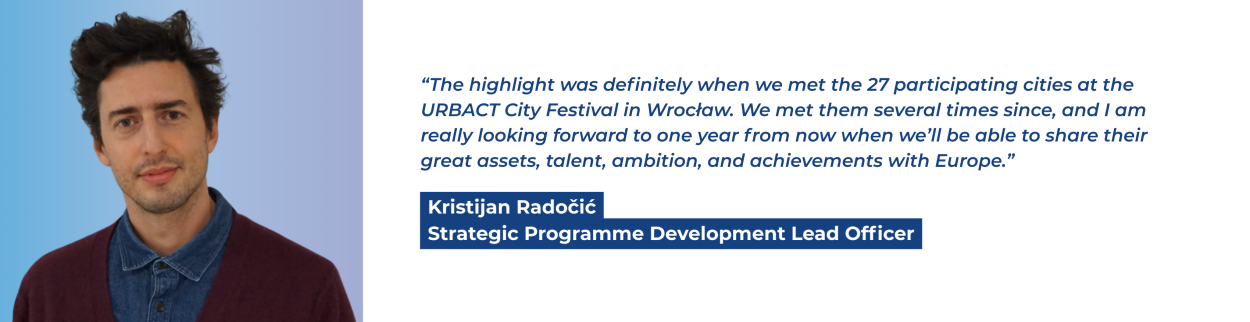
The programme is structured into phases, ultimately, concluding with the delivery of pilot actions and shared learning. Starting in June 2025, teams from across the participating cities entered the ‘DISCOVER’ phase, combining research, fieldwork, and collaboration with their respective thematic experts in areas. The first in-person event took place in September in Ljubljana (SI), symbolising the transition from discovering what matters to defining how to make it happen (the ‘DEFINE’ phase).
Stay tuned for more achievements from the URBACT Pioneers Accelerator programme as they implement integrated, participatory approaches to urban sustainable development.
Cities are the future
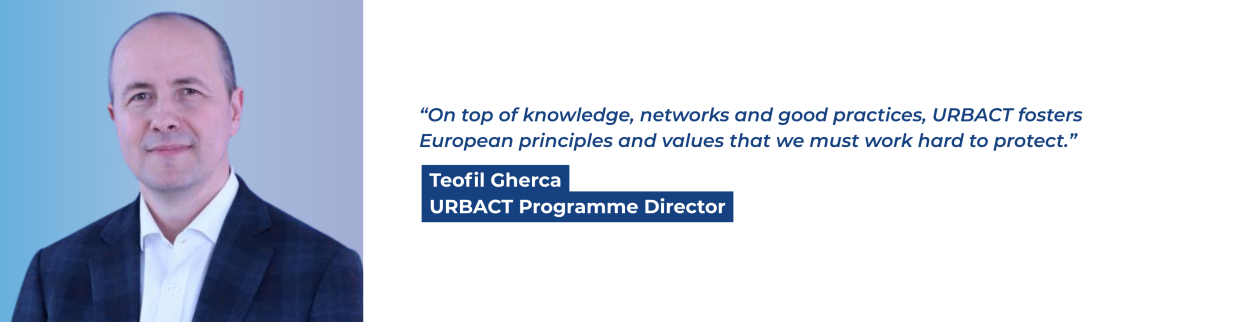
By reflecting on URBACT’s 2025 highlights, we can look forward to the future – furthering not only the programme but also URBACT's commitment to supporting the recently-published EU Agenda for Cities. Cities need support in tackling the integrated nature of contemporary urban challenges. European urban cooperation brings real results to cities, building their capacities to act at both the local and EU level.
See you in 2026 with URBACT's New Year’s Resolutions...Let's continue to advance sustainable urban development together! In the meantime, follow @URBACT on social media and, if you haven’t already, subscribe to our newsletter.