What's new

Check URBACT's latest stories, updates and events!


  • From local innovation to European transfer: Komotini and the future of accessible cities

    From local innovation to European transfer: Komotini and the future of accessible cities


    AUTHOR: IO CHATZIVARYTI, LEAD EXPERT FOR URBACT TN C.ALL


    As European cities face growing pressure to create more inclusive, sustainable, and people-centred urban environments, accessibility is increasingly moving from the margins of policy discussion to the centre of urban governance. Yet for many municipalities, especially medium-sized cities, translating accessibility commitments into coherent action remains a challenge. Fragmented planning, limited technical capacity, and insufficient stakeholder coordination often prevent accessibility from becoming a truly systemic urban priority.

    The URBACT Transfer Network C.ALL – Accessible Cities for All offers an alternative approach. Led by Komotini, the network explores how accessibility can evolve from isolated interventions into an integrated governance model linking mobility, public space, participation, digital innovation, and social inclusion. At the heart of the network lies the transfer of the good practice “Komotini Accessible City for All”, a methodology developed progressively over two decades through cooperation between the municipality, civil society organisations, technical experts, and people with disabilities themselves.


    Rather than presenting accessibility as a technical checklist, the Komotini approach treats it as a continuous urban process embedded across all areas of city planning. Seven European partner cities — Jarosław, San Lucido, Bratislava, Galway, Dubrovnik, Pentágono Urbano in Portugal, and Zrenjanin — are working to adapt this methodology to their own local realities through study visits, stakeholder engagement, and peer-learning activities.


    DSC09165[71].JPG


    Eleftheria Gkiosou

    See more
  • ReDAN Network in Ormož Basins Nature Reserve

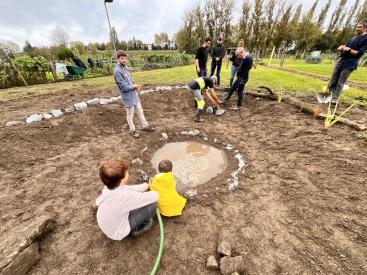
    ReDAN partners meet in Ormož to explore how degraded areas can become places for nature and people

    What can happen when a degraded industrial area is no longer seen only as a problem, but as an opportunity? This question guided the kick-off meeting of the URBACT IV Transfer Network ReDAN – Reviving Degraded Areas for Nature and People, held in Ormož, Slovenia, from 4 to 7 May 2026.

    The meeting was hosted by the Research and Development Centre RRC Ormož (Slovenia), Lead Partner of the network, and brought together partners from the Municipality of Alcanena (Portugal), Limerick City and County Council (Ireland), the Municipality of Srebrenica (Bosnia and Herzegovina), the Municipality of Bogovinje (North Macedonia), the Municipality of Priboj (Serbia), and the Municipality of Yaremche (Ukraine).

    Although the partners come from very different local contexts, they all share a similar challenge: how to give new life to degraded, abandoned or underused areas in a way that benefits both nature and local communities.

    Nina Prelog

    See more
  • YOUth SPACE LINK across Europe

    At the beginning of March, project coordinators from the Social Participation Office of the City of Lublin carried out visits to three partner cities of the URBACT Transfer Network YOUth SPACE LINK: Plasencia (Spain), Torres Vedras (Portugal) and Sofia (Bulgaria). The visits provided an opportunity to explore local youth-focused initiatives and exchange experiences on the development and management of youth spaces. The network’s Lead Expert also took part in the visits.

    Volodymyr Vityk

    See more
  • YOUth SPACE LINK in Alba Iulia!

    On 17–18 February, representatives of the URBACT Transfer Network YOUth SPACE LINK, including coordinators from Lublin and the network expert, visited Alba Iulia, one of the network partner cities.

    Volodymyr Vityk

    See more
  • Event

    Online info session: Call for URBACT Accelerator for Ukraine and Moldova

    From November 2026 to May 2028, this new bespoke learning programme for Ukrainian and Moldovan cities aims to strengthen their capacities on urban reconstruction, revitalisation, resilience and crisis management. Activities include knowledge-sharing events, design and funding of small-scale urban actions in Ukraine and Moldova.


    This call is looking for:

    URBACT
    Online
  • The future-of-work transition starts locally

    Network article by Petra Grgasović, Lead Expert of Network4Work.


    Zoltán Szenes

    See more